This semester, my students and I in Anth 150 (Anthropology of Life in the United States) at American University have been pondering the life, death, and memorialization of the late Sandra Lee Smiscon (1958-2003). We have been especially intrigued by the location where Sandra was shot by an unknown assailant, around 3:30 am on July 12, 2003, under the overpass of Yesler Way at 4th Avenue in downtown Seattle. (She died soon afterwards at nearby Harborview Hospital). This spot of the killing is usually referenced as a marginal location, frequented by the down and out, the homeless, and substance abusers. It is a place that commuters heading to and from Pioneer Square, near Elliot Bay, often pass by, without really looking at. It is normally thought to be, in effect, “off the map” of mainstream Seattle. For many involved in the Missing and Murdered Indigenous Women’s/People’s (MMIW/P) movement, the painful desolation of this spot is a potent symbol of the predicament of MMIP, who are often treated as if they are off the map of the conventional social world.

Yet we would like to suggest an alternate approach to this haunting place. Is it possible that this location, where Sandra regularly spent time during her trips off of the Yakama Nation Reservation in central Washington state, was in fact replete with meaning and significance anchored in ancient indigenous history and spiritual time depth? Sandra’s family members recall that she was well steeped in the life-ways and spiritual wisdom of the Yakama Nation. Partly guided by her influence, her son George Lee Jr, (Powatathla / Pah Tuuthlah) has emerged as a spiritual visionary associated with the Toppenish Creek Longhouse. Might it be that the place where Sadra’s life was so tragically taken away is in a curious way, a place of uncanny power and deep remembrance?
Yesler Way runs on an east-west axis, roughly following the route of old Native American trails, originating in Elliot Bay and continuing east to present day Lake Washington.
The Winter village site on Elliot Bay, at what is now the foot of Yesler Way, was known to the ancestors of today’s Duwamish, Suquamish, and Muckleshoot tribal members as Dzidzilalich, “Little Crossing-Over Place” in Lushootseed, the indigenous language of Puget Sound. The adjacent tidal marshes supported fishing and foraging and are recalled as the site of approximately six large cedar longhouses into the early 19th century. Significant exchange of goods and knowledge traveled between Dzidzilalich to Lake Washington and the foothills of the Cascade mountain range, and beyond that into the Columbia basin plateau of the interior.
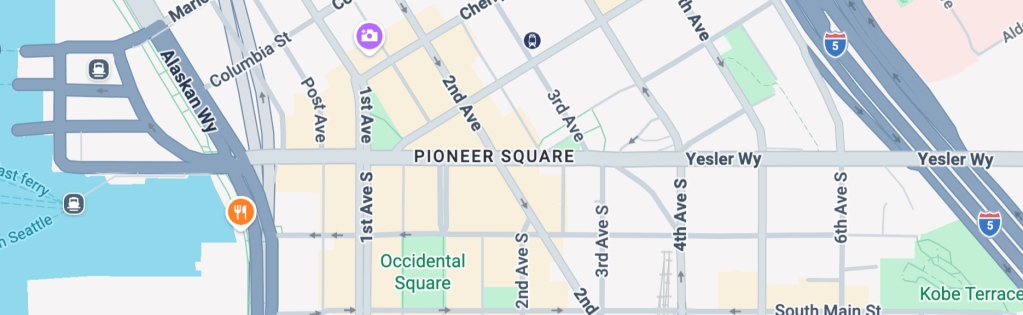
From the site of the Yesler Way overpass one can glance down to the ancient former village site on Elliott Bay and towards the Olympic peninsula beyond. Is it possible that in some ways Sandra was drawn to this location, and to the deep memories embedded within it of the gifts of Mother Earth and the life-sustaining waters of the bay?
Yesler Way also summons up memories of more painful recent histories. In 1853, Henry Yesler, originally from Virginia and sometimes termed the “founder of Seattle,” opened Puget Sound’s first steam-powered saw mill. As the surrounding ridge areas were heavily logged, horses and oxen dragged large greased cross-logs down the hillside, along a route that was dubbed “Skid Road” and later “Skid Row” in reference to the logs that skid down its muddy contours. Native and non-native workers at the mill became heavily associated with excessive alcohol consumption. “Skid Row” during the Depression of the 1930s came to reference any urban thoroughfare marked by substance abuse, transients, homelessness and desperation. By the 1890s Seattle’s Skid Row was known as Mill Road; around 1903, when it was paved, it became known as “Yesler Way,” the name it retains to this day.
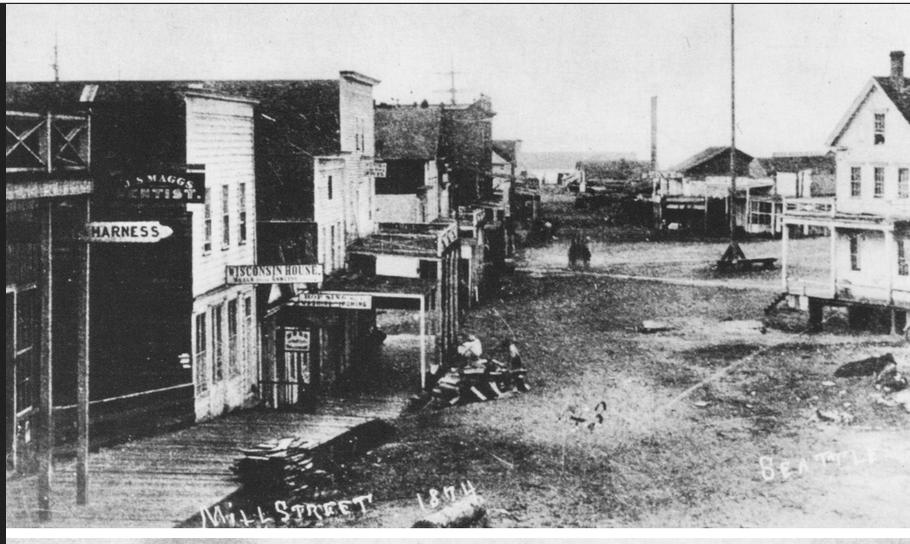
The 4th Avenue block below the Yesler Way overpass can be thought of as a potent “chronotope” of this complex, multilayered history, in the sense that the term was introduced by Russian literary scholar Mikhail Bakhtin, and further developed by linguistic anthropologist Keith Basso. A chronotope is a “time-space,” from Greek chrónos “time” and tópos “space” binding spatiotemporal processes in a way that functions as a kind of active agent in the unfolding of a literary narrative or historical experience. The space in a sense brings together the histories of the ancient trading and migration route from Elliot Bay to Lake Washington and the Columbia plateau interior, as well as the ecological and social disruptions brought by Euro-American industrial colonialism, associated with the Yesler sawmill, massive logging operations, and the spread of alcoholism through Native communities. At the same time, speculatively, perhaps the enclosed space below the underpass summoned up memory images of the longhouses down the hill, that for generations provided security and comfort to the Native residents of Dzidzilalich winter village. Conditions under the overpass can be rough, but it does provide some protection from Seattle rains and offers a measure of friendship and companionship to members of the local homeless community.
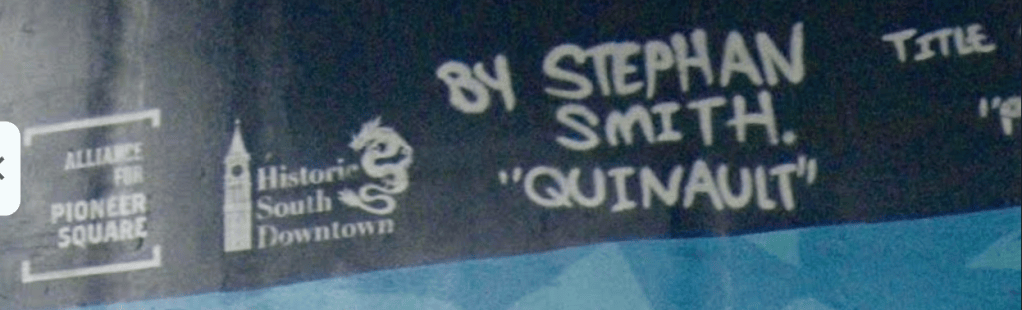
As it happens, these overlapping themes are powerfully evoked in a striking art work that has graced the abatement of the Yesler bridge along 4th avenue for the past five years. The work was commissioned by the Alliance for Pioneer Square’s Public Realm Work Group. In October 2021, the enrolled Quinault/Makah artist Stephan Smith began work on this 14-by-74-foot public mural, which he called “Duwamish,” honoring the Native residents of this land.
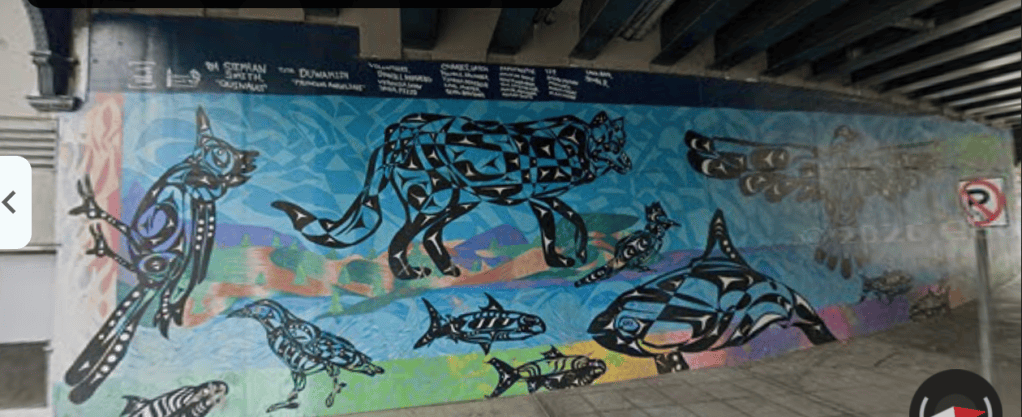
The mural it sometimes said, has turned the old 1910 Yesler Way bridge into a visual land acknowledgement, honoring countless generations of indigenous residents of this stretch of territory. Smith has brilliantly integrated the aesthetics of local Coast Salish and Nuu-chah-nulth (Nootka) peoples of Vancouver Island with the edgy energies of graffiti street art. In the center, a great eagle spreads its wings; great wolf, bear, salmon, orca and raven seem drawn towards the center, perhaps evocative of the human and animal migration routes that since time immemorial have traversed the waters and lands around Puget Sound and beyond, across the Cascades into the Columbia River plateau. I believe that hidden within the imagery are the letters SEALTH—the Lushootseed name of Chief Seattle, the great Duwamish and Suquamish leader.
The work was created with the assistance of many local community volunteers, whose names are inscribed above the mural; the work, sometimes termed cultural medicine, serves as living testimony to the neighborhood’s continuing commitment to healing proximate lands and peoples.
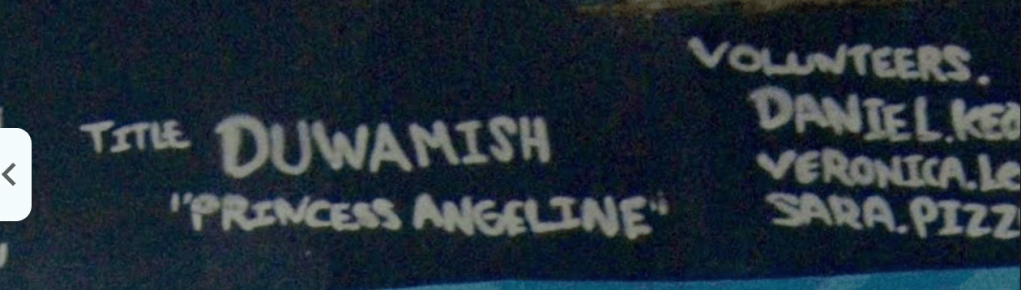
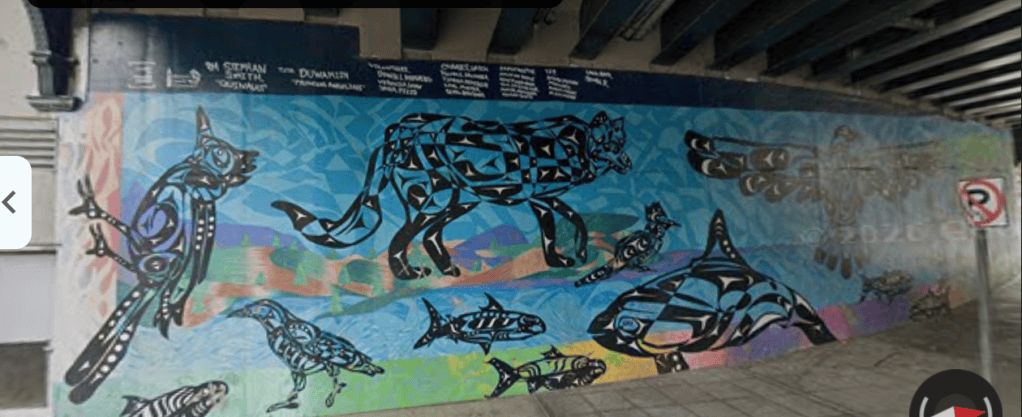
At many times of year, the mural is fronted by tents and bedrolls inhabited by homeless individuals, who it is hoped will take some solace from its vibrant colors and intricate designs, sleeping under the sheltering arms of the great eagle.
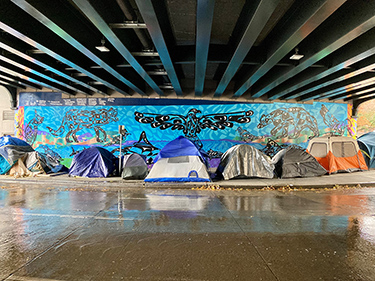
The mural was created 18 years after Sandra was fatally shot at this site, and I am not sure if Stephan Smith was directly aware of her tragic death. Yet we might speculate that like Sandra, Smith was somehow drawn to this place of enduring power, and sought to honor histories both of Native pride and of Native pain within this enclosed zone. Enhanced by the Smith mural, this tunnel-like space continues to operate as a multi-dimensional “chronotope,” a dynamic portal allowing passageway between different times and different spaces.
As we campaign for justice for Sandra and demand a fully reopened investigation into her murder, let us take some time to reflect on the place where she transitioned from this mortal realm. The space below the Yesler Way overpass, to be sure, is an enduring site of mourning and sorrow, yet it also may be a kind of monument to indigenous creativity and vitality, stretching across the generations. Perhaps it is, in this respect, a fitting resting place for the spirit of Sandra and all her sisters and brothers in the extended MMIP community, near and far.
Addendum by Ellen Schattchneider: To continue on the theme of the 4th and Yesler space as a kind of active “portal” across temporal and spiritual zones, the artist seems to play on the fact that a pedestrian or driver descending Yesler Way glimpses in a framed view the old site of the indigenous village on the shores of Elliot Bay with the majesty of Puget Sound and the Olympics spread out in the distance. The mural in effect brings that view to life, revealing a deeper vision than is afforded to the conventional eye. The theme of special sight is perhaps enhanced by the prominent eyes of raven, salmon, orca, wolf , bear, and eagle, who may be lending their acute vision to their human cousins, to see what is normally obscured. In keeping with Northwest Coast aesthetics, the animal beings are quasi transparent, with external and internal anatomical forms created through the formlines of ovoids, U-shapes, and S-shapes, consistent with the ways in which these sacred beings are understood to hold and channel energies resonating between multiple layers of existence. As Claude Levi-Strauss notes in his classic Split Representation article, these designs afford “split” multiple gazes appropriate to sculptural elaboration of boxes and masks, enabling the viewer to grasp multiple truths and registers of reality at once. Seen one way, the animals are standing still, yet all seem poised for motion, as wind and wave move through and with them. The transparent penetration of underlying landscape colors through the animals is presumably suggestive of the intimate kinship between these clan beings and the elemental energies of sky, water, and land. The net effect seems to transform Yesler Way—which since 1852 has been a kind of violent gash of resource extraction across the lands above Elliot Bay—-into a healing home of spiritual energies. Within the sheltering expanse under the old bridge, ancient animal beings from sky, land and sea all are reassembled as medicine for that which ails us.
References
Tammy Ayer. “Back into focus: Yakama man pieces together identity of slain mother with faded memories and old photos.” Yakima Herald. https://www.yakimaherald.com/news/topics/the_vanished/back-into-focus-yakama-man-pieces-together-identity-of-slain-mother-with-faded-memories-and/article_0323d28a-16f3-11e9-aa6e-b339c8097a6b.html
Uncovered: Sandra Lee Smiscon’s case: https://uncovered.com/cases/sandra-smiscon
Stephan Smith murals; https://www.instagram.com/koolaha2022/
Indigenous mural brings warmth to Yesler area By EMMA HINCHLIFFE https://www.djc.com/news/ae/12144510.html


