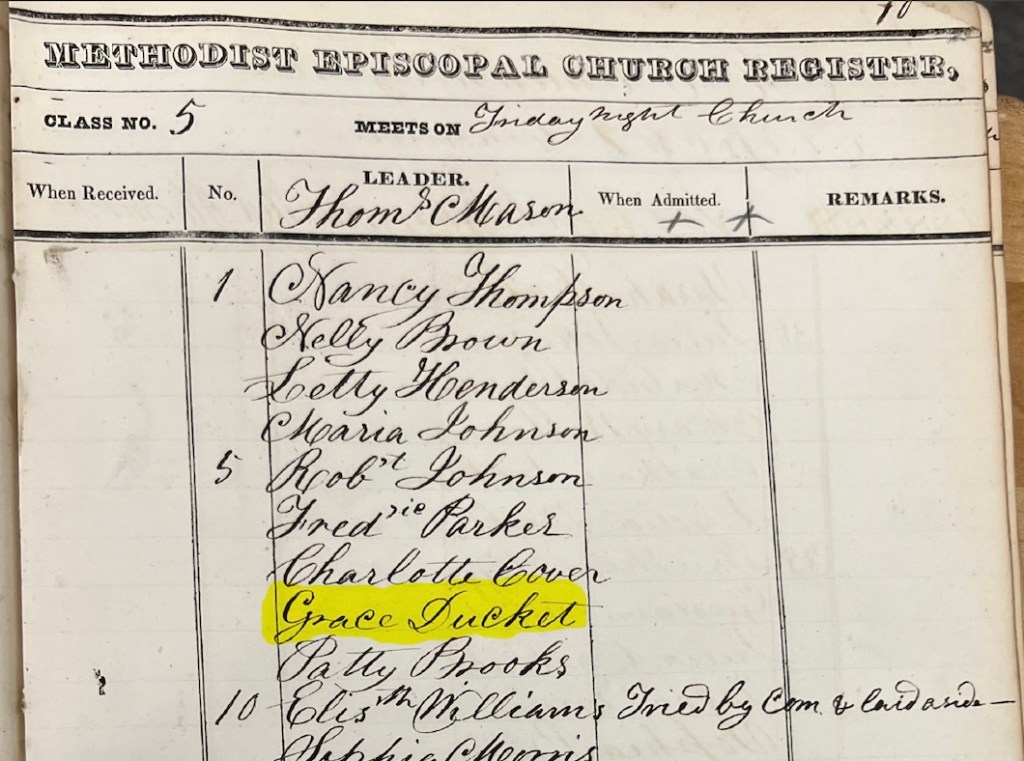
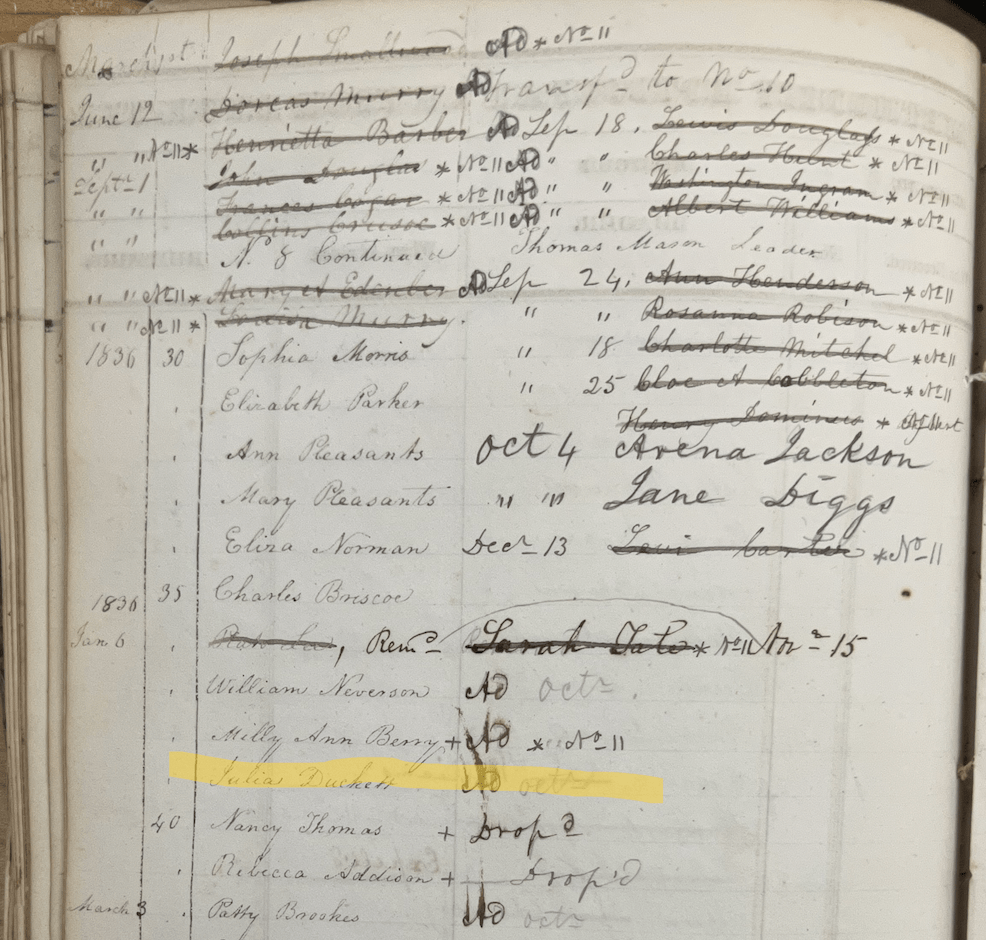
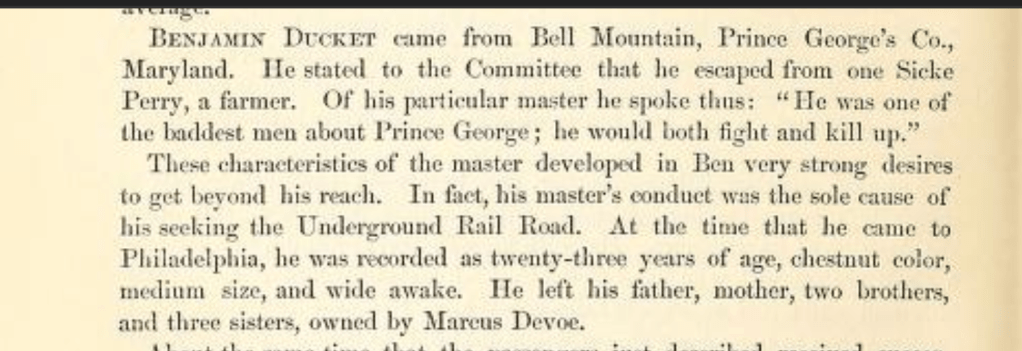
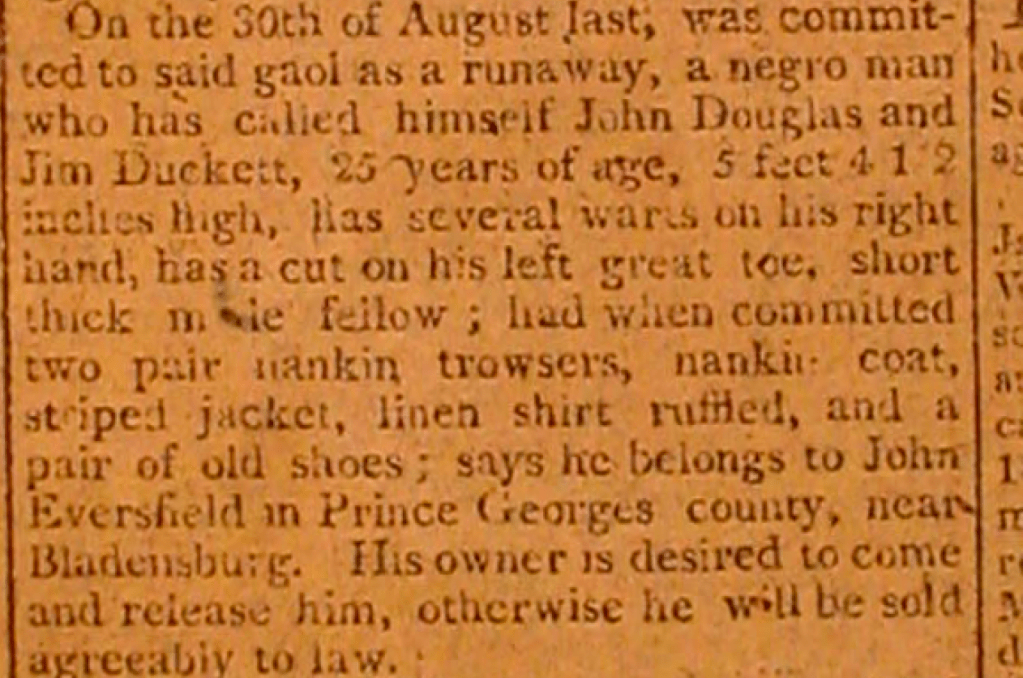
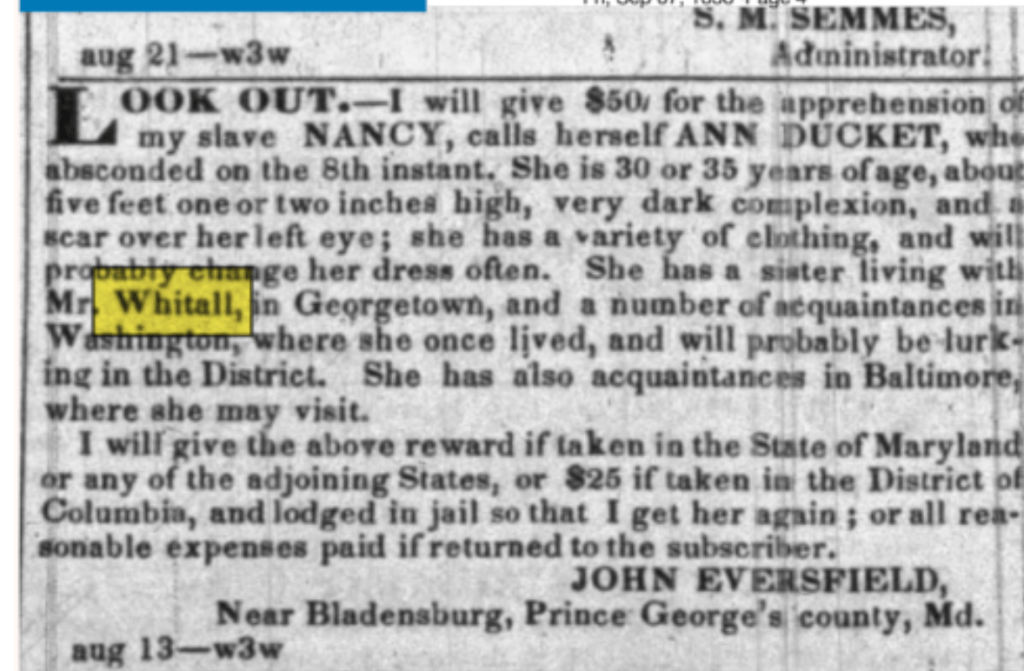
The 1836 register of the Methodist Episcopal Church (later Mount Zion Church) in Georgetown, District of Columbia, lists as a member “Pattie Brooks”, recorded just below the name of Gracie Ducket, who was enslaved by Samuel Whitall, who leased the property known as Belle Vue (later known as Rittenhouse Place, and after that, Dumbarton House).
Register, Mount Zion Methodist Church, 1836 showing Patty Brooks and Grace Ducket
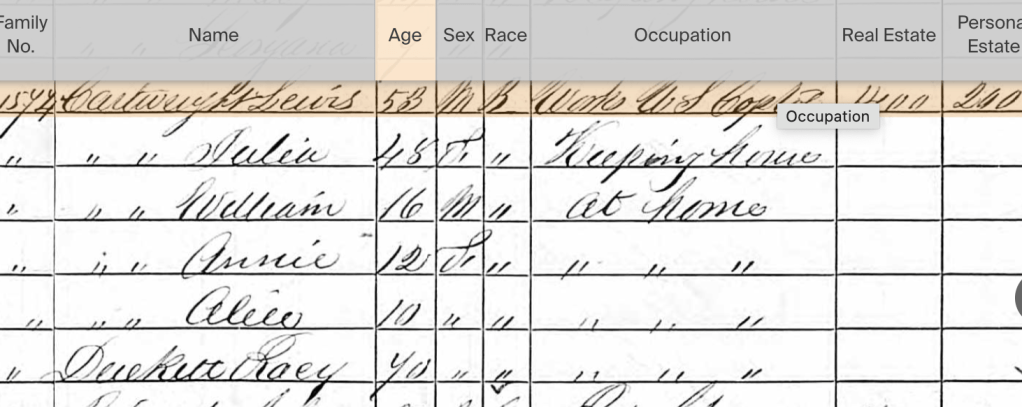
The 1860 census records Pattie Brooks, mulatto, servant, as a free woman of color, born 1810, residing in dwelling 531 in Georgetown Ward 2, within the household of the Black woman Charity Lemon, age 70, with Laura Bell, also Black, age 60. Pattie resides two households away from the free couple (Rev) Louis (Lewis) Cartwright and his wife Julia Cartwright, the daughter of Gracie Ducket who at that point was still enslaved by Lydia Whitall, the widow of Samuel Whitall. (Gracie would be freed two years later by the will of Lydia Whitall in early April 1862).
1860 census showing Patty Brooks near Lewis and Julia Cartwright
Four years later, in 1864, the Georgetown Directory records Patty Brooks residing at 23 West Street (later P Street) in Georgetown. She is the widow of “Harry Brooks.”
1864 Georgetown Directory Patty Brooks, colored, widow of Harry, home 23 West St (P St)
In her 4 January 1868 Freedman’s Bank application, Pattie Brooks indicates that she was born in Montgomery County, Maryland, residing at 22 West Street between (?) Montgomery Street (later 28th street). She is widowed, with no children. She opened her account with $130. She was, she reports, formerly enslaved by George Peter and his wife Sarah.
1868 Freedman’s Bank application by Patty Brooks for $130
Major George Peter (1779-1861) was the son of Robert Peter (the first mayor of Georgetown) and Elizabeth Peter. George became the leading slaveowner in Montgomery County, owning about 100 persons in 1860. Sarah Norfleet Freeland) Peter, 1805-1846, was George’s third wife. George evidently owned property in Georgetown as well as Montgomery County. Both George and Sarah Peter are buried in Oak Hill Cemetery, adjacent to Mount Zion Cemetery. George’s brother Thomas Peter famously married Martha Custis Peter, granddaughter of First Lady Martha Custis Washington, and resided in Tudor Place in Georgetown.
As of this writing, I am unsure how and when Pattie Brooks attained her freedom from George and Sarah Peter. Nor is it clear if her late husband Harry Brooks was ever free, or if he was enslaved throughout his life. Since Pattie is listed as a widow in the 1864 city directory, Harry must have died before that year.
The 1870 census records Pattie Brooks as head of household, in Georgetown, residing with Nellie Brown, 17, and Maria Johnson. 60. She lives next door to the Lemon family, including Charity Lemon, with who she resided a decade earlier in the 1860 census. Pattie lives three households away from Rev. Lewis and Julia Cartwright, a household which now includes Gracie Ducket, who, as noted above, had been listed just above Pattie Brooks in the 1836 Mount Zion Church register. Gracie Ducket and the Cartwrights are buried in Mount Zion.
The 1874 and 1875 Georgetown city directories record her as Patsy Brooks, living at 23 West Street (later P Street).
Pattie appears to be the same person as Margaret B Brooks, recorded in the death records of undertaker Joseph Birch, as residing at 23 West Street (later P street) in Georgetown, born 1892, died 8 August 1876, buried in Mount Zion Cemetery. In early American English, Pattie or Patty were hypocoristics (pet names) of Margaret and Martha, through a common transposition of the letter “P” and “M.”
If Pattie Brooks were still enslaved in 1850, she might have been the 40 year old enslaved woman in the estate of George Brooks in Medleys, Maryland in the 1850 slave schedule. Alternately, it is possible that Harry and Pattie/Margaret appear in the 1850 census as the free couple of color, Hary (b 1795) and Margaret Brooks (b 1805) in District 1, Dorchester County, on the eastern shore of Maryland, with evident children James Brooks. Wesly Brooks, Hester Brooks, and Sarah Jane Brooks. This seems unlikely, given that Pattie Brooks was worshipping in Georgetown in 1836 and residing in Georgetown in 1860, but cannot yet be ruled out.
I am unsure if Harry and Pattie (Margaret) Brooks were related to Sarah Brooks, who had been enslaved by Joseph Nourse, evidently at the time he owned Belle Vue. In slavery and freedom Sarah worked as the cook at the Highlands (later the Sidwell Friends campus). She died in 1875 and who is also buried in Mount Zion Cemetery.
I am puzzling over a connection through ancestry.com indicating that Abduvohid “Abdu” Abdurasulov, born in Samarkand, Uzbekistan, and I are share about 2 per cent DNA. This could indicate we are second or third cousins, or this might, because of the complexities of relative endogamy, mean that we are related to one another in more than one way, at a greater genealogical distance. Abdu is ethnically Tajik, but Ancestry’s algorithms indicate that about ten percent of his DNA is consistent with Eastern European Jewish background. He believes that the connection is likely to be through his great great grandmother, Sharofat Sadikova, whom he understands came from Eastern Europe and settled in Samarkand many decades ago.
Samarkand, on the ancient silk road across central Asia, has an centuries-old Jewish community, sometimes known as the Bukharan Jews. However, I am assuming our connection is more recent, through the mass evacuation of Jews to Soviet Central Asia, from Eastern European sections of the Soviet Union in 1941 and 1942, in advance of the Nazi invasion of the Soviet Union. About 1.1 million Soviet Jews are known to have been evacuated to central Asia; of these, at least 300,000 are believed to have perished from disease, starvation or exposure.
I know of several relatives on my father’s side of the family who were evacuated, but I am not sure if any of these constitute my connection to Abdu. These are:
My father’s mother’s sister Pauline Zeltzer Klein, and her children Eva and Joseph Klein, were evacuated from Moscow to Adzitarovo (Адзитарово), in the Karmaskalinskiy rayon, Republic of Bashkortostan, about 1,400 km east of Moscow. (This is several kilometers west of Kazakstan). They stayed in a house that had been previously occupied by a Tatar family, who had evacuated further east into central Asia. The Kleins stayed there until the tides of war turned, and then returned to Moscow, where Pauline with difficulty reclaimed rights to her old apartment, where she and her husband Sol continued to live for the rest of their lives.
My father’s mother’s father’s daughter’s son, Hirsh Osofskiy (1883-1943), his wife Gesia, and their eleven year old son Efim, were evacuated in 1941 from Babruysk, Belarus to Kazakstan. Since the Wehrmacht occupied Babruysk on June 28, 1941, I assume the family fled the city before then (At least 20,000 Jewish residents of Babruysk were subsequently massacred by the Nazis). Hirsh and Gesia perished during the war in Kazakstan, but their son Efim was cared for by Kazakh shepherds and survived. He later returned to Babruysk after the War and his descendants continue to reside in Moscow. Efim’s son, however, shows no genetic connection with Abdu.
My second cousin once removed (my father’s father’s father’s daughter’s son’s son) Bruno AUSLÄNDER, (1921-2018) was evacuated to Uzbekistan during the war. I am uncertain how precisely he reached Uzbekistan. His parents, Nathan and Netti, and brother Joseph resided in Radautz (Radauti), in Bukovina, Romania, up until the time they were deported by Romanian fascists in October 1941 on death trains into Transnistria (fascist occupied Ukraine), where they rather miraculously survived in Moghilev during the deportation era, before returning to Radautz, Bukovina at the end of the war. Bruno must have somehow made his way into Soviet controlled territory and from there been evacuated east. This must have been perilous; as is extensively documented, many Romanian Jews from Bukovina who traveled north of the Bug river were murdered by the SS Einsatzgruppen (mobile killing units) in occupied Ukraine. Bruno, we know, married a Soviet woman, Valea, A registration card indicates he made his way to Tashkent in Uzbekistan in 1941-1942, He survived the war and was back in Radautz by 1945 with her parents and brother. He eventually settled in Canada. (About 150,000 Jewish evacuees are documented in such registration cards in Tashkent, digitized by Yad Vashem and the US Holocaust Memorial Museum).
However, I suspect our connection is in fact through my mother’s side of the family, about whom we know much less. Abdu and I appear to have DNA matching cousins on my mother’s side, so that is probably where we concentrate our efforts. A cousin reports that my mother’s brother, the late Louis Epstein, has DNA connections to Abdu on both Louis’ mother’s and father’s side, which is intriguing.
My mother’s mother Yetta Epstein ( who gave her maiden name as “Anderson”, which appears not to have been her real maiden name) evidently emigrated from Pavoloch (Zhitomir, Ukraine) to Baltimore, Maryland, USA, around 1913. My mother’s father Isadore Epstein, emigrated from Babruysk, Belarus in 1911 to New York. (By coincidence, by father’s mother’s family and mother’s father both came from Babruysk.) Both Yetta and isadore must have left many relatives behind in Ukraine and Belarus, but do not appear to have spoken of these connections extensively to their children.
The USHMM and Yad Vashem databases list several Jews from Pavoloch, Ukraine who were evacuated to Uzbekistan. These include:
Samoil Gerchenko, born in 1898 to Grigoriy. who is listed on a Tashkent registration card.
Shika Ruzhinskii, born 1896, son of Mikhail, also listed on a Tashkent registration card.
Boris Samonin, born 1900 son of Osvey? also listed on a Tashkent registration card.
I do not know if any of these persons were related to Yetta or her sister Bessie. The cards do not indicate if any of these individuals survived World War II.
In terms of possible relatives of my mother’s father, Isadore Epstein from Bobruysk, the USHMM database lists thirty-one Epstein’s evacuated from Bobruysk to Uzbekistan, according to the Taskent registration cards. (One Epstein from Bobruysk, it is interesting to see, was Nathan Epshtein, who somehow made it to Nantes, France, and was then murdered in Auschwitz). Perhaps one of these Epshteins evacuated to Tashkent was related to my mother’s father Isadore Epstein and was married or related to Abdu’s great great grandmother Sarofet Sadikova.
I see on social media that there are various Epstheins currently living in Tashkent but I am not sure if I am related to any of these. I also see that the USC Shoah Foundation site lists about twenty survivor interviews with references to time spent in Samarkand, Uzbekistan but I have not requested access to these yet.
Looking at things from Abdu’s side of the family, the USHMM database of Holocaust Victims and Survivors (and the JewishGen compilation) lists about 11 individuals with the surname Sadikova or Sadikov (the male version of the name) from the Tashkent registration cards. These are:
Brana Sadikova, born 1911, from Barancha [Altai Republic?]. daughter of Iosif
Ester Sadikova, born 1897 (prior location not listed), daughter of Leib
Sfirsa Sadikova, born 1906, from Moscow, daughter of Boris
Fania Sadikova, born 1888, from Belets, MSSR. Moldova, daughter of Abram.
Anna Sadikova, born 1913 from Bel’tsy, MSSR. Moldova, daughter of Dersh
Khaia Sadikova, born 1908 daughter of Bentsion, from Orgeyev, Orgeyevskii, MSSR (Moldova)
Sima Tsadikova, born 1904, daughter of Shmul from Kishinev [Chișinău, Moldova.}
Anna Tsadikova, born 1900, daughter of Isaak, from Odessa [Ukraine]
Angel Sadikov, born 1906, son of David, from Orgeyev, Orgeyevskii, MSSR (Moldova) , Soviet Union
Mortko Sadikov, born 1896, son of Mendel, from Barancha [possibly Altai Republic?]
Moisei Sadikov, born 1912, son of Mendel, from Ketrosa (I believe Chetrosu, Moldova)
Of these, I am not seeing an obvious connection to my known family members. Six of those listed are from Moldova/Bessarabia. From 1941, Moldovan or Bessarabian Jews were deported to Transnistria, along with Jews from Bukovina, including my father’s father’s family. Bel’tsy, listed above, was near the notorious Răuţel camp, where many Jews died under horrific conditions. I know that my father’s father’s sister Julia AUSLÄNDER, married a man, Joseph Pagis, from Kishinev. I believe my father’s mother’s mother’s family, the Weinsteins, has roots in Odessa.
One scenario might be that an Epshtein from Bobruysk married a fellow evacuee named Sadikova, and that is the source of our link.
The fact that my mother’s brother’s Lou Epstein has DNA links to Abdu on both his father and mother’s side suggestions more than one evacuation route might be salient. These would include the Epstein/Epshtein evacuation history from Baburysk to Tashkent, with the possible added connection through my mother’s mother’s family from Pavoloch in Ukraine. (Abdu had been under the impression that his great great grandmother Sarofet had roots in Ukraine.) Perhaps future research will cast light on this enigmatic aspect of our family history.
My Mount Holyoke College students and I have been intrigued and moved by the story of Joseph Anderson, an African American laborer buried in Mont Zion cemetery in north Georgetown, Washington DC. Like Moses Boone, Joseph Anderson was interred without this brain, which had been extracted by a Smithsonian anthropologist in 1904 for the “racial brain collection.” As of this writing, the brain remains in the biological collections of the National Museum of Natural History. We hope progress is being made towards repatriation, in eventual consultation with descendants.
Joseph’s Ancestry
The precise circumstances of Joseph Anderson’s birth and parentage are somewhat murky. His 1895 marriage license to Laura V Chinn in Alexandria, Virginia lists his birthplace as “Canada” and his birth year as 1865. His parents are listed as “Henry” and “Henrietta”. Five years later, in the 1900 census he lists his birthplace as District of Columbia, birth date December 1862. He may also appear in the 1870 census, as born in Virginia, although this maybe a different Joseph Anderson.
If Joseph really was born in Canada, that might suggest that his parents had escaped on the Underground Railroad and eventually made their way to safety in Canada. That could be consistent with a free Black couple Henrietta W Anderson, 20 (b. 1840, in the District of Columbia ) married to Norman Anderson, barber, 36 (born Virginia) [who is perhaps the same person as “Henry” in the 1895 marriage record of Joseph] —residing in the 1860 census residing in Appleton Ward 2, Wisconsin, living with their son, two year old William Anderson, born in Canada, 1858. So perhaps the family moved in and out of Canada at some point, and Joseph, like William was born there. Two decades later in 1880, Henrietta, widowed, resides in Georgetown DC. as a housekeeper in the household of the Black male laborer, Robert Robertson, at 189 N. 26th street. I am not sure what became of Henrietta and Norman’s son William (note that the name William is repeated through the subsequent family line.)
Joseph Anderson in the DC Area
On 7 June 1892, Joseph Anderson married Mary E Harris in the District of Columbia , but, according to her divorce filing. he deserted her after a month. Joseph later remarried, to Laura V Chinn on 7 March 1895, who had been working as a domestic in the District. (Mary Harris Anderson charged that Joseph had failed to first obtain a divorce from her, and she sought court permission to return to her maiden name.)
In 1900, Joseph and Laura Chinn Anderson were residing at 1117 L St, NW. Joseph was working as a barber, like his apparent father or stepfather Norman Anderson, Joseph and Laura resided with Laura’s parents, John F Chinn and Laura Chinn, and her brothers Clarence Chinn and Raymond Chinn (mentioned below).
Joseph Anderson’s death certificate indicates he had been a patient (“inmate”) at Freedman’s hospital for seven days, before dying of acute interstitial meningitis on 30 July 1904. The extraction and autopsy of his brain presumably took place soon after his death. He was buried in Mount Zion on August 1, 1904.
Joseph Anderson and his wife Laura Chinn Anderson evidently only had one child, William James Anderson (Sr), evidently born January 3, 1900 (four years before his father’s death).
After Joseph’s death, Laura supported herself and her son as a dressmaker. and by taking in lodgers On May 1, 1906, she had another son, William Ralph Grayson, evidently out of wedlock. On December 29 1931, William married Celeste Johan Biscoe. William Ralph Grayson died 4 February 1990 in the District of Columbia. The couple was evidently childless. (His 1990 obituary, it is interesting note, references him as the son of John F and Laura Williams Chinn; although the 1939 obituary of their daughter Laura Chinn Anderson Robinson, refers to him as her own son.)
On February 28, 1912, Laura Chinn Anderson remarried, to the carpenter Wellington C. Robinson, who died May 5, 1927. Laura died October 4, 1939 at her residence 1925 2nd St, NW.
Let us return to Joseph and Laura Anderson’s son, William James Anderson, Sr. He married Leah (Lee) Lewis (of Berkeley, Spotsylvania, Virginia) on 3 Aug 1922. in DC. They are recorded as a couple with children in in the 1930, 1940, and 1950 censuses. In 1960, William J Anderson plasterer, and his wife Leah B Anderson, resided at 1630 and a half, 10th st, NW. Leah died in the District of Columbia 11 Sep 1996. I am not sure of the death date of William James, Anderson, which must have been at some point after 1960.
William James Anderson, Sr and Leah B Lewis Anderson had at least nine children:
Mary F Anderson, b 1924, who in the 1930 census is living with her parents William and Leah Anderson at 941 Florida Avenue. In 1950, she was still unmarried at age 27, residing in a basement apartment on 13th street, NW. She might be the Mary F Anderson in the 1954 city directory residing at 1458 Columbia Rd, apt 201.
William James Anderson, Jr. 9 DEC 1927- 29 NOV 1975. In 1930 and 1940, he was living with his parents and siblings. He married Ruth Naomi Campbell (1929-2017) on 28 Dec 1945 Children included Vermel Anderson. July 1, 1960 – March 16, 2023, William James Anderson III, d. before 2017 and Leona Anderson, d. before 2017
Harvey Anderson. b. 1930. In 1960 Harvey Anderson Sr. and his wife Lillian Anderson were residing on G Street West, with two year old Harvey Anderson (Jr) in the home of Harvey’s uncle Theodore Butter, at342 G St SW, #2.
Rogers Anderson, b. 1934
Lillian R Anderson, b 1936
Frank M Anderson, b 19387 Samuel M Anderson, b 1941
Samuel M Anderson, b 1941
Marcellus Anderson, Sr. 1943-2012 (Temple Hills, Maryland; buried Lincoln Cemetery. )
Burnell Anderson, b 1945
Collateral Chinn Relations
Joseph Anderson’s in-laws, the Chinn’s, were members of an extensive African American family with roots in Virginia and the District of Columbia.
Joseph Anderson’s wife Laura V Chinn’s siblings, the other children of John F Chinn and Laura Williams Chinn, included:
John Franklin Chinn (Jr), b 1868 Virginia, died 20 Apr 1945. Enlisted in US Army 1896. Married Mary. Married Emily Jackson. On May 20 1907, married Mary Schureman. Children included: Henry S (1884–); Bertha Beatrice (1889–1931); Arthur Franklin (1892–1953); Ethel Martha (1893–); Crystal C (1897–)’. Also appears to have married a Laura Williams, and had a son Raymond Chinn, b, 16 MAR 1894 in Alexandra, Virginia, and died 11 February 1962 in Philadelphia, PA.
2. Raymond Chinn, b 1885, married Lurray Allen.
11 Feb 1962
3. Ulysses Chinn, b 1885,
4. Magnus Chinn, b, 1876. Enlisted in US Army 1896
Artist Lynn Marshall-Linnemeier routinely “mines” the visual history of race in America, combing through iconography found in old stereoscopic images, postcards, photographic albums. She repositions figures from the era of enslavement and Jim Crow, who were initially framed in keeping with prevailing white nationalist racial conceptions. Her multimedia composites give in effect, new life to these re-excavated predecessors, emphasizing their dignity and resilience, often relocating them within mythological terrains of restoration, tranquility, and healing.
Lynn Marshal-Linnemeier, “Sweeps” , College on camvas, 20″x24″ (2917-2024_
In her recently restored collage, “Sweeps” (2017-2024) Marshall-Linnemeier present three African American child chimney sweeps, perhaps taken from a stereoscopic card. African American boy chimney sweeps (“sweeps”) were used extensively in the US South into the early 20th century. As in Europe, apprentice boys were coerced into this extremely onerous and dangerous work, climbing through narrow, twisting flues (designed to increase the upward draft of fireplaces fires), scraping away creosote and accumulated soot with hand tools and with their special narrow caps. They risked asphyxiation, pulmonary disorders, burns, and soot-induced carcinomas. As apprentices they had no legal recourse if abused, ad if employed, they were often paid a pittance.
Curiously, in Europe, chimney sweeps, though subjected to great abuse and injustice, were often conceived to be agents of good fortune. It was considered good luck to touch their soot- covered sleeves or, when glimpsing them from afar, to touch one’s own button and make a wish.The superstition may have been rooted in the scenario of the sweep disappearing into the dangerous, invisible space of the flue and then reappearing, as if reborn from the land of the Dead. (An echo of that old folk belief appears Bert the Chimney Sweeps’s song in Mary Poppins: “Chim chim cher-oo!/Good luck will rub off when/I shakes ‘ands with you/Or blow me a kiss/And that’s lucky too.” (Songwriters: Richard M. Sherman/ Robert B. Sherman, Mary Poppins).
Perhaps a trace of that magicality informs Marshall-Linnemeier’s entrancing piece, Sweeps. In the original images, three boys of differing heights are posed facing the viewer, in dark uniforms, with their tools and pointed caps. I am not sure if the pointed caps, different from the usual stovepipe hats worn by sweeps, were meant as an allusion to dunce caps or Klan hoods, or were in fact practical tools designed to scrape away soot as the child worker ascended.
In any event, one senses that these children now rise up not into suffocating narrow chimneys, but rise with the majesty of trees in the wilderness of St. Helena, South Carolina, one of the Sea Island of the (Gullah-Gechee) Low Country. The youths remain in black and white, but stand beside a color-filled stream, with cool blues and turquoise promising to quench their parched lips and throats, in distinct contrast to the rising fire and smoke that once tormented them. Their erect postures are echoed in a great tree that towers above them, as floral petals and birds flit around them. The trees roots are visible through earth, reaching down towards the cooling spring.
In a second panel to the right, the same configuration is evoked, but now missing identifiable human figures, although there seem to be evocations of ancestral figurines in classical West and Central African sculptural traditions. A variation of the central tree is now rising in the air, its roots much more pronounced. To my eye, this floating tree’s branches are now raised like arms, and there may be three ancestral like large faces hinted at in the tree’s upper foliage. One has the sense that the three chimney sweeps, who suffered so much earthly toil, have now been translated or sublimated to a higher plane of existence, as they become integrated with the ancestral realm that blesses all who remain below. In this light, it is worth recalling that for the BaKongo peoples of central Africa, trees are honored as the dwelling places of the ancestors, serving as living portals between the visible world of mortals and in the invisible lands of the eternal powers.
In that sense, the work’s title seems to have multiple meanings. “Sweeps” were consigned in life to sweep away the detritus left behind by untold thousands of chimneys. The full value of their labor and lives was all to often ignored or swept away by the dominant order of things. Yet now, through the artist’s aesthetic and spiritual process, the young workers, like all who behold them, are swept upwards, rising with the trees with a water-world of life-sustaining spirit.
My Mount Holyoke College students and I have been fascinated, moved, and deeply distressed by the story of the African American child Moses Boone, 1902-1904. After his death at the age of 21 months, at Children’s National Hospital in Washington DC, his brain was extracted by physical anthropologist Aleš Hrdlička to be included in the US National Museum’s (Smithsonian Institution) racial brain collection, where it remains to this day. Moses body (without the contents of his cranium) was buried in Mount Zion Cemetery in north Georgetown several days later We are not sure if his family members were informed that young Moses was interred without his brain.
We all hope that H.R.6805 – African-American Burial Grounds Preservation Act (2022) and related legislative remedies will lead to restorative justice for the memory of Moses Boone, his family, and many others impacted by unethical collecting practices related to ancestral remains.
[In Appendix I, I discuss some of Hrdlička’s published work on African American children and adult brains; please note that this section may be extremely distressing for many readers.]
What can be uncovered about about Moses’s parentage and ancestry? I have not seen a birth certificate or other record directly listing Moses’ parents, so we must infer Moses’ parentage indirectly. His District of Columbia death certificate lists his death on February 27, 1904, having been a patient for 23 days at the Children’s National Hospital, suffering from tuberculosis. His home address is given at 514 Ricketts Court. His death certificate records he was buried on March 2, 1904 at Mt Zion Cemetery (Georgetown, District of Columbia). Ricketts Court, which no longer exists, but which, contemporary maps suggest, was between 24th and 23rd street and F and E streets in the Foggy Bottom neighborhood.
Nineteen days earlier, on February 8, 1904 a woman named Estella Boone died. She was buried on February 11, 1904, also in Mount Zion Cemetery. The Evening Star on February 12 also reports her address as 514 Ricketts Court; the 1900 census indicates she had given birth to five children, one as recently as October 1899. We may thus safely conclude that Estella Boone, the wife of Victoria Emmanuel Boone, was the mother of Moses Boone, born 1902.
The 1902 city directory lists both Estelle and her husband Emanuel Boone as residing at 2411 Snow’s Alley, NW which was between K and I street, just west of 24th, so within a couple of blocks of Rickett’s Court. So it would appear the Boone family had recently, just before Moses and Estella’s deaths, moved a short distance within the neighborhood
Moses’ father was clearly Victor Emmanuel Boone, who according to the 1900 census was born June 1862 in Maryland. he died 28 July 1905 in Washington DC. The widowed Victor Emmanuel Boone took his own life; according to the newspaper account this was over his continuing illness and an inability to secure employment.
Moses’s Father’s Side
The first reference to Moses’ father (Victor) Emmanuel (Emanuel) Boone is in the 1870 census in District 3, Talbot County, on Maryland’s eastern shore. The eight year old Emanuel Boone, appears as the only child listed in the household of black couple Daniel Tilghman born 1825, and his wife M Elisabeth Tilghman. It seems likely that Daniel and Elisabeth were the grandparents of Emmanuel, who had been mothered by their daughter.
A possible candidate for Emmanuel’s mother is the black free female Mary J Tilghman, listed as 6 years old in the 1860 census in Easton, Talbot, Maryland, living in the home of the free Black couple Vincent and Jane Needles. She next appears as Mary Tilghman, age 12 in the 1860 census. In 1860 is residing in the household of the white planter Robert Hughey, in Easton Talbot county, Maryland. Perhaps given the precarious nature of life from free Black families on the antebellum eastern shore of Maryland, her parents had placed her out, first with Black relatives and then with a white farmer. If she was the mother of Emanuel, born around 1862, she might have been about 17 years old when she gave birth.
Vincent or Vinson Needles also appears as a free Black man in the 1840 census, in a household of six free Black people (an adult woman, two daughters, and three sons) in District 4, Talbot County, Maryland.
A reasonable candidate for Emmanuel’s father is James Boone, who in the 1860 census is listed as a free Black man age 30, born 1830 residing in Trappe, Talbot County, in household 777, headed by the free Black farmer Wesley Pierce.
In 1870, evidently the same man, a black James Boone, born 1820, was residing in Queen Anne’s County, just north of Talbot County, married to Maria Boone, with children Laura Boone, 8, and William Boone, . It is possible that Maria is the same person as Mary Tilghman. Or it may be that Emmanuel’s mother had died after his birth in 1862, and the boy was being raised by his maternal grandparents, the Tilghmans.
This James Boone, possible father of Emmanuel, seems likely to be related to an older free black James Boon, born 1814, listed in the 1850 census, residing in adjacent Caroline County. married to Henriett Boon with their one year old child Isiah Boon. This older James Boone also seems to appear in the 1880 census in Church Hill, Queen Anne’s county, Maryland, born 1810.
In 1860, it seems significant that James Boone resided two households away from the white enslaver Owen Boon, who in 1860 owned three slaves: a 30 year old male, a 15 female old female, and a 10 year old male.
In 1870, there was one black family with the surname of Boone in Talbot County, Harrison Boon, b 1840, wood sawyer. and his wife Patience, b. 1842, residing in the county seat of Easton. It is possible that Harrison had been enslaved by Owen Boone, noted above.
The Black Tilghmans.
Daniel Tilghman, with whom young Emmanuel was residing in 1870s, has earlier had appeared as a free black man in Talbot County in the 1850 and 1860 censuses.
He would seem to be the son of Daniel Tilghman (Sr) who appears in the 1830 census in Talbot County, as a free Black man born between the ages of 36 and 54, living with a free black woman; he also appears in the 1840 census in Caroline County, Maryland, in a household of three free Black persons, a man over 55, a woman over 55, and a girl over 10.
This older Daniel is evidently referenced in a document attesting to the freedom of Daniel Tilghman. dated July 25, 1809 reference then as 26 years old, so born around 1793. He is recorded as born and raised in Talbot County, Maryland, black, height 5’6.5”, with a “pretty large scar on the outward part of his left thigh, about six inches above the knee:.”(Maryland State Archives,:*C1842-1, Entry 1, p 22, witnessed by Jonathan Ozom)
Another Daniel Tilghman, was manumitted by the last will and testament of Henry Lowe Hall. in Prince George’s County bearing the date May 06, 1817. He is described as a “Bright Mulatto” 5’0’, with a small scar over his right eye. (p 78)
The White Tilghman Family
These multiple free Daniel Tilghmans must have been closely connected to the prominent white TIlghman family of Talbot County, Maryland, descended from Richard Tilghman (1626–1675) a surgeon in the British navy who founded a plantation at the Hermitage. near Centreville in Queen Anne’s County, Maryland. Many of the white Tilghmans were extensive enslavers. The Tilghman family seat, the Hermitage plantation on the eastern shore, held dozens of enslaved people in the late 1700s. A grandson of Richard was James Tilghman (1743-1809), who owned 50 slaves in 1790.
It is interesting to note that the Richard Tilghman descendants were divided between Loyalist and Patriot sympathies during the Revolutionary War period. Richards’s grandson, Matthew Tilghman was the de facto leader of the Revolution in Maryland, heading the Committee of Safety and representing Maryland in the Continental Congress, 1774-1776 (he voted for the Declaration of Independence but was not one of the actual signers). safety In the Annapolis Convention he played a leadership role in the establishment of the Maryland Constitution, Matthew’s nephew and son in law was Lt Colonel Tench Tilghman (1744-1786), Aide-de-Camp to Gen. George Washington during the Revolutionary War. He famously carried Lord Cornwallis’s surrender papers from Yorktown to the Continental Congress in Philadelphia. See; https://en.wikipedia.org/wiki/Tench_Tilghman.
in summary, a possible scenario is that Victor Emmanuel Boone’s mother was a daughter of Daniel and Elisabeth Tilghman, possibly named Mary Tilghman, and that she died after she gave birth in 1862, leaving the boy to be raised by his grandparents Daniel and Elisabeth. Perhaps Victor Emmanuel’s father was James Boone, who had been free as early as 1860, but who remarried, leaving his son Emanuel to be raised by his maternal grandparents. Or perhaps Emmanuel’s mother became Maria Boone, and she and husband for some reason entrusted the Tilghman’s with raising Emmanuel.
Moses’ Mother’s Side.
Moses Boone’s mother Estelle Berry first appears in the 1870 census in Alexandria Ward 4, Virginia (the city had been retrocessioned from the District of Columbia in 1832). 4 year old Estelle is residing in dwelling 44, the household of the Black male wood sawyer John Young, 61, born Maryland, and his presumed wife Sarah Young, 53, born Maryland, along with Estelle’s siblings Mary E Berry, 6, and James Berry, eight months old, and 12 year old Milly Fudge, 12, All three of the Berry children are listed as born in West Virginia, so they evidently only came to Alexandria at some point after September 1869, when little James was born. As was the case with Victor Emmanuel Boone, it seems likely that Estelle and her siblings were being raised by their grandparents.
(This John Young may have been one of several John Young’s whose served in Maryland’s US Colored Troops during the Civil War but I am not sure of this. )
The most likely candidate for Estelle’s mother is Anna Berry, who in 1870, was also living in Alexandria, Ward 4, in household 287, that is to say in the neighborhood of Estella and her siblings. Anna is employed as a domestic servant in the household of white clergyman Rev. J.S. Johnson, born in Georgia, and Jane Johnson, born in New York. Anna Berry is listed as age 20, so born around 1850, Virginia.
A decade later, the 1880 census records a “Hester Berry,” born West Virginia, 1867, who is evidently the same person as Estelle Berry. She is a servant at 112 Prince Street, Alexandria, in the household of the white government clerk Thomas Foster.
The 1880 census also indicates that James Berry is still living with his “grandparents”, Sarah Young and John Young, nearby at 41 Prince Street, Alexandria. Also living in the household is Sarah Young’s son John Berry, 22, a widower and a wood sawyer like his father. In 1881, the Alexandria City Directory indicates John Young and John Berry, both Black laborers, are both residing at “s s Prince, 3e West” in Alexandria. I am not sure why the two Johns, father and son, have different surnames. Living there as well is 10 years old James Berry, who was an infant in the 1870 census. Also in this household are Millie Fudd, 15, Sarah’s daughter; Annie Fudd, Sarah’s granddaughter, age 10; and eight month old, Issac Fudd, born September 1879, all presumably related to the older “Millie Fudge: of the 1870 census.
John Berry, only 22 in 1880. seems too young to be an actual parent of Estelle, Mary or James, but he might be one of their paternal uncles. This would seem to suggest that John and Sarah Young were Estelle’s paternal grandparents. In other words, their son had married the mother of Estella, Mary, and James, who may well have been Anna. As of this writing, I am not sure of Anna Berry’s maiden name.
This same year, 1880, Estelle’s possible mother may appear as Anna M Berry age 36, in the 1880 census residing at 173 Staunton Avenue, Hillsdale, Washington DC, married to Richard Berry, with a daughter Mary M Berry, 10 years old. who would seem to be too young to the same person as earlier Mary, sister of Estella. Also living with them are Richard’s adopted daughter Sarah Meads, 14 and Mary Meads, 14.
In any event, Estella Berry and Victor Emmanuel Boone married one another on 15 June 1885 in the District of Columbia. By 1887 the couple was residing in Snow Alley. In 1888 and 1889 they are living at 1122 Connor Alley, NW.
The 1900 census records Emmanuel and Estella Boone, 30 years old, residing once again in Snow’s Alley, with their children Priscilla, 13, Emmanuel Jr, 8, Marie, 5, Leis 3, and George, 1. Moses, born 1902, was of course not born at the time of the 1900 census.
Moses’ name is listed, as far as we know only in the city’s death certificate and the Smithsonian racial brain collection records, and in several newspaper death announcements
Victor Emmanuel’s final address in the 1905 City Directory was 1147 Government Alley, NW, slightly different than the address given on his death certificate 1137 Government Alley.
Estella’s Siblings
What became of Estella Berry Boone’s siblings, Mary E Berry, born 1864, and James Berry, born November 1869?
I have not yet traced Mary Berry, after her 1870 residence in Alexandria, Virginia. She is clearly different than the Mary Berry, b. 1859, daughter of Jacob and Eliza Berry, living in Baltimore Ward 5 in 1870.
As seen above, James Berry, born 1869, in the 1880 census was still residing with his grandparents Sarah and John Young in Alexandria.
It should be noted that this is a different James Berry than the slightly younger James W Berry born in December 1864, who in 1880 lived on Columbia Street in Alexandria. This alternate James Berry married Mary L Washington in Alexandria in 1893, and lists on his marriage license his parents as William and Annie Berry.
Also different would seem to be the James Berry, born West Virginia, listed in the 1900 census a incarcerated in New Jersey State Prison, and in 1910 in the Beaver County jail. However, this man was listed as born in June 1872. His death record in 1912 lists his father as “George”.
Nor is this John B Berry, born 1858 in West Virginia, who in 1870 resided with his parents Thornton and Harriet Berry, in Washington Ward 1.
The 1887 census lists two Black men named James Berry in Alexandria, both laborers, one residing at 80 n Fairfax and the other residing at Gibbon nr St Asaph (the ams addresses of Phillip Berry). The first of these is more likely to be “our” James Berry.
Collateral Descendants of Moses Boone
On February 8, 1922 four of Estella’s children published the following memorial in The Evening Star (p. 7)
Boone, Sacred to the memory of our dear mother, ESTELLA BOONE, who departed this life eighteen years ago today, February 8, 1904. Gone to a land of pure delight where souls immortal reign; Infinite day excludes the night And pleasures banish pain
Her devoted children Pricilla Edmond, Marie Arnold, Emmanuel and Louis N Boone
The Evening, Sart. Feb 8, 1922, p. 7 (
What do we know of the lives of the children of Estella and Victor Emmanuel Boone, the siblings of Moses Boone?
Moses’ eldest sibling, Priscilla Boone (1887-1948) married Walter Edmonds (b 1885). Their children were: Isaiah Edmonds, 1910-1939, and Walter Nathaniel Edmonds (Jr), 1915-1985. She later married Augustus Wilson, on August 10, 1938 and took the name Priscilla Edmonds Wilson. (She had no children with Augustus Wilson; this was his third marriage).
Isaiah Edmonds married Henrietta Waynes on October 3, 1928. Their son was Roland Edmonds.
Isaiah’s brother Walter Nathaniel Edmonds (Jr) married June Louise Potts. Their daughter Jean Marion Edmonds (1932-2020). married Leroy Clifton Jackson (1929–2000). Their children included Karen Denise Jackson Sellman (1951-2018), Clifton Ranard Jackson, 1952-1991, Candace Jackson, and Cheryl Jackson.
In 1950, Walter N Edmonds (Jr) placed a memorial notice in the Evening Star: “In sad but loving memory of my dear mother Priscilla Edmonds Wilson, who departed this life two years ago today, September 4, 1948. Mother you left a beautiful memory/A sorrow to great to be told/But to us who loved and lost you/your memory will never grow old. SON, WALTER N EDMONDS” (Evening Star, September 4, 1950, p. 4)
Moses’ sister Marion or Marian Edmonds married Benjamin F. Arnold, 1895-1937 in Hamilton, Ohio, and later married Reuben C Miller (b 1875) in 1938 in Washington DC. In 1930 she worked as a live-in cook for white architect Phillip Frohman on Macomb Street in Cleveland Park. In the late 1930s, she worked at 3238 R Street in Georgetown, as a live in servant for Howard Davidson, Colonel Army Air Corps. The 1940 census has two entries for her: under her earlier name of “Marian Arnold” in Georgetown in the Davidson household, and under “Marian Miller” with her husband Reuben Miller and three of his children by a previous marriage, two sons Douglas Leroy Miller and Rude Miller , and daughter IneyMiller. Marion’s adopted son Douglas Leroy Miller later worked as a cook in California, married to Dorris, with children David, Maria and Timothy. Douglas died on 21 Feb 1993 in Hayward, Alameda County, California.
Moses’ brother Emmanuel Boone, Jr. married Cora Johnson (b. 1890). Their children were Nathaniel Boone, b. 1914 and Mildred Boone Sims, b. 1923, to whom Emmanuel was a foster father.
Emmanuel Boone Jr served in Europe in World War One (Company “A”, 343rd Labor Battalion Quartermaster’s Corps) and died at the US Veterans Hospital in Aspinwall, Pennsylvania on April 6, 1936. He worked as a laborer; his final address was 406 21st NW in the District.
In the 1950 census, Mildred Boone Sims was living with her widowed mother Cora Johnson Boone at 426 New York Avenue.
Moses’ brother Louis Napoleon Boone (1897-1982) married Pearlie Boulware Pratt, 1907-2007. Their son was Paul Boone (1924-1970)
Moses’ brother George Boone, born October 1899 appears to be the George Boone who died December 14, 1912, age 13, in Freeman’s Hospital (Evening Star, December 19, 1912) who was buried in Mount Zion Cemetery (West), presumably with his mother Estella and brother Moses. His residence is given as Annandale, Virginia. Perhaps the orphaned George was living with an uncle or aunt.
Finally, what became of the Fudd family, that is to say, Estelle Berry Boone’s apparent aunt Millie and cousins Alice and Isaac Fudd. and the “Millie Fudge” of the 1870 census?
Isaac Fudd, the grandson of Sarah and John Young, born September 1879, sadly seems to have spent his life in public institutions. The 1900, 1910 and 1920 censuses record him as an inmate at the Pennsylvania School for Feeble Minded Children. By 1930 he had been transferred back to the District of Columbia, and resided at the Home for Aged and Infirm in D.C.
Appendix I. Hrdilicka’s Records
Please note that this section may be extremely distressing to read.
Smithsonian anthropologist Ales Hridilicka describes his process for extracting, analyzing and preserving mammalian and human brains in: his book Brains and Brain Preservatives. Proceedings of the US National Museum, 1906.
A section of the book describes brains removed from child and adult Black children. On p. 264, Hrdlička reviews the conditions of several autopsied brains of Black persons. It is possible that one of these may refer to the brain of Moses Boone, who died, as noted above, on February 27, 1904. On March 23, 1904, he autopsied the brain of a child whom he referred to as “Colored Child” (about one fourth white), estimating the age at 3 years. He does not give the name of the autopsied subject.
ScreAles Hridilicka. Brains and Brain Preservatives, 1906. p. 265
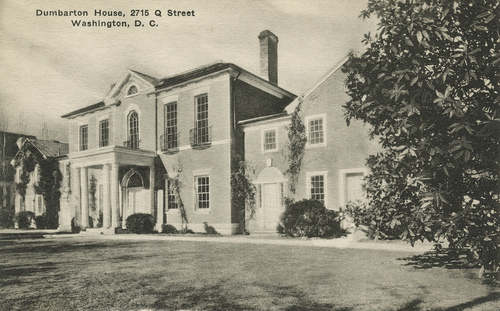
I have been puzzling over two enslaved brothers, Stephen Bennett, born around 1849 and James Bennett, born about 1852, both enslaved at Belle Vue or Bellevue House, later known as Rittenhouse Place, and now (after relocation) know as the modern Dumbarton House in Upper Georgetown, located at 27th and Q streets, Both boys were owned by Lydia Newbold Whitall 1784-1862, the widow of Samuel Whitall (1775-1855), from whom she probably inherited the boys when her husband died (unless she acquired them in a different manner.) Lydia manumitted the two brothers on May 17, 1858 (filing the papers on June 3, 1858), through the following document, (no 5 of 172 and 1873, Manumission records of Washington County in the District of Columbia):
From Manumission of Stephen and James Bennett, by Lydia N Whitall, 17 May 1858
“Know all men by these present that I Lydia N Whitall of Georgetown in the District of Columbia for consideration of five dollars current money to me hand paid by Stephen Bennett and of the like sum to me in hand paid by James Bennett…have manumitted, liberated, set free from slavery and every kind of servitude, and do by these presents manumit my servants and slave boys Stephen Bennett age nine years and James Bennett, aged six years, the children of the free woman named Minnie or Mina who is able and willing to maintain keep and support the said two boys Stephen and James until they are able to work, labor, maintain and support themselves and I do hereby declare that these two negro boys Stephen and James to be henceforth during the residue of their lives manumitted liberated set free and discharged from all and every species of servitude and slavery. In testimony wherefore I have herewith set my hand and seal this 17th day of May in the year 1858, Lydia N Whitall. (Signed sealed and delivered in the presence of Henry Reaves, John [Marbury, Jr.?)
The younger brother James Bennett, appears two years later, in the 1860 census, residing with his mother “Jemima Bennett,” born 1830 in Virginia who is employed as a maid in the household of MajorDaniel James Sutherland in Washington Ward 4. Sutherland was the US Marine’s Quartermaster, and during this period was responsible for the design of the Marine Corps uniforms. ‘
Major Sutherland soon after this was cashiered from the military, evidently on charges of dereliction of duty, and died a little more than a year later, following a late night fall in the Metropolitan Hotel in New York City on November 29, 1861. In 1863, his widow Anna Nicholson Sutherland (1830-1906) resided at 409 NY avenue in D.C. I am not sure what happened to the household staff, including Jemima and James Bennett, after the Major’s death. By 1870, the Major’s widow Anna had remarried and moved to New Hampshire, where she resided without servants. The 1900 census records her as living again in the District of Columbia, without live in servants.
1860 census, District of Columbia, showing Jemima and James bennett i household of Daniel Sutherland, Marine Corps quartermaster
Who was Jemima Bennett?
The first reference I see to Jemima Bennett, the mother of Stephen and James, is a runaway slave ad placed by Richard S Reed, in repeated advertisements in May 1847:
Twenty Dollars Reward. Ran away from the subscriber living in the lower end of Fairfax County, near the Chain Bridge, on Monday, the 19th inst,m my negro girl Jemima Bennett, She is about sixteen or seventeen years og age; and about five foot two or three incheshigh; straight and well former; has a good suite of hair, tolerabley straight; and has large feet. Her mother lives in Washington City, between Gen. Van Ness and teh Glass House, and calls herself Ann Jones, who it is likely may conceal her. She had on when she left home a red mixed calico dress, and a blue mixed calico sun bonnett, with past board slats. I will give the above reward if taken and secured in any jail so that I can get her again. Richard S. Reed. (Baltimore Sun, 14 May 1847, p 4)
The enslaver was Richard Sanford Reid, 1806-1871, who lived in Langley, Fairfax County, Virginia (He is buried in a family cemetery, now on the grounds of Central Intelligence Agency). He was the son of Robert Randolph Reid and Susannah Wren Reid, and was married to Elizabeth Reid. The 1860 slave schedule shows him only owning one slave, a male of 35 years old.
The ad speculates that Jemima was headed towards her mother Ann Jones’ residence, near the famous Van Ness House, then on the Tyber river, a tributary of the Potomac, a location now at the corner of what is now 17th Street and Constitution Avenue, the present day location of the Pan-American Building. In the 1840s, the house was the propery of the prominent attorney Thomas Green, who in 1865 was infamously accused (though never convicted) of complicity in John Wilkes Booth’s failed conspiracy to kidnap Abraham Lincoln and hold him in the Van Ness Mansion.
The mother of Jemima may appear in the 1850 census in Ward 1 Washington City, as Ann Jones, born in Virginia in 1814, married to a William Jones, born in the District of Columbia. This might be the same William Henry Jones, a free man of color, who in 1857 sued to complete a land purchase he had begun in 1849.
If Jemima crossed the Potomac at Chain Bridge, she would have entered the District of Columbia in the vicinity of Georgetown and potentially close to the Whittall residence at Belle Vue.
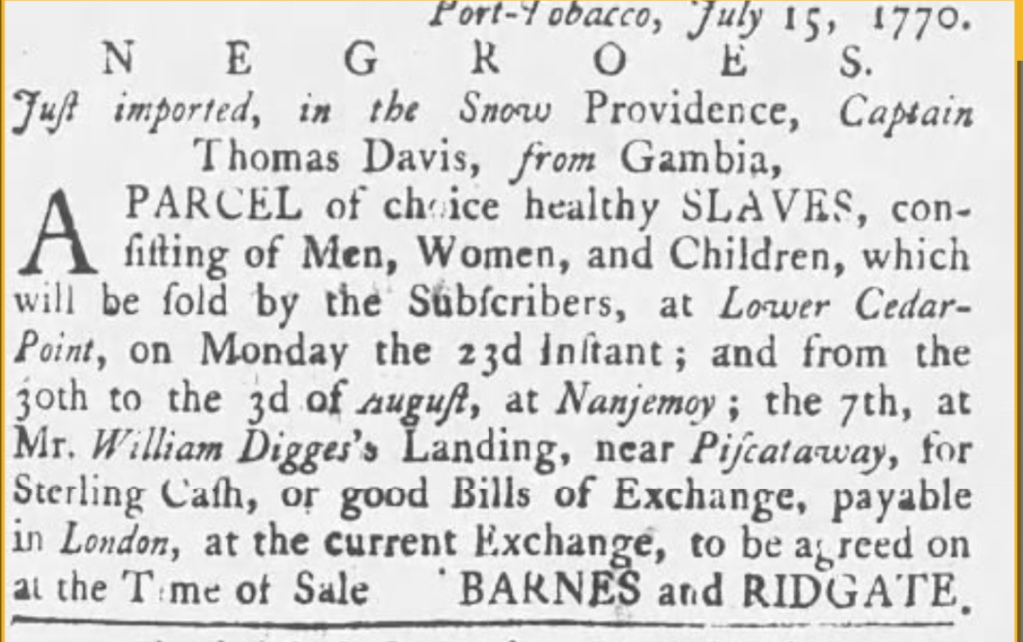
It seems possible that after her April 1847 escape across the Potomac, Jemima was sold by Richard Reid to Samuel Whitall of Georgetown. If so, the two sons she subsequently bore, James and Stephen, would have been the property of Samuel Whitall and then passed to his widow Lydia. (However, I have not seen a record of of any such sale).
Since Stephen and James were enslaved as of 1858, and since slavery followed the state of the mother, their mother Jemima (Mina or Minnie) Bennett must have herself been enslaved at least up until 1852, when her younger son James was born.
As of this writing I am unsure if Jemima was previously freed by Lydia N Whitall, or attained freedom in some other fashion. The 1850 slave schedule for Captain Samuel Whitall in Georgetown records six slaves, including a 19 year old female, born around 1831, who seems likely to have been Jemima. The youngest male in the household is 16, so Stephen either had not been yet born in 1850 or was being held elsewhere. (It may be significant that one free man of color, R.F. Beall, is listed as farm hand in the 1850 census in the Whitall household.)
Captain Samuel Whitall (b, 15 May 1775) died on May 14, 1855 in Georgetown. His will designates his wife Lydia as his principal heir, but makes no reference to any slaves. I have not yet located his estate’s probate records, which might contain an inventory naming the specific bondspeople in his estate.
Bellevue, the property within which Lydia Whitall and her slaves resided, had earlier been owned by Joseph Nourse, registrar of the Treasury (( have written on enslaved people in the Nourse family, including the Brooks family). Captain Samuel Whitall for some time rented Belle Vue, before it was purchased by his son and then passed on to Captain Whitall’s daughter Sarah Whitall, who married the banker Charles Edwin Rittenhouse on September 10, 1841. Neither the Rittenhouse nor Lydia N Whitall are listed as slaveowners in 1860.
Grace (Gracy) Duckett
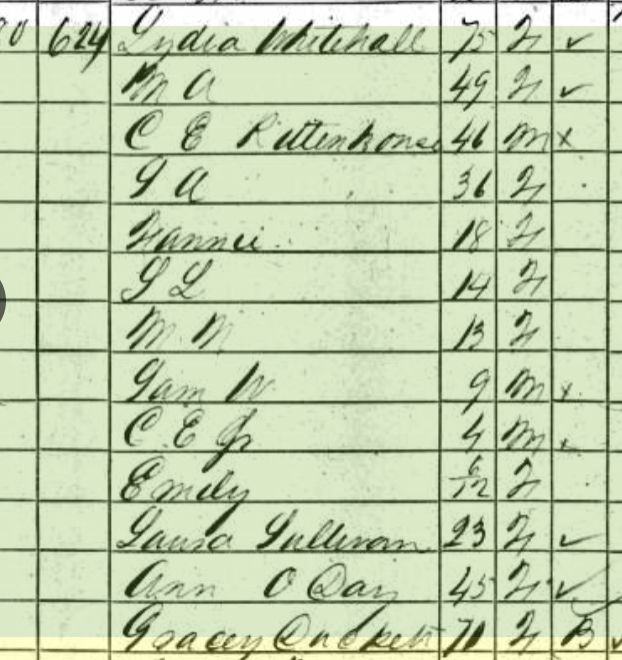
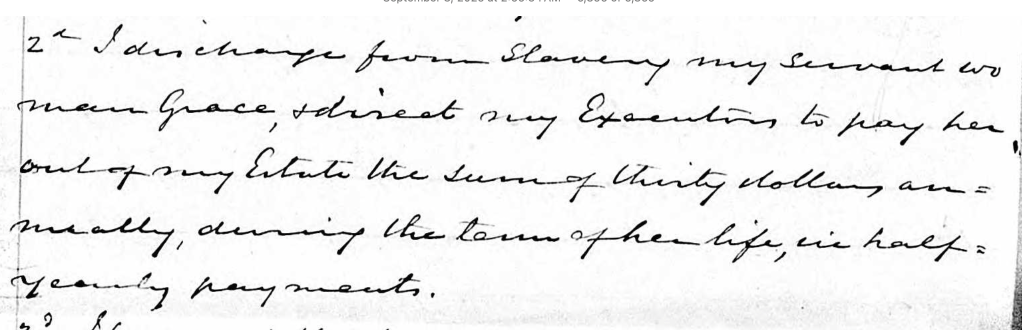
Four years after manumitting the boys Stephen and James Bennett, Lydia Whitall died in Georgetown, on April 2, 1862 (two weeks before all enslaved people in the District of Columbia were emancipated.). Her will stipulates that her enslaved woman “Grace” was to be freed, and paid an annual sum of thirty dollars. This was clearly the same person as the woman “Gracy Duckett” listed two years earlier as a free woman of color, age 71, in the 1860 census, living as a servant within the Whitall-Rittenhouse household. Grace’s status in 1860 thus appears to have been somewhat ambiguous; she appeared as free to the census enumerator yet still was legally enslaved.
By 1864, “Mrs Gracy Ducket, colored,” is listed in the Georgetown Directory, living at 31 West Street, which I believe is now the present 2620 P Street, the home of her daughter Julia Ann Duckett Cartwright, wife of Lewis Cartwright (Julia and Lewis had married May 19, 1841). This was close by the home of the white banker Charles Edwin Rittenhouse, at Montgomery and Stoddart, that is to say present day 27th-28th and Q, the modern Dumbarton House location, where Grace, the Bennett children, and perhaps Jemima had previously been enslaved. Gracie Duckett may have been married to Augustus Duckett (c. 1800-1879), who appears in Georgetown as a free man of color from at least 1840 onward, but I am not entirely clear on this.
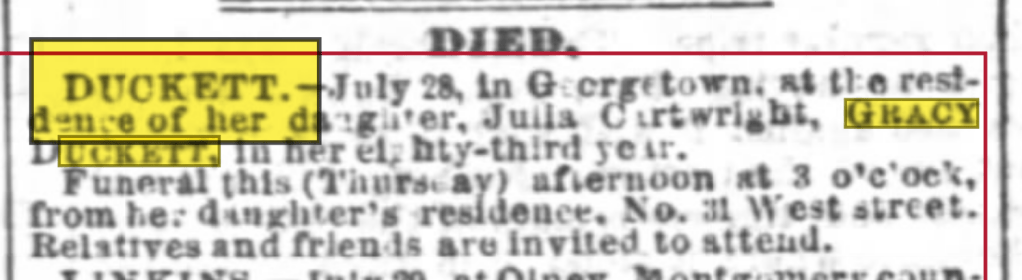
Gracie Ducket died in 1874 and was buried in the Female Union Band Society cemetery, adjacent to her daughter and son in law’s home. Her headstone, still extant. reads, “In memory of Gracy Duckett the mother of Julia Cartwright, died July 28, 1874 Aged 83 years.”
What might Gracie Duckett’s relationship have been to Jemima Bennett and her sons Stephen and James? Might they have been kin of some sort?
What became of the Bennett’s?
After the 1858 manumission record, I can see no trace of Jemima Bennett’s son Stephen Bennett. Stephen’s brother James Bennett, who as noted above is in the 1860 census residing with his mother in the Sutherland household, might appear in the 1870 city directory as “James E Bennett”, waiter, colored, residing at 217 Seventh Street (A Black James Bennett however, does not appear in the 1870 census) Charles Edwin Rittenhouse and his wife Sarah Whitall Ritenhouse are listed in the 1870 census without any live-in Black servants.
James and Stephen’s mother Jemima Bennett might appear in the 1864 Georgetown city directory as “Mrs Jemima Thomas, colored,” residing at Stoddert near Mill, (27th and Q street) , that is to say a block away from Rittenhouse Place (the former Belle Vue). The 1870 census in Georgetown records a “Jemima Thomas,” born 1830 in Maryland, who seems to be living at Rock near Gay, that is to say near the present day 27th and N streets, several blocks south of Rittenhouse Place. She might also appear in the 1875 DC City Directory as “Jemima Burrs” servant, living at 1143 23rd street NW, and in the 1880 census as the married woman “Jermima Burrows,” a 50 year old Black servant residing at 615 Seventh Street in downtown DC, born in Virginia in 1830, living in the household of the white man, the Tennessee-born Sumner S Kirk (1854-1884), an attorney a “dealer in patent rights,” who died four years later. I have not found a further trace of Jemima in District records.
I would be grateful for any suggestions in tracing Jemima Bennett and her sons Stephen and James.
Other Black Bennett’s in the District of Columbia
Note: The 1850 census records one free Black couple with the surname Bennett in the District of Columbia: Eli Bennett, born 1826, a cartman, and his wife Catherine, in Washington Ward 4.
The 1860 census records a free Black woman, Hannah Bennett, born 1810 in Virginia, with her evident children Eliza Bennett, b 1839 in Kentucky, George Bennett, b. 1852 in D.C. and Joseph Bennett, born 1853 in DC. Hannah appears in the 1862 and 1864 DC city directory, as the widow of Henry Bennett, residing at M street and 23rd streets. In the 1870 census she is listed as “laundress,” still residing with her son Joseph Bennett, in the household headed by Charles Hall, a mulatto plasterer. Joseph Bennett died, unmarried, July 25, 1875 and was buried in Mount Zion Cemetery. At the time ofhis death he resided on Potomac near Chain Bridge, and was a member of Mount Zion Methodist Church (Mt Zion Cemetery Information System).
On May 6, 1862, Louisa Kearney of 108 Prospect Street, Georgetown, filed for compensated emancipation for her two slaves, Agnes Bennett and her daughter Anne Bennett, noting her late husband [Lt Colonel James Kearney] had acquired Agnes from Richard Mason in 1843 or 1844. (This most likely was the prominent physician, planter and enslaver Dr. Richard Chichester Mason of Alexandria, Virginia) Lt General James Kearney, retired from the US Army Corps of Topographical Engineers, 10 had died four months earlier in Georgetown
Louisa Kearney’s 1862 petition states, “Agnes Bennett was of the age of Twenty Two, and of the personal description following: A dark mulatto woman, about Five feet in height, two front teeth ou; said Anne Bennett, was of the age of Five years, A bright mulatto child about Four feet high… the woman Agnes Bennett, has been in my family for the past sixteen years, she is a faithful servant I have always found her honest and correct; said Anne Bennett, is a smart child to whom the family is very much attached.”
This is the Martin Luther King Jr Day address I delivered at Congregation B’nai Israel in Nothampton, MA on Sunday, January 14, 2024
Delivered at the Congregation B’nai Israel (Northampton,MA) Martin Luther King, Jr. Day Observances
Good morning. I am grateful to join with all of you, and would like to thank my colleague at Mount Holyoke, Joshua Roth, for arranging the invitation to speak with you at the CBI Cafe. I’d also like to acknowledge the presence of my wife, Ellen Schattschneider, who teaches at Brandeis, and who has travelled with me on the journey I am about to share with you.
Mourning and Solidarity
This weekend, we gather across the nation to celebrate what should have been Dr. Martin Luther King, Jr.’s 95th birthday, and reflect on the stony road we’ve travelled in the 56 years since Dr King’s assassination in Memphis. This is an appropriate moment to consider the possibilities and challenges of what might be called “mourning across borders.” In what respects do acts of memorialization powerfully bind us together, across profound differences of faith, history, politics, or race? When, in turn, does it prove enormously difficult to interpolate ourselves into other people’s positions of grief, especially at times when we are so deeply engaged with our own senses of pain and loss that universal mourning seems impossible to imagine? When is mourning across borders feasible, and when is it nearly inconceivable?
I think it fair to say that for all of us gathered here today, these questions have weighed on us heavily during the one hundred days since October 7, 2023 [1]. Progressive Jews have a long shared history of coming to the table, we might say, in acts of shared mourning, seeing reflected in other communities’ tragic experiences of loss a somber mirror of our histories of pain and violation.
Consider one of the most iconic moments in the Black-Jewish alliance, when Dr. King locked arms with Rabbi Abraham Joshua Heschel, Rabbi Maurice Davis, and other Jewish faith leaders, with Black and White Christian clergy, and with John Lewis and many others, in walking together across the Edmund Pettus Bridge in Selma, Alabama, on March 21, 1965, two weeks after the horrors of Bloody Sunday. As is well known, a thousand African American freedom marchers wore yarmulke or kippah, known that day as “freedom caps,” in solidarity with their Jewish allies. At that moment, everyone understood themselves to be participating in a shared act of transcendent collective mourning, honoring the memory of many others across racial divides, among them: murdered civil rights activist Jimmie Lee Jackson, beaten at a demonstration in Marion, Alabama; Unitarian minister James Reeb from Massachusetts, killed by racists a few days earlier in Selma; the three dead of Freedom Summer in June 1964 in Philadelphia, Mississippi—James Chaney, a Black activist from Meridian, Mississippi, and Andrew Goodman and Michael Schwerner, both Jewish activists from New York City. Also present in many people’s minds were the memories of the Jewish lynch victim, Leo Frank; the innumerable Black men and women struck down in racist mass violence since the end of Reconstruction; and, the six million of the Holocaust. This shared penumbra of mourning for all victims of injustice was the emotional and spiritual foundation of the entire Civil Rights movement. That sense of common purpose, driven by shared grief, was key to the passage soon afterwards of the Voting Rights Act and the other major accomplishments of the era.
October 7 and Beyond
How distant those days seem today, in the shadow of October 7, 2023 and its tragic aftermaths. Many of our Jewish students at Mount Holyoke have shared their complex experiences of anguished ambivalence. How can they publicly grieve for the 1,200 Jews and foreign residents of Israel murdered by Hamas and Islamic Jihad on that day, when many of their fellow students tell them that such mourning pales into insignificance compared to the mass death and suffering of civilians in Gaza in the past three months? The challenge is perhaps especially great for those Jewish students who identify themselves with progressive and social justice causes, yet sense, they may no longer have a home in their familiar circles, when so many fellow students and faculty are failing, as they see it, to denounce anti-semitism in its multitudinous forms? At such moments of agony and fear, how can we find a path back to the shared terrain of common mourning, that at previous moments of crisis was the starting point for the recognition of our shared humanity?
I don’t have easy answers to these enormously difficult and urgent questions. Still, I thought it might be helpful to share how, at other challenging moments, my students and I, in partnership with community members, have found ways to pursue shared acts of mourning, as we have tried to build on the ideal of the Beloved Community, to which Dr. King dedicated his life.
Encounter in a Cemetery
In Fall 2001, I was teaching at Oxford College of Emory University, the original campus of Emory, which had been built, significantly, by enslaved labor from the late 1830s onwards. In the wake of 9-11, we were especially eager to find a shared project that could bring together our Jewish, Christian, Muslim, and non-sectarian students, across the inevitable gulfs of fear and distrust that followed the terrorist attacks. We found ourselves engaging with the local African American community, the descendants of those persons, five generations back, who had constructed the campus while in bondage, and then continued in freedom, to work at the college, under Jim Crow, fully knowing their own children were prohibited from attending the institution.
The local Black community was in particular pain since the city’s historic Black cemetery, which dated back to slavery times, was largely inaccessible due to decades of neglect by the city government. This was due in a curious way to the passage of the Civil Rights Act in 1964; as an “end run” around the public accommodations provision of the Act, the city cemetery had been largely privatized. Public funds were directed through a private Foundation to the upkeep of the white half of the cemetery, where early Emory College presidents, faculty, and white Methodist worthies were interred, but no funding was directed towards the Black half of the burial ground.
So my students came up with the idea of a joint project to restore the cemetery, cutting back privet, re-erecting fallen headstones, and restoring long-covered pathways. They met with the town’s historic Black Methodist and Baptist congregations and we began work together on weekends, in a year long project. My wife Ellen, teaching on the Emory main campus in Atlanta brought along her students who planted a memorial garden, which the city eventually named “Ellen’s Garden.” The students then collaboratively curated an exhibition on the multiracial history of the cemetery, working with descendants of the enslaved and of enslavers. Newspaper coverage followed, and the City of Oxford was eventually prodded into renegotiating the funding stream for the cemetery, providing perpetual care for all graves, Black and white.
As my students later wrote, the most important learning lesson of the entire project came about entirely unexpectedly. On the first workday in the cemetery, we were approached by an elderly white man whom I will call “Rob.” He was, I must admit, a feared figure for many of my students and our Black neighbors. He was known, ever since he came back from Vietnam, to have been deeply embittered; he would fly a Confederate flag sometimes from his porch, and walk up and down the town streets with his two large Dobermans, as Black grandmothers with trepidation sheltered their grandchildren within.
That morning he parked his pick-up truck in the cemetery and strode towards us, and cast a displeased look at 40 students and a couple of faculty members, trying without much success to cut down fallen branches. I glanced nervously at my collaborator JP Godfrey, the lay leader at Rust Chapel United Methodist Church and the leading Black member of the City council. We cautiously went forward to greet Rob. “Looks like you folks really don’t know what you’re doing,” he said after a long silence. “That’s true, Sir,” I said, “We sure are new to this kind of work. We’d welcome any guidance you could give, us.” He thought for a moment and then said, “Well, I tell you, never did sit right with me, the way the city treats these…graves. Those folks deserve the same resting places as anyone else.”
He then left in his truck and came back a half hour later, with two nephews and six chainsaws. They set to work instructing my students on how to clear privet and fallen branches. For the next six months he worked harder than anyone else at clearing the graveyard. One day, regarding him working in the hot sun with several of my students, Annette, an African American matriarch, approvingly quoted an old Black Georgia proverb, “Sweat-producing labor is soul-cleansing labor.”
When Rob was diagnosed with pancreatic cancer that spring, those same Black matriarchs who had been fearful of him sent those same grandchildren to walk his dogs. Covered dishes appeared on his porch at sunset. When he died a year later, his final wish was to be buried in the Oxford African American cemetery to which he had devoted the final stretch of his life. His interracial funeral was sometimes said to be the best attended white person’s funeral in the history of Oxford, Georgia.
So this was a lesson that many of my students said they would never forget. They were inclined, as progressive social justice-oriented students, to regard Rob as irredeemable. A white, flag-waving Confederate, driving an old pick-up truck. Yet the work of common mourning, along with “sweat-producing labor” in the cemetery, opened up a window that, allowed, unexpectedly, everyone’s better angels to step forth. Here, under the hot sun, we were able to meet one another, and grasp our shared humanity, precisely through the mystery of mourning across borders.
Teaching through Partnerships
Over the subsequent two decades, my teaching and work as a museum director and curator has often centered on comparable projects of shared grieving that have occasioned joint celebrations of life, transcending diverse divides. In Ellensburg .Washington, my students and I worked with Yakama and other Native American community partners to honor the memory of indigenous ancestors, who had loved and tended to local lands, which had been forcibly alienated from them. We collaboratively designed an indigenous garden on campus, work that my students at Mount Holyoke have emulated. The students and their Native partners have been interested in extending the work of common memorialization beyond the human realm, to aid in the restoration of salmon runs in local rivers and the return of indigenous tubers to proximate marshlands. Here in the Connecticut River Valley, our students, Joshua, and I have been working on developing an exhibition on the history of enslavement in South Hadley, which will involve, we hope, productive dialogue between the descendants of enslaving and enslaved families in the area and lead, in time, to markers honoring enslaved ancestors.
More recently, my students and I have been pursuing other acts of mourning across borders. Last year in my seminar on museums, a group of students became deeply engaged in ongoing memorialization efforts around a brutal mass lynching in 1878, in Mount Vernon, Indiana. Seven Black men were killed over the course of two days, in violent white response to efforts to register Black voters and desegregate the local high school. I had become involved in these efforts through my distant cousin, Ben Uchitelle, whose great grandfather had been a leading Jewish merchant in town during the time of the lynching. Ben partnered with a committee led by one of the few Black young women remaining in the County, Sophie Kloppenburg, who was leading the efforts to erect a memorial on the courthouse square to the murdered men. The committee had not yet had a chance to locate the descendants the lynching victims and asked me and my students to help out.
After months of work, we were able to locate descendants, among them the remarkable African American poet Andre Wilson in the San Francisco Bay area, three of whose ancestors had been killed by white lynchers in 1878. Andre had always heard growing up that one of his ancestors had been burned alive in a railroad car by Klansmen. This aligned, my students and I realized, with an account we’d read that one of the victims had, horrifically, been thrown alive by the white mob into the fire box of a locomotive. Inspired by conversation with Andre and other descendants, the students campaigned successfully for Emory University to recontextualize a photograph of the 1878 lynching, displayed on the library website. The library website now properly identifies by name every one of the Dead.
Partnering with Andre Wilson: “Here in this Train Car“
It has been joyous to develop a friendship with Andre, who is deeply committed to Black-Jewish solidarities. Among other things, his uncle Admiral George Dawson, an African American communist plumber in Los Angeles, fell in love with and married Dawn Chava Goldstein, a woman who had survived Auschwitz. (Dawn was warmly welcomed into Admiral’s extended Black family, although sadly she was ostracized for life by her Jewish family, who couldn’t cope with her marrying a Black man).
Andre and I are now writing together about shared processes of mourning, that revolve around two deadly train cars. My great grandparents, Isaac and Clara Auslander, were deported from Radautz, Bukovina, in northern Romania, in mid October 1941, during Sukkoth, along with their 11 year old grandson Severin Pagis and 1,500 other Jewish residents. They were deported on trains to Transnistria, set up by the fascist regime in collaboration with the Nazi as a site of final solution for Romanian Jews. Many died on the death train, in the camps, and by the guns of the Einsatzgruppen in southern Ukraine.
Severin, who later took on the name Dan Pagis, after the war became one of Israel’s leading poets and literary scholars. He never spoke of what befell him or the family with that sealed cattle train. The only trace is his most famous poem, which many of you may know,
Lines written in pencil in the sealed cattle car
here in this carload
i am eve
with abel my son
if you see my other son
cain son of man
tell him that i
The poem ends abruptly in silence. It can either be read as the inauguration of a timeless, eternal night, or as a circle, “Tell him that I am …Eve, here in this carload…” and so on, forever.
Significantly, Pagis refuses to situate his narrative in a specific moment or place, and only locates the narrator in the mythic spacetime of Genesis, where we encounter the distant tracings of Eve, the Mother of us all. The phrasing in Hebrew of the line “Cain son of man,” is “ben-Adam,” which means not only Adam, but son of man, Everyman, for we are all Adam’s children. Here is a story of universal tragedy, in which we all mourn, in common. As readers, mercifully, we are not literally confined within a sealed railway car. And yet we find the predicament in the poem uncannily familiar—-for we are all, at the end of the day, metaphorically bound together in a cyclical story of Brother raising his hand against Brother, tied for eternity together, “here in this train car”.
Andre and I find this poem enormously salient to our shared endeavor of interfaith and interracial solidarity, of navigating a course of common grieving for all victims of injustice and intolerance. The two train cars on our minds, in 1878 in Indiana and 1941 in Bukovina, bind not only Blacks and Jews, but everyone community worldwide, in the aftershocks of terror and tragedy. We are consigned forever, it seems to ride together in these death trains, to witness again and again, the worst of what humanity is capable of, while also beholding the best of our human efforts, to create poetry and art, to strike a light of terrible beauty in the darkness.
Cousin Dan Pagis, a co-founder of Peace Now and scholar at Hebrew University died in June 1986. His grandson Amir now is serving in the IDF, along with so many thousands of others. I cannot imagine what Dan would have made of the horrors of October 7, which were simultaneously unthinkable and all too familiar for him and those who lived through the killing fields of the Shoah. Nor can I know what might have befallen the many interfaith friendships he was so committed to amidst the terrors unfolding in Gaza. I do know that for his first cousin, my father Joe Auslander, born the same year, 1930, as Dan, the last three months have been unbearably agonizing, witnessing monstrous suffering on both sides of the border and contemplating a global rise in anti-semitic rhetoric. Dad has supported calls for a ceasefire, and yet wonders at times, how can we pursue the work of Tikkun Olam, of making the world whole, when so many we had taken to be close allies cannot bring themselves to condemn publicly anti-semitism, or even speak out against the Hamas assaults of October 7?
Learning from Hisham Awartani and his Family
Since November 26, my father, Ellen, and I have found great inspiration in the story of Hisham Awartani, whom as many of you know, was one of three young college students of Palestinian descent shot in a hate crime in, of all places, Burlington, Vermont. (Also shot were Kinnan Abdalhamid, who attends Haverford College near Philadelphia, Pennsylvania; and Tahseen Ahmed, who attends Connecticut’s Trinity College). Hisham remains paralyzed below the chest, a bullet lodged in his spine. His mind remains as brilliant as ever, and he hopes to return next month to classes at Brown University, in a wheelchair, to continue his advanced studies in mathematics and ancient Near Eastern archaeology.
My Dad is a pure mathematician and his colleague Mary Gray (American University) has taught members of the Awartani family, a family known for their mathematical accomplishments. We were thus able to reach out to the Awartani’s, and in turn have been able to mobilize mathematicians and archaeologists to support Hisham and his family. Ellen and I have regularly visited Hisham during his neurological rehabilitation in Boston. My students at Mount Holyoke feel a particular connection to Hisham, and have been writing to him; a banner card from them, in many languages, hangs prominently in his hospital room. My students have been especially moved by Hisham’s and his family’s insistence that excessive attention should not be given to him and his suffering, but rather his story should alert us to the stories of innumerable other “Hishams” and their families, whose collective suffering in these past months has been beyond all measure.
On his first weekend in the rehab hospital Hisham was visited by the Brown University chaplain, Rabbi Jason Klein. Hisham turned to him, and asked, “Rebbe, would you please bless me in Hebrew?’[Jason notes Hisham is the only Brown student who addresses him as “rebbe”!] It was a beautiful moment, and I have been thinking of all those, many thousands, who have died since October 7, for whom blessings are being said, or left unsaid, on both sides of the Israel-Gaza border, Is there any way we can find in our hearts to follow Hisham’s example, to accept and honor blessings across the great chasms of pain, fear and loss that we all feel at this moment? I fear that at this moment each of us are confined within the private railway cars of our individual agonies, where all the children of Abraham, Brother against Brother, raise their hands against one another, again and again. Might we return from those sealed cattle cars to that Bridge in Selma, led by Dr. King in 1965, where we can once again march, hand in hand, arm in arm, reaching across all faiths, in the common quest for compassion, justice, and righteousness? Can we once again imagine a world in which the yarmulke might again be a Freedom Cap, a shared tabernacle for all of the Lord’s children, in which shared mourning for those lost in the Struggle helps gives us a shared glimpse of a Better place?
The Great Work Ahead
There is nothing easy about any of this. To begin with, we must draw a conceptual distinction between grief and mourning. Grieving in its early, initial stages is impossibly piercing, inconsolable, suffocating, Grief knows no time, only pain that seems beyond all balm, beyond any concievable endpoint. (Here I am an indebted to the insights of my wife Ellen Schattschneider who is psychoanatically trained and writes extensively about mourning and memory work). Only with the passage of time, and only with care and grace, do we learn to live with grief. That gradual, halting process of re-embracing life, without ever fully erasing the pain of loss, is what we term “mourning. “ When early grief is conjoined with fear, steps toward mourning in their deepest sense seem almost inconceivable, so immediate and primal is the terrifying, raging chokehold of anxious grief. Joshua, Ellen, and I and our many colleagues near and far agree that there has never been a time as challenging as this to teach on college and university campuses. Everywhere we find our students caught in grief, fear, rage. We encounter layers upon layers of pain, all parties navigating the open wounds of mutual betrayal, all of us plagued by the inability to listen charitably to one another. Pleas for shared mourning clearly strike many as impossibly naive in contexts when our respective communities believe themselves fighting for their very survival against daunting odds. When all are convinced they may face potential annihiliation, how can any of us find the space even for fully mourning our own, to say nothing of mourning across borders?
And yet, for those committed to principles of Tikkun Olam and the visions of the Beloved Community, there is no work more important, precisely because it is the hardest thing imaginable. This will surely be sweat-producing labor that, will, we pray, in time be soul-cleansing labor, even if it takes many years (perhaps generations) to accomplish. We must together struggle, together, in Dr. King’s footsteps, to go to the Mountaintop and gaze upon the Promised Land. That great work depends on recalling together those who won’t get there with us in a physical sense, even as we seek to allow them to travel with us in spirit. The is perhaps the greatest gift of mourning, to allow us to detach ourselves from our beloved Dead in a physical sense while allowing the Dead in more complex ways still to travel with us.
The transformation of grief into mourning depends, ultimately, on Love, which for Dr. King was the at the heart of all truely transformative social action. As he wrote in the Letter from a Birmingham Jail,
“Unenforceable obligations are beyond the reach of the laws of society. They concern inner attitudes, genuine person-to-person relations, and expressions of compassion which law books cannot regulate and jails cannot rectify. Such obligations are met by one’s commitment to an inner law, written on the heart.”
The moral compass of social action, ultimately, must be anchored in this inner law, which is simultaneously collective and personal, political and spiritual, engaged in public responsibility while “written on the heart.” As we honor the Lost on all sides, and find a way to listen to the variegated voices of the Dead, may we strive together to fulfill the promise of shared Life and common Love, in their deepest senses, for ourselves and our intertwined posterities.
Thank you.
________________________________
ACKNOWLEDGEMENTS: I am grateful for comments on an early draft of this essay from: Jay Ball, Amila Buturovic, Laurie Kain Hart, Elizabeth Price, Heidi Ravven, Jordan Sand, Ellen Schattschneider, and Rev. Avis Williams.
NOTE 1: I acknowledge that for Palestinians and their allies, an exclusive focus on the events of October 7 is often viewed as problematic, in part because the salient history of Palestinian suffering dates back at least to the 1948 Nakba if not earlier. The enormous suffering and loss of life in Gaza since October 7 also weighs heavily on all these discussions. In turn, many Jewish interlocutors emphasize that October 7 saw the greatest loss of life in a single day by Jews since the Holocaust, and that the long history of Jewish suffering in Europe and across North Africa and the Middle East must also be brought to the table. A necessary precondition for any project of shared mourning across borders is frank and open discussion of these long, partially intertwined histories of suffering, oppression, and injustice.
SUPPORTING HISHAM: To support Hisham Awartani in his long recovery, readers may wish to contribute to the GoFundMe site set up to assist with his medical and rehabilitation costs: https://www.gofundme.com/f/support-for-hishams-recovery
Melanie Klein, “Mourning and Its Relation to Manic-Depressive States,” The International Journal of Psychoanalysis 21 (1940): 125–153. To download PDF:
The current traveling exhibition, African Modernism in America, 1947-67, now at the Philips Collection, Washington DC, features a first rate painting by the Ugandan artist Manyolo Betty Estelle (1938-1999) titled “Cattle People” (1961) on loan from the Fisk University Galleries. The scene is of a young couple, either courting or newly married, of the Bahima, an Ankole people of Uganda. A young woman, perhaps pregnant, stands to the left of a resting herd of Ankole cattle, with magnificent curving horns; to the herd’s right stands a young man, with a long staff of the sort that would be used in herding. The man is in profile, and the woman is seen frontally, her head turned towards the man; the couple gaze at one another, and the cattle’s eyes are, like the woman’s turned, towards the man.
Manyolo Estella Betty. Cattle People, 1861 (Fisk University Galleries)
The figures are set in a verdant Ugandan landscape, framed below a green canopy of tree foliage. The composition is divided into a kind of triptych. A tree trunk rises from the left of the woman, and another tree in the center of the canvas is just above the cattle, its curving branches echoing the curving shape of the central bovine’s horns. Another branch is glimpsed to the right of the young man. His herding pole, taller than he is, functions as a kind of trunk itself. linking the ground and the canopy. A green pathway is visible below the herd, linking the man and woman. And just above the herd, green hills are visible in the background. The net effect is evidently to emphasize the intimate integration of cattle, persons, trees, and landscape in the Bahima cosmos/
Two head of cattle are in particular prominence: this configuration may be consistent with the opening Bridewealth prestation among the BaHima people. as described in Roscoe (1907), an early ethological account of the Bahima: “ When betrothed couples are old enough to marry, the youth takes a milch cow [a cow giving milk] and a heifer [a female cow that has not bore a calf yet] to the girl’s parents; this gift ratifies the engagement, though he is not allowed to see his future bride.” Alternately, the group of cattle may evoke the traditional ten cows, according to Roscoe and Eilham 1973 that were given as bridewealth, legitimating the marriage. If the woman is in fact pregnant, the implication may be that the coming child will be properly, by virtue of the bridewealth transaction, integrated into the lineage of the groom’s people.
The green pathway connecting the female and male figures, underneath the resting herd, seems likely to emphasize that the cattle bridewealth herd has help create an enduring path or bond of vitality and life-giving potential, binding the couple and their respective lineages.
Among the diverse cattle-keeping people of eastern and southern Africa, cattle are a repository of life-giving sacrality, imbued with ancestral energies and considered essential for the reproduction of Life in its deepest sense (see especially Evans-Pritchard 1940; Lienhardt 1961, Comaroff and Comaroff 1990). Both female cows and human females experience nine months of gestation, and for this and many other reasons, bridewealth cattle are deemed the most appropriate replacement for the loss by the bride’s people of the future fruits of her womb. Through cattle, the inevitable tensions between affines are modulated and recalibrated; multiple kin on the groom’s side often contribute to the bridewealth herd and the received cattle, in turn, are distributed through the bride’s people’s larger kinship network In this way, the two extended families’ shared investment in the future of the marriage is made visible to all, as a kind of tangible promissory note for the eventual future children of the union, who will continue to bind together their disparate in-laws into an intimately integrated social field. The possible pregnancy of the female figure may hint at this theme of future blessings, enabled through the life-giving potentialities of cattle.
It is intriguing that Manyolo has chosen to show the woman’s gaze and that of the resting cattle all facing to the right of the image, towards the standing young man. This might at first seem puzzling, since bridewealth cattle will leave the groom and his father’s people, and head towards the bride’s father and his people. Yet perhaps the evocation here is on a certain exchange of energy flows and the overall gendered framing of Hima society . The in-marrying bride will, as in so many patrilineal, patrilocal societies, leave her father’s household and move to the groom’s household; the groom and his lineage are the center of social action in the marriage process, and this centrality is made visible in the painting, arguably, through the upright herding pole. The young woman on the left (the ‘distaff’ side) and the cattle herd in this sense are all ultimately oriented towards the male figure, the Axis Mundi of this social drama, and thus they all turn their gaze towards him. There is, to be sure, a touching romantic poignancy to this exploration of courtship, but at the end of the day, one might surmise, the weight of patriarchy still organizes the composition of the painting, as it does the structures of Bahima social life.
Addendum: I’ve just read a brilliant essay by anthropologist Anselm Kizza-Besigye (2019). who is of Bahima background. He notes that his Muhima grandmother’s mother Zelda, in defiance of colonial and postcolonial state regulation, continued to graze her own cattle herd independently and nomadically into the 1990s, residing beside them . So perhaps I have misread the painting and Manyolo is depicting not bridewealth cattle as such, but rather the standing woman’s own herd, which is not in fact fully encompassed within male sovereignty.
References
Anselm Kizza-Besigye, The Bahima. June 13, 2019, posted on DocDroid
John and Jean Comaroff. Goodly Beasts and Beastly Goods. Cattle and Commodities in a South African Context. American Ethnologist, May 1990. pp 195-216
E.E. Evans-Pritchard, The Nuer. 1940
Itzhak Eilam. The Social and Sexual Roles of Hima Women: A Study of Nomadic Cattle Breeders in Nyabushozi County, Ankole, Uganda. Manchester University Press, 1973.
Godfrey Lienhardt Divinity and Experience : The Religion of the Dinka: Oxford University Press,1961.
REV. J. Rosco. The Bahima: a Cow Tribe of Entkole. Journal of the Royal Anthropological Institute. Vol. 37 (Jan. – Jun., 1907), pp. 93-11
Recently, Cate Atkinson, community historian with Historic Chevy Chase DC, explained that the house in which I grew up between the years 1965-1979, at 5807 Chevy Chase Parkway, NW, Washington DC, may well have been located on the site of an old burial ground, in which the remains of enslaved peop8le associated with the Belt plantation may been interred. I have recently written on the slavery-related history of this neighborhood, but it had not occurred to me that my family might have actually resided on or adjacent to an old slave cemetery. Given that much of my research and writing, including my 2011 book The Accidental Slaveowner, has revolved around enslaved burial grounds, this news has been particularly startling and fascinating.
Small triangular park at base of Oliver Street at Chevy Chase Parkway, likely part of the location of old Belt Plantation cemetery, “God’s Acre”. Our childhood home, 5807 Chevy Chase Parkway is the white house in the center behind the park (Google Street View)
As I have noted, the manor house of the Chevy Chase plantation, established by Col Joseph Belt around 1725, is generally reckoned to have been half a block northwest of 5807, at the site that is now 3734 Oliver Street, about 500 yards southeast of Chevy Chase Circle.
Plaque to Col, Joseph Belt, at the intersection of Western Avenue and Chevy Chase Circle
Several doors away, Dr. Egbert Clark built a house at 3749 Oliver in 1908. Egbert Kent Clark, son of Dr. Egbert Clark, recalls that when sledding down the hill of Oliver Street as a child (evidently c. 1920) he would to veer sharply right to avoid headstones clustered at the base of the hill.
Belt Manor House, prior to 1907 (now the location of 3734 Oliver St, NW, Washington DC)
“This was the Belt family cemetery called “God’s Acre.” It covered the territory which now encompasses the intersection of Oliver and Chevy Chase Parkway, the triangular park adjacent to it and many of the surrounding houses and yards. E. [Egbert] Kent Clark, who, as we mentioned before, was a resident of Oliver Street in the early days of Chevy Chase wrote, “Just past where we lived on Oliver Street, the land dropped steeply. It was a good sledding hill, and one had to make a sharp right turn at the bottom of the hill. If you didn’t make a turn you had to dodge the tombstones in an old cemetery.” During the excavation for the houses at 5724 Chevy Chase Parkway and 3700 Oliver Street, both on the southwest corner of the intersection, around fourteen human skeletons were uncovered. The builders had them removed so that the construction crew, who had refused to work among the remains, would return and build the houses. All the remaining tombstones were removed by 1925 to make way for the streets and houses planned for the intersection. The graveyard had been in existence since before the revolution. It is believed that Colonel Belt himself was buried there in 1786. As generations of Belts lived and died, the cemetery grew. The last burials probably took place before 1885. As you stand at this Intersection, Keep in mind that although the developers of Chevy Chase removed all the tombstones and a few unexpected remains, the vast majority of those laid to rest in Chevy Chase are still there.” (Footseps: Historical Walking Tours of Chevy Case, Cleveland Park, Tenleytown, Friendship, Neighborhood Planning Councils 2 and 3, 1976. p. 32)
A related account elaborates, “The Belt graveyard covered a surprisingly large section of land just east of the manor house, between it and the Broad Branch [the creek currently covered by Nevada Avenue). Gravestones covered an area about as big as five or six medium sized residential lots until the mid twenties when they were removed….Around fourteen human skeletons were uncovered during the construction of the house at 5724 Chevy Chase Parkway, also in the twenties. The construction crew refused to work with the pelvises, skulls and other remains lying around the newly dug basement. So the builders picked them up and carted them away.”Origins 11, 1976, Neighborhood Planning Councils 2 and 3. https://chevychasehistory.pastperfectonline.com/archive/0FFF2109-353C-4950-AAD8-037001835730
1903 map. The later “Chevy Chase Parkway” identified as 37th street. Cemetery evidently at intersection of Oliver Street and 37th street. Baist’s real estate atlas of surveys of Washington, District of Columbia : Volume 3.Present day map of Chevy Chase DC, showing location of old Blelt Manor House: cemetery was at intersection of Chevy Chase Parkway and Oliver Street.
According to the 1920 census, there do not appear to be residences at 3700 Oliver or 3724 Chevy Chase Parkway, suggesting that the buildings were still under construction. By 1923, 3700 Oliver was occupied by Harold G and Frances Moulton. I am not sure of the original owners of 5724 Chevy Chase Parkway, adjacent to 3700 Oliver.
Egbert Kent Clark, Jr. (1907-1999) was born 31 Dec 1907 so his sledding memories presumably date to the late 1910s or perhaps early 1920s, prior to the 1925 final removal of the surviving headstones. I am not sure where the headstones were removed to, or if any of them have been preserved anywhere.
Cate reports that a neighbor, two doors away from the house I grew up in, recalls workers unearthed a skeleton when digging for a swimming pool.
Aerial view: 5897 Chevy Chase Parkway, showing triangular park, and the likely area of the previous Belt cemetery, at the intersection and Oliver and Chevy Chase Parkway
As indicated in the neighborhood history account quoted above,the small triangular park in front of our old house, at the base of Oliver Street, where my sister Bonnie and I often played, was a central site of the old Belt cemetery. It seems likely that the headstones for the white family members were in the foreground area, closer to what is now the base of Oliver Street, and that enslaved people might been buried further back, that is to say closer to what is now Patterson street. Patterson descends towards Nevada Avenue, which covers the old Broad Branch Creek, which evidently ran through the old Belt plantation property. Presumably, the final resting places of the enslaved were not marked with headstones.
I am not sure if it is significant, but when we moved into 5807 in the mid-1960s, there was a pathway that ran from the triangular park along the western edge of our house, adjoining the alley that intersected with Patterson. (My mother, uncomfortable with the constant foot traffic across our front lawn, and past our dining room and kitchen, had the front yard and the rear end of this path fenced off around 1970. ) Speculatively, might this pathway have described the western boundary of the old burial ground?
Who is buried in the old slave cemetery?
Which enslaved persons might have been interred in this burial ground?
The 1761 will of Colonel Joseph Belt, which indicates many names of his enslaved persons, indicates that an unnamed a group of slaves were to be divided between the four children of Colonel Belt’s late son Joseph Belt, Jr. , including Joseph Sprigg Belt, c. 1752-1819. Presumably, some of these enslaved people remained on the Joseph Sprigg Belt property in Chevy Chase, which in turn was inherited after 1819 by his son Charles Richard Belt. Some or all of these inherited enslaved individuals seem likely to have been laid to rest in the burial ground between 1761 and 1819, when Joseph Sprigg Belt died.
As of this writing I have not located Joseph Sprigg Belt’s 1819 probate records (in the District of Columbia or Montgomery County) , which might lists the name of other enslaved people he owned, who might have been interred in this burial ground between 1819 and 1862, when Charles Richard Belt freed seven enslaved people under the terms of Compensated Emancipation.
Hannah and the Bowie Family
We can be reasonably confident that one enslaved person buried in the Chevy Chase Belt cemetery was the enslaved woman Hannah, whom Charles Richard Belt in 1862 attested was the mother of Lethia Bowie (born around 1813) and Henry Augustus Bowie (born about 1821) He writes: “Lethea and Henry are brother and sister, the children of Hannah who belonged to the late Jos. Sprigg Belt, residing in said county and they were born his property. Lethea’s children were all born at the petitioner’s residence after the death of his Father [in 1819].” Since Lethia was evidently born around 1813, we might speculate that her mother Hannah was born around 1795. I am not sure why Lethia and Henry took the surname “Bowie”; perhaps Hannah used the surname Bowie herself or perhaps Bowie was the surname of the children’s father. As I noted in a previous posting, the Belt slaveowning family married multiple times into the Bowie family, so it possible that the “Bowie” named of the enslaved family is derived from the slaveowning Bowies, a prominent Maryland extended family. (One family tree on ancestry.com lists Joseph Sprigg Belt as the father of the enslaved children of Lethea and Henry, but no evidence has been provided in support of this assertion.)
The enslaved Bowie family may have had some relationship to the family of Ellen Ursula Bowie Belt, 1805-1861, the sister of law of Charles Richard Belt. She was the wife of Lt William Joseph Belt (the brother of Charles Richard Belt) and the daughter of John Burgess Bowie and Catherine Duckett Hall Bowie. She was also the mother of Samuel Sprigg Belt, 1845-1920. The 1870 and 1880 censuses record Samuel Sprigg Belt residing in the household of his uncle Charles Richard Belt. (The 1870 census incorrectly lists him as “Samuel Sprigg.”) By 1880, Samuel Sprigg Belt, who was by then married to Mary Wilson Belt, was listed as the head of household.
In any event, Charles Belt in his 1862 petition indicates that he purchased a full interest in Hannah and her children from his brother Lt. William Joseph Belt after the death of their father Joseph Sprigg Belt in 1819. Charles Belt’s compensation petition implies that Hannah was deceased by 1862. Presumably she was buried on the plantation, in the burial ground near where my sister and I grew up.
nb Lethea Bowie might be the same person as Alethae Bowie (servant), born around 1816 in Maryland, listed in DC interment records: died 26 October 1866 and buried in the Colored Methodist Cemetery (Georgetown, later known as Mount Zion.)
Other slaves of Charles Belt:
Charles Belt’s 1820 census indicates he owns the following eleven enslaved persons:
Slaves – Males – 14 thru 25
2
Slaves – Males – 26 thru 44
3
Slaves – Males – 45 and over
1
Slaves – Females – Under 14
4
Slaves – Females – 14 thru 25
1
1820 census, showing slaves owned by Charles Richard Belt
Presumably, the only adult female (age 14 to 25) was Hannah. One of the females under 14 may have been Lethea Bowie, who was freed in 1862 along with her children. The other nine persons do not seem to correspond to any of those listed in Charles Belt’s 1862 Compensated Emancipation petition, all of whom were born after around 1821. Those freed were Henry Augustus or Julius (later Bowie), born around 1821, and Lethea’s five children, as follows:
George Bowie, age 31, b. 1831 Andrew Bowie, age 17 born 1845 Hamilton Bowie, age 15, born 1847 Harriet Bowie age 19 born 1843
Eliza Bowie, age 13, born 1849
So it seems a reasonable inference that these nine either died, or were sold away, between 1820 and 1862. Some of these individuals may have been buried in the God’s Acre cemetery.
Note that the 1860 slave schedule, enumerated two years before Compensated Emancipation, lists Charles Richard Belt owning seven slaves, residing in one slave cabin:
Female, age 48 b. 1812
Female, age 40, b. 1820
Male, age 28, b 1832
Female, age 16, b. 1844
male, age 14, b, 1846
male, age 13, b, 1847
Female, age 10, b. 1850
The eldest female, age 48, must have been Lethea Bowie, but the 40 yeaar old female does not correspond to anyone listed in the 1862 petition, so perhaps she died or was sold away between 1860 and 1862. The other five individuals seem to correspond in ages with the five children of Lethea listed in the 1862 petition.
Eighteen years after DC emancipation, the 1880 census lists two black servants in the manor house of the old Belt plantation, by then the household of Samuel Sprigg Belt, in which Charles Richard Belt, then age 89, was still residing: William Gross, born about 1850 in Maryland, and the young women, Birtie Mason, born around 1864 in Virginia. It seems likely that William Gross, who seems to have grown up in Calvert County, District 2, Maryland, had a prior relationship with Samuel Sprigg Belt’s family, who form 1835 onwards were residing in Calvert County. MD. In 1870, the 20 year old William Gross resided about 50 households away from Ellen Ursula Bowie Belt, the mother of Samuel Sprigg Belt.
I hope at some point it will be possible to honor with markers or other signage, such as Witness Stones, the enslaved people who labored on the Belt plantation under conditions not of their own choosing, from c. 1726 to 1862, including those whose final resting places are in this old burial ground.
Addendum: Other Black Bowie Family Members?
I am not sure if Hannah, Leathea Bowie, or George Augustus Bowie might have been related to any of the following enslaved or free persons of color in the District of Columbia, with the surname Bowie:
the enslaved woman Millie Bowie, who on June 10, 1824 filed a petition for freedom, asserting that her owner William M. Offutt had several years earlier illicitly transported her from Virginia to Maryland.
Arnold Bowie, listed in the 1840 census as head of household, with four other free persons of color, in Washington City, District of Columbia. Arnold Bowie, born 1807, is also listed in the 1850 census in the District of Columbia, married to Mary A Bowie, b. 1811, with children James, A, Lewis, Juliana, Emily, Randall, Columbus, G.
Kitty Bowie, listed in the 1840 census as head of household, with five other free persons of color, in Washington City, District of Columbia.
Priscilla Bowie, listed in the 1840 census as head of household, with three other free persons of color, in Washington City, District of Columbia.
Richard Bowie, listed in the 1840 census as head of household, with two other free persons of color, in Washington City, District of Columbia, one an adult woman and the other a girl under ten years old. He may been the Richard Bowie who married Anne Thomas on 21 April 1838.
Four individuals, Henry Bowie and his three children, freed through compensated emancipation in 1862, as the property of Ignatius Fenwick Young, trustee of Mrs James (Anna) Brent, who had acquired these slaves through the will of her grandmother:
Henny Bowie, a mulatto woman aged about Fifty (50) years—Sound & healthy value $700 Rezin Bowie, a black boy the child of said Henny aged about Eighteen (18) years—Sound value $900.— Hank Bowie a boy copper colored the Child of said Henny aged about Fifteen (15) years healthy value $700. Mary Louisa Bowie, a bright mulatto girl and Child of said Henny aged about thirteen (13) years value 800.
I have recently been deeply moved, and rather startled, to realize that the street on which I grew up, Chevy Chase Parkway in Northwest Washington DC, was located on the grounds of a former a slavery-based plantation, evidently in operation from the 1720s, until perhaps as late as April 1862. I have been eager to identify the enslaved people who worked this land under conditions not of their own choosing, and to trace their descendants.
Colonel Joseph John Belt (c. 1680-1761) obtained the original patent to the 500 acre Chevy Chase tract (later expanded to 1000 acres) from Charles Calvert, 5th Lord Baltimore on July 10, 1725. The Chevy Chase property was located across what is now portions of Montgomery County, Maryland, and northwest Washington DC. He reportedly built the two and half story Chevy Chase Manor House around 1725 at what is now 3734 Oliver Street, Northwest, Washington DC, a half block from where I grew up, at 5807 Chevy Chase Parkway. The manor house was a few hundreds yards southeast of Chevy Chase Circle, within what is now the District of Columbia side of border. The house was evidently occupied by Belt descendants until 1907, when it was razed.
Map of present day Chevy Chase DC, showing 3734 Oliver St, NW (former location of Colonel Joseph Belt’s Chevy Chase Manor Chose)
Colonel Joseph Belt’s 1761 will provides substantial information on the distribution of his slaves. He names 28 slaves, and indicates that there were other slaves, not named. It is not clear from the will which slaves were associated with the Chevy Chase tract, and which were linked to his other properties, such as the properties in Prince George’s Co. called “Good Luck” or “The Addition to Good Luck”, and in Frederick County, Friendship and Seneca Hills, although there may be hints that can be inferred about which enslaved people were associated with which farm.
In his will, Joseph Belt leaves these named slaves: “To his wife, males Sango, Batchelor, Wall, Bob, and Nero; and females Sarah with her children Jenny and Flora, another Jenny, Bess, Nan with her son Charles, plus a boy named Juba. He leaves his son Humphrey adult slaves named Rochester and Tom and boy slaves named Batchleor and Sango. To his grandson Joseph Sprigg, for the use of Sprigg’s mother Rachel, he leaves slaves James (adult man), Toby (boy), Babb (adult woman), and Babb (girl), said slaves to go to grandsons Osborn and Thomas sprig after Rachel’s death. To his son Tobias Belt, Joseph leaves slaves named Hercules and Toby, both adults. To his grandson Richard Belt son of Jeremiah, he leaves a slave girl named Jenny. To his grandson Thomas Belt son of Joseph, he leaves a girl named Pegg and a man named Shrewsbury. To William Belt (grandson?) he leaves a girl named Jenny and a boy named Sam. The will states that his remaining slaves are to be divided among several of his children.”
1761 will of Joseph Belt, bequeathing several enslaved persons, including, Toby, Babb (woman), Babb (grl)
Other slaves, not named, from the Chevy Chase Plantation were to be divided among four children of the the Colonel’s late son Joseph Belt, Jr. that is to say the Colonel’s four grandchildren, as follows:
1761 Last Will and Testament. Joseph Belt, referning the trace of land called Chevy Chase
1.Charles Belt, b. 1791
Elizabeth Belt, b. 1756
Ann Belt, b. 1767
Joseph Sprigg Belt, c. 1752-1819.
In addition, some of the Chevy Chase land was bequeathed to: Thomas Belt, also a son of Joseph Belt, Jr. Thomas, who, as noted above, received the slaves Pegg and Shrewsbury from this grandfather. (Thomas Belt moved at some point to North Carolina and died there, bequeathing several slaves to his heirs and requesting that his enslaved woman ‘June’ not be sold out of the family.)
Some of the Chevy Chase land was also, it appears, inherited by William Belt.
Belt Family Background
Col Joseph John Belt was the son of John Sprigg Belt (1645-1698) who was the son of Humphrey Belt (b. Yorkshire, England, c.1615-aft. 1663 ), who arrived in Jamestown Virginia, 3 July 1635, on board the ship America. By 1663, Humphrey Belt was settled in Anne Arundel County, Maryland.
It should be noted that there were many other enslaved people owned by members of the extended Belt family. For example, the will of Col Joseph John Belt’s half brother, Jeremiah Belt (1698-1768), signed 1750 and probated 1768, bequeaths to Fielder Gant the Negro Sarah and Negro Roger.
Tobias Belt and Humprey Belt: Slaves and Freepersons
Tobias “Thomas” Belt, to whom his father Colonel Joseph Belt in 1761 had bequeathed the enslaved men Hercules and Toby, died in 1785. His probate inventory for the Chelsea Plantation, Prince George’s County, lists 12 slaves, including Toby (age 53), mentioned in Col Belt’s will, although not Hercules. Also listed are Tom, age 26, Merandor (23), Dobney (14), Hannah (45) ,Nilly (20) , Sophia (15), Lurana (7), Leath (4), Esther (18), Tinney (7), Teni (?), 9,
1785 inventory, Tobias Belt, Maryland State Archives
A decade later, in Upper Malboro, Prince George’s County, in her 1795 will, Mary (nee Gordon) Belt, widow of Tobias “Thomas” Belt, emancipated Judson Norris, Jane Gilmore, Harriot Smith, and Luke Gilbert (through gradual emancipation.) Also coming off of this plantation was Alethia “Lethia” Browning Tanner, (b. 1781), listed as Leath, age 4, in the 1785 inventory, inherited by Tobias’s daughter Rachel Belt Pratt. Alethia, with the assistance of Joseph Doughtery (Thomas Jefferson’s footman), purchased her freedom in 1810. She became a prominent figure in DC black business and Methodist church circles, and purchased the freedom of her sister Laurena, (listed as Lurena, age 7, in the 1785 inventory).
Tobias’ brother, Humphrey Belt emancipated the enslaved person Trimly Digges on March 12, 1811 in Prince George’s County (Maryland State Archives).
The Prince George’s County court record for 27 June 1732, contains a complaint by William Johnson that he is a free negro who came from London in 1729 and who was sold by Captain William Spaven to Col Joseph Belt and should be released. I am unsure what happened to William Johnson.
Enslaved People in Chevy Chase
The only group of enslaved people I have been able to trace as probably remaining in Chevy Chase area appear to have been associated with Joseph Sprigg Belt, c. 1752-1819, the grandson of Colonel Joseph Belt. As noted above, Joseph Sprigg Belt was bequeathed in 1761 about a quarter of the slaves associated with the Chevy Chase tract. Some or all of their descendants seem to have come into the possession of Joseph Sprigg Belt’s son Charles Richard Belt, after 1819.
Charles Richard Belt, c. 1794-1884
In 1850, the only slaveowner with the surname Belt within the District of Columbia was (Colonel) Charles Richard Belt. After his death the Nevada-based “California syndicate.” led by Francis G. Newlands, acquired his property as his estate was settled. This process led to development of Chevy Chase in the late 19th and early 20th centuries by the Chevy Chase Land Company.
1897 map showing land (shaded) acquired by Chevy Chase Land Company
Joseph Sprigg Belt, the son of Joseph Belt Jr (1717-1761) and Anne Sprigg, (1712-1775) and grandson of Colonel Joseph Belt, d. 1761, appears in the 1800 census in Prince George’s County, Maryland, owning one slave. He may be enumerated in the 1810 census as “J Bald” in Frederick, Maryland, owning eleven slaves. (Perhaps he inherited a group of slaves between 1800 and 1810.)
Joseph Spring Belt died in 1819, evidently in Prince George’s County. I have not yet located his will or probate inventory.
Charles Richard Belt, born about 1794, was the son of Joseph Sprigg Belt III, 1752-1819, who as noted above, was bequeathed by his grandfather Col. Joseph Belt in 1761 about one quarter of the slaves held on the Chevy Chase tract. His mother was Sarah Burgess, b. 1769-1794). Upon their father’s death in 1819, Charles and his brother (Lt) William Belt were willed several slaves, including Hannah, perhaps born around 1795, and her daughter Lethea (later Lethi or Lethea Bowie), perhaps born around 1813. Hannah later bore a son Augustus or Julius, who later took the name Henry Gustus or Henry Bowie. Charles, according to his 1862 emancipation petition (quoted below) at some point bought out his brother William’s interest in these slaves.
1n 1820, the year after his father’s death, Charles Richard Belt owned eleven slaves:
2 males, ages between 14 and 25 3 male ages between 26 and 44, one male. age 45 four female, under 15 1 female, age 14 to 25
In 1840, Charles Richard Belt owned thirteen slaves:
2 males, under age 10 2 males, ages 10 through 23 1 male, age 36 through 54 3 females, under 10 3 females, 10 through 23 1 female, 24 through 35 1 female, 36 through 54
In 1850, Charles Richard Belt owned nine slaves, with ages and gender as follows;
33 Female 28 male 19 male 13 female 12 female 8 male 10 female 5 male 3 female
1850 Slave Schedule for Charles R Belt showing 9 slaves
In 1860, Charles Richard Belt owned seven slaves, still listing as his Post Office Tenleytown, District of Columbia
Female, age 46 Female, age 40 Male, age 28 Female, age 16 Male, age 14 male, age 13 female, age 10
Boschke, Topogrpahical Map Washington : D. McClelland, Blanchard & Mohun, 1861. Showing Col. C.R Blet property just south of the Washington County line
The Boschke topographical map for the late 1850s (1861) depicts Col. C.R. Belt’s residence in the same location as the old manor house constructed by his great grandfather Col Joseph Belt, due east of the east jog of the Brookville Road, immediately south of the northwest boundary line of Washington County (unincorporated District of Columbia). This location, the present day 3734 Oliver Street, is about two tenths of a mile southeast of present day Chevy Chase Circle, at the intersection of modern Connecticut and Western Avenues. (The Boschke map is slanted about 45 degrees left of north.)
1860 slave schedule (DC) for Charles Belt, showing seven slaves residing in in one slave dwelling
Enslaved and Free People of Color in the Neighborhood
The 1850 census records that among the Belt slaves’ closest neighbors was the free family color headed by Thomas Harris, including with wife Mary Harris, and their children John, Mary, Joseph, and Lewis, who resided along Broad Branch Road (the future location of the Lafayette-Pointer Park and Lafayette Elementary School), about a mile east of Belt manor house.
1850 census, showing Charles Richard Belt, and the free Harris family.
The enslaved persons on the Belt plantaiton might also have had some contact with enslaved people in the vicinity. Immediately north of Charles Belt’s property was the land of Joseph H Bradley, who in 1860 owned a 16 year old male slave, and who in 1862 petitioned for compensation for the 13 year old slave Eliza Carter. To the east was the property of Charles Bradley who is in 1850 owned two 16 year old male slaves. To the immediate south was David P Shoemaker, who in 1850 owned an 18 year old male slave. Three miles south was the District of Columbia’s largest slaveowner, Margaret Barber, the widow of Cornelius Barber) of North View (located on the land that is now the Naval US Observatory), who owned 29 persons in the 1860 slave schedule.
In April 1862, Charles Richard Belt petitioned for compensated emancipation for the following seven enslaved individuals in the District of Columbia. “Lethea Bowie, and her children George, Harriet, Andrew,Hamilton, and Eliza Bowie, and also Henry Augustus (or Julius)”
April 19 1862 Petition of Charles Richard Belt for compensated emancipation for seven slaves
The ages and descriptions of these individuals are given as follows;
Lethi (Lethea?) Bowie, age 49, b. 1813 (“Lethea is about 5 feet 6 inches high healthy, corpulent, very pleasant and polite when spoken to, a dark copper color; was raised in petitioners service and has been for many years his cook”)
Henry (Augustus) Gustus, age 34, b. 1828. (“enry is a dark copper, about five feet seven inches, strong, well made has a doure look, and an impediment in his speech which gives him the appearance of want of intelligence: he is however a smart active and good farm hand”)
George Bowie, age 31, b. 1831 (“George is a very valuable servant would have commanded the highest market price as a farm hand; is strong active, healthy, skilful, sincere, about if not quite six feet high, a dark copper color;”_
Andrew Bowie, age 17 born 1845 (“Andrew, a valuable servant, about five feet ten, farmhand and cobbler, polite has a hesitation in answering,)
Hamilton Bowie, age 15, born 1847 (“Hamilton dark copper speaks but seldom, greene look, some each in his eyes or rather defect that gives them a peculiar color quite ingenious, handles carpenters tools very well, good farm hand”)
Harriet Bowie age 19 good seamstress, born 1843 (“Harriet about five feet six inches high, copper color; good appearance, good sempstress, and able servant, faithful and honest,)
Eliza Bowie, age 13, born 1849 (“Eliza, copper color well grown for her age, stoops a little when backing, good face, good natured, pleasant when spoken to, about five feet high”)
Charles Richard Belt in his 1862 petition for compensation elaborates that “Lethea and Henry are brother and sister, the children of Hannah who belonged to the late Jos. Sprigg Belt, residing in said county and they were born his property. Lethea’s children were all born at the petitioner’s residence after the death of his Father. Mr. Jos Sprigg Belt left his two children, your petitioner and his brother William J. Your petitioner after the death of his said father in 1819 continued to reside at the home place. Hannah the mother of Lethea and Henry lived with him as his slave, and he subsequently purchased the interest of his brother in these servants.”
In addition, a compensated emancipation petition filed by the clerk Morris Adler (1780-1872) of Georgetown indicates that he purchased an Ann Bowie, age 22, for $800 from Charles Richard Belt. A filed bill of sale dated 15 September 1859 indicates that Ann Bowie “is now working in the home of Morris Adler,” to whom she had evidently been rented out as a domestic servant. Ann, born around 1840, presumably was a daughter of Lethea Bowie.
I do not know if Lethea Bowie was related to the Lethe, later the well known Alethia “Lethia” Browning Tanner, (b. 1781), listed in the 1785 probate inventory for Tobias Belt.
The Free Bowies after Emancipation
I do not see a subsequent reference to Lethea Bowie, born about 1813, after her 1862 emancipation. She may be related to Lethee Bowie, age 45, born around 1817, who was manumitted in the District of Columbia in April 1862 by George Hatton, who had purchased her in 1856 from B. O. Sheckells. This Lethee is the mother of three year old John Bowie, born around 1859.
Three years after Emancipation, on 17 Aug 1865 “Henry Gustus,” the brother of Lethea Bowie and son of Hannah, entered into a contract with J.W.A. Hobbes, registered with the Freedmen’s Bureau in the District of Columbia, for a wage of ten dollars per month. He next appears in the 1870 census in Washington Ward Seven as “Henry Bowie,” married to Lucy, and residing with Elizah Dorsey, domestic servant, who may been a kinswoman. The 1871 census records Henry Bowie, laborer, at 1 st near K southwest. He may be the same Henry Bowie who in 1893 in DC applied for a pension of having served in the 10th United States Colored Calvary. Perhaps he is the same Henry Bowie working as a laborer in DC in the 1890s and 1900s for the Bureau of Printing and Engraving, and in 1902 residing at 108 Canal street, SW.
George Bowie, the eldest child of Lethea Bowie, is listed in the 1867 city directory as a miller, colored, at 6th n Market, Georgetown. He appears in the 1870 census in Georgetown, as a 40 year old, so born around 1830 working in a flour mill and living with his children:
John J Bowie, age 19, b. 1851 Annie E Bowie, age 15, b. 1855 Mary Bowie, age 12, b 1857 Elizabeth Bowie, age 10, b 1860
These children’s mother and the spouse of George Bowie was clearly Caroline Bowie, age 24 (born about 1838) who was emancipated in 1862, by Notley Enoch Moreland (1803-1863) In this emancipation petition, Moreland lists as the children of Caroline: Jack Broom, Annie Broom, Mary Bowie, and unnamed child, not yet christened, who must have become Elizabeth Bowie. Moreland states in his compensation petition he acquired Caroline through his “present wife” and that all the enslaved children were born after Caroline came into his possession. This is a little puzzling since Notley Moreland’s wife was Christina, nee Joy, whom he married February 1, 1826, evidently twelve years before Caroline Bowie was born.
Jack (later John) and Annie, it should be noted, are listed in 1862 as “of yellow complexion” so it is possible that their father was white (or was perhaps the free mulatto Jackson Broom, of Georgetown), and not actually George Bowie, who may have adopted them after Emancipation.
Notley Moorland, like Charles Richard Belt, listed Tenleytown as his post office, so the enslaved couple George and Caroline were likely in proximity to one another.
The 1879 city directory lists Caroline Bowie, dressmaker, as the widow of George R. Bowie, who must have died previous to that date, after 1870. The 1880 census shows Caroline as servant, residing in the home of the black barber, James Lyles, at 7 Rock Street (now 27th street) in Georgetown.Caroline also is listed in the 1893 city directory, at 1234 Rock NW (now 27th street, south of N Street.). (Note that a younger Caroline Bowie, also widowed, is also in the 1880 census, listed as a messenger in the Interior Department. living at 510 19th street.)
George and Caroline’s son John J Bowie marries Rebecca West on 27 December 1869. In 1879, John Bowie is listed as a laborer living at 115 L Street, Southeast. In the 1880 census, John and Rebecca reside in Goal Alley between 6th and 7th avenues, NW, with their children Lincoln, Gertrude, Frank, and Susan. Lincoln Bowie marries Lina Price 23 August 1888, and then have at least one child, Robert Bowie, 1900-1928. The 1891 city directory lists both John J Bowie, “fireman” and his son Lincoln Bowie, “fireman” residing at 2222 Virginia NW, in DC. Lincoln Bowie in 1905 is at 1212 4th NW. John Bowie appears in the 1910 census as a news dealer in Washington Precinct 6, living at 480 Washington Street NW, still married to Rebecca (laundress), with their son Lincoln Bowie, employed as an engineer at the US Capitol.
Lincoln’s younger brother Frank Bowie, marries 4 February 1902 in DC. His World War One registration card lists his full name as Francis John Frank Bowie, occupation fireman at the Raleigh Hotel, residing at 1713 Florida Avenue.
George’s sister and Lethea’s daughter Harriet Bowie, is a bit perplexing. The 1870 census lists two black women named Harriet Bowie of approximately the same age residing in Georgetown, who might be the same person (census enumerators sometimes counted the same individual twice.) First, a Harriet Bowie, born around 1850, is listed as a domestic servant in the household of the white man William Thomas (book binder) and his wife Mary Thomas in Georgetown. Second, a Harriet Bowie, also a domestic servant, born about 1845, is living in Georgetown, in the household of Richard Canter, a black laborer. (Recall, that the Harriet Bowie emancipated by Charles Richard Belt in 1862 was listed age 19 so born around 1843). This same woman appears in the 1879 city directory as Harriet Bowie, cook, residing at 171 High Street, (present day Wisconsin Avenue), Georgetown. The 1880 census records her, as born January 1848, residing on High Street in the home of her “sister” “Clara Canter,” widow of Richard Canter. The 1881 city directory shows her as a servant living at 3506 Prospect in North Georgetown (now, adjacent to Georgetown University). In the 1890 the city directory lists both Harriet Bowie, cook, and Clara Canter at 1623 32nd street, adjacent to Tudor Place in Georgetown. The 1900 census records Clara Canter living at 1670 “Valley” street (the old name for 32nd street) but with no sign of Harriet.
A Harriet Bowie marries a Benjamin Machall on 29 September in 1872 in DC but I can no further reference of a Benjamin Machall or a Harriet Machall.
This might mean that Clara Canter was the twin sister of “our” Harriet Bowie, and hence another daughter of Leathe Bowie, but i am not sure of this.
Leatha’s daughter Eliza appears in Freedmen’s Bureau records of May 6, 1866, living on G Street between 6th and 7th, in a household of two persons, as “sick,” supplied with groceries by the visiting Freedmen’s Bureau agent. The next year she is listed in the 1867 city directory lists as Elizabeth Bowie, cook, colored, 3rd street, west corner G north. She is evidently the same woman as the Eliza Bowie who died of an inflammation of the brain in 1869, age 20, residing in Georgetown.
Leathea’s evident daughter Ann Bowie, born about 1840, (who was sold by Charles Richard Belt in 1859 to Morris Adler, who manumitted her in 1862) is difficult to trace. She is clearly not the Anna Bowie, born 1841, a free woman of color and washerwoman listed in the 1860 census, in Washington Ward 1, married to a James Bowie. She is too old to be the Anna Bowie, born about 1861, who marries Phillip Whiting in 1883. She might possibly be the Ann Bowie, born 1841 in Maryland, married to William Bowie, with son Frank Bowie, residing in Washington Ward 2 in the 1870 census. She appears as widowed, a servant, in the 1880 census, residing with her daughter Ellen Bowie, born 1860, at 1130 3rd St NW. She appears as widowed, a cook, in the 1900 census, at 1219 16th street (at M street), in the household of the white man John Evans, whose nephew is a bank clerk.
I do not see references to brothers “Andrew Bowie” or “Hamilton Bowie,” the sons of Lethea, after their 1862 emancipation.
However, residing in 1870 with George Bowie and his children in Georgetown is an Andrew Reed, common laborer, born 1845, the same year. So perhaps Andrew Bowie changed his name to Andrew Reed, for some reason. This Andrew Reed, widowed, appears in the 1920 census, living with his son John W Reed.
Also, it is possible that Hamilton Bowie appears in the 1870 census as Hamilton Lyles, servant, born 1852 in Maryland, residing in the household of Robert and Maria Johnson in Georgetown, DC. This Hamilton Lyles marries Emily Bouldin on 15 August 1873. In the 1880, 1900 1910, 1920 and 1930 censuses, the family is residing in Orange, New Jersey; with daughter Elizabeth,
Other Persons of Interest
Sprigg Bowie, born 1851 in Maryland, may have been related to the Bowie family enslaved by Charles Richard Belt, whose father Joseph Sprigg Belt, was the son of Anne Sprigg and Joseph Belt Jr. It may also be relevant that Joseph Belt’s daughters Mary and Rachel both married into the Sprigg family. Sprigg Bowie appears in the 1879 city directory residing in Willow Ave, SW, and in the 1880 census on C Street, SW, residing with his brother in law Moses Holt and his sisters Amelia Holt and Rachel Butler. The 1891 city directory lists him at 315 C Street SW The 1900 census shows him married to Elizabeth Bowie, with a son Sprague or Sprigg Bowie (Jr.). Sprigg Bowie Sr marries 14 May 1903 to Henrietta Diggs (1858-1933.) He was employed as a railroad porter and died August 2, 1917. He was funeralized at Metropolitan Zion Wesley Church on D Street SW.
Antebellum Bowie Slaveowners and Free Persons
Where does the Bowie name came from? The fact that both Lethe, born about 1813, and Henry Augustus, born around 1828, used the Bowie surname, would suggest it may have been the surname of their father (either enslaved or free, black or white), or perhaps it was a name used by their enslaved mother Hannah.
There were several free persons of color with the Bowie surname in the District of Columbia and Maryland during the antebellum period, including:
–The 1840 and 1850 census lists in DC the free couple Arnold and Mary A Bowie, and their children, James, A, Lewis, Julian, Emily,Randall, Columbus, and G Bowie.
The evident son of Arnold and Mary Bowie, James Bowie, born 1837 appears as a free man of color in the 1860 census, married to Anna Bowie, born 1841, washerwoman, in Washington Ward 1. They also appear in the 1870 census, with James Bowie listed as a waiter in a hotel, Ann as a dressmaker, and their 15 year old daughter Teresa Bowie in school. James seeks likely to be the son of Arnold and Mary Bowie, listed in the 1850 census.
James’ brother Randall Bowie, (b. 1847, d, 27 April 1933) served as a teamster in the US Navy during the Civil War. He marries Susan around 1880, and is buried in Arlington Cemtery.
I am not sure if this Bowie family has any relationship to Hannah (Bowie), the mother of Lethea and Henry Bowie, manumitted by Charles Richard Belt in 1862.
–The 1850 census in DC lists a free black man Charles Bowie, living in the household of Elisha Riggs, banker (the founder of Riggs National Bank).
The 1862 Compensated Emancipation petitions for the District of Columbia list about 14 newly freed persons name Bowie, in addition to Lethe Bowie and her six children, emancipated by Charles Richard Belt. These are:
Ann Bowie, age 22, owned by Morris Adler, who (as noted above) purchased Ann for $800 from Charles Richard Belt on 15 September 1859.
Clarissa Bowie, aged 20, owned by William H Dougal
Louisa Bowie, age 8, owned by Mary M. Dodds
Sandy or Frank Bowie, age 14, owned by Albert B. Berry of Maryland (who states he owned Sandy’s mother and that Sandy was hired out in the District of Columbia)
Lethee Bowie, age 45 and her son John, age 2, owned by George W. Hatton, who purchased Lethee from B. O. Sheckells, in 1856.
Caroline Bowie, age 34, and her children Jack Broom, age 8, Annie Broom, agr 7, Mary Bowie, age 3, owned by Notley Moreland, who acquired Caroline from his wife, Christina Jay, nee Givens. (As noted above, Caroline is clearly the wife of George Bowie, eldest son of the Leathe Bowie emancipated by Charles Richard Belt.). Moreland also emancipates Nace Johnson, purchased from the estate of Richard Bowie.
Nicholas Bowie, age 15, owned by Martha Manning
Jack Bowie, age 27, owned by J.C. and H.A. Willard
Henny Bowie, age 50, and her sons Rezin Bowie, age 19, and Hank Bowie, age 15, and her daughter Mary Louisa Bowie, age 14, emancipated by Fennick Young trustee for Mrs. L Anna Besuch? wife of Francis A Besuch?
It may be significant that the Belt family intermarried at least twice with the prominent Bowie family of Maryland. Perhaps the enslaved Bowie name was somehow connected to one these white Bowie lines?
There may be historical connections to the estate of (U.S. Congressman) Walter Ferguson Bowie, 1748-1810. who in 1790 in Prince George’s County, Maryland, owned 47 slaves and in 1800 owned 63 slaves. He was an immediate neighbor of at least eight Belt family households, including Osborne Belt, Thomas Belt, Mary Belt, Jonathan Belt (of Thomas), Benjamin Belt, James Belt. Benjamin Belt (of James), Middleton Belt. His widow was .Mary Townley Brooks Bowie (1747-1812)
One of the leading Bowie slaveowners was Mary Bowie, of Queen Anne’s District, Prince George’s County, who in 1820 owned 75 slaves.
The 1850 slave schedule for Maryland lists 34 slaveowners with the surname Bowie, including ten in the Marlborough District of Prince George’s county, where the Belts had property.
The 1850 slave schedule for the District of Columbia lists one slaveowner, R Bowie, with the surname Bowie, owning seven slaves. He is a physician in Georgetown.
The 1860 slave schedule for the District of Columbia lists one slaveowner with the surname Bowie, Cora Bowie, owning one enslaved woman aged 35.
Two years later, in 1862, compensated emancipation petitions were filed by three Bowie slaveowners in the District:
Mrs. Melvina Bowie (nee Berry) for seven individuals: Wm Ross, James Shriner, Lemuel Terry, Celia Ross, Rachel Terry, Manny Ross Susan Terry. She acquired these slaves through the estate of her late husband, Allen Perrie Bowie who died in 1855, in Prince George’s County.
2. Thomas C Bowie emancipated Sophia Coolidge, obtained through the will of his Grandmother Mary Weems of Prince Georges County.
3. Robert (Rob) Bowie, of Prince George’s County, emancipated Sidney Coolidge, age 50, whom he had acquired through the will of his mother, Mary M Bowie. Sidney is the husband of Sophy Coolidge: the couple had lived for several years in the District, and Sidney had spent time in both DC and Prince George’s County.
I hope continued research will be able to identify enslaved people who resided and labored in the Chevy Chase area, and to trace their descendants.
Acknowledgements: Carl Lendowski (Historic Chevy Chase DC) alerted me to the history of the Belt’s slavery-based plantation during a recent walking tour of my old neighborhood. Many thanks to Carlton Fletcher for letting me know that Colonel C.R. Belt is marked on the 1861 Botschke map.