In Search of Martha (Pochahsquinest) Bassett (1936-1968) of the Yakama Nation

My students and I are beginning work assisting our collaborator Emily Washines and her relatives in the Yakama Nation (central Washington State) in understanding the life of her cousin Martha Bassett (traditional surname Pochahsquinest). Miss Bassett. who went missing in Chicago in 1967, was searched for by her family for decades. Recent forensic DNA research has established that Miss Bassett is almost certainly the same person as a Jane Doe, whose remains were recovered in Will County, about an hour south of Chicago, on 30 September 1968:
https://storiesoftheunsolved.com/2021/01/25/will-county-jane-doe-1968/

Martha baseett, 1955 Wapato High School Yearbook

An autopsy at the time indicated that she had died violently two days earlier, so about 28 September 1968.

There are numerous media reports on recent progress in this Cold Case, including: https://dnasolves.com/articles/martha-bassett-will-county-illinois-1968/

Some of these are drawn on for the Find a grave entry on Miss Bassett. These reports assert that Miss Bassett came to Chicago in 1960. However, BIA records indicate she arrived in Chicago through the Federal location program in January 1957, from Yakima County, Washington state, to Chicago, Funds for her relocation were provided under Public Law 959, also known as the Indian Relocation Act of 1956. (Records in NARA Chicago, from the BIA employment files contain some information on her arrival in Chicago and the fruitless search for her from Summer 1968 onwards.)

Where did Martha live in Chicago?

There is a surprising disjuncture between the records of the BIA Chicago Branch (Field employment0 Office, which list Martha residing in residential hotels in the Loop or Uptown neighborhood, including the McCormick YWCA and, for eight years, at the old Sheridan Hotel, 4607 Sheridan, in Uptown (which was already emerging as a Native American neighborhood) and the Chicago Telephone directories, which list a woman of the name Martha Bassett residing on Chicago’s South Side, initially in Woodlawn and later in Bronzeville, from 1958 until 1966. Perhaps they are separate individuals or perhaps Martha in a sense lived a double life, moving back and forth between the residences expected by the BIA for single young woman, and the dynamic emerging Black neighborhoods of the South Side.

Initial Timeline (The Life of Martha Bassett)

January 3, 1936. Possible birth date of Martha Bassett. Parents; John John Bassett (Pochahsquinest), born OCT 1894 Death 12 NOV 1968 • Wapato, Yakima, Washington, USA and Ida Henry Bassett, born ABT 1890 • Rock Creek, Skamania, WA, USA. Death 01 OCT 1939 • Wapato, Yakima, Washington.

Siblings include:

Amelia Bassett 1916–1972

Wanapum ‘Wapt’ Bassett1920–1998 (who made constant efforts to support and trace her)

Savike Bassett1925–

Jack Bassett1926–1952

William Washwell Bassett1926–1934

1940. I do not see Martha Bassett in the US Federal census records for 1940. I do not know if the 1940 Yakama reservation census records are on line

  1. The “Yakima” (sic) reservation census records may be searched at: https://1950census.archives.gov/search/?page=1&reservation=Yakima I don’t believe these are transcribed yet, so it may be necessary to search them page by page for the Basset or Pochahsquinest families.

nb. 1960 US Federal Census census records will not be released until April 2032 (although family members may be able to request some records)

  • Martha is listed in the Wapato WA High School Year book.
  • Martha is listed in the Wapato WA High School Year book
  • Dec 3, 1956. Martha Bassett applies for funding from BIA for Federal relocation to Chicago

March 10 1957. The Dalles Dam, constructed by the Army Corps of Engineers, floods Ceililo Falls, an important fishing site on the Columbia River near the Washington-Oregon state border This rising waters destroyed one of the oldest continuous indigenous settlements in North America. A financial settlement of $26.8 million had been reached with the tribes associated with the Celilo site ($15,019,640 was allocaed to the Yakama.( Martha Bassett did receive some payments from this arrangement, so presumably came to Chicago with some financial resources, unlike others who were relocated during this era. See photograph of the settlement signing with Yakama representatives at: https://www.oregonhistoryproject.org/articles/historical-records/yakama-nation-corps-discuss-celilo-settlement/

  • January 7, 1957, the day of Martha’s official relocation to Chicago , following a several day bus ride from Toppenish on a Greyhound bus. On BIA religious preference card, indicates a preference for the Catholic faith
  • Begins training with the Western Union company as a teletype operator,
  • In early 1957. Martha first lived at the YMCA. Hotel 826 So Wabash
  • She hen resided at the McCormick, YWCA, 1001 South Dearborn
  • February 2, 1957. Living at 4349 W Jackson.
  • December 7. 1957. Bank application lists Martha’s address as 608 South Dearborn, Apt 511. (now a Parking Lot) She is not listed this year in the Chicago Telephone Directory.
  • Feb 15, 1958. BIA telegram indicates that letters of inquiry have been sent seeking the location of Martha Bassett, who evidently hasn’t been in touch with the Branch office.
  • The 1958 Chicago directory does list a Martha Bassett residing at 5640 S Indiana Avenue. Chicago IL, with the phone number HY3-2463 (HY was the prefix for Hyde Park) That address, currently a vacant lot, is in the Woodlawn neighborhood in the Chicago South Side, about seven blocks west of Washington Park, between 57th and 56th streets. This would have been a transitional neighborhood in the late 1950s, under conditions of “White Flight,“ and was increasingly African American. Her residence was located across the street from the old “Indiana and 56h Park”, now known as Lorainne Hansbury Park, named for the celebrated African American playwright, author of “A Raisin in the Sun”. Martha would have been able to take walks in the beautiful nearby Washington Park, an perhaps walked through the University of Chicago neighborhood to partake of the Lake Michigan lakefront. I am not sure what bus lines at the time were near this location. Martha may have had to take bus to the old “Little Englewood L” subway station on 63rd street, in order to get into the Loop and other sites of employment in downtown Chicago.

1959=1966. From 1959-1966, a Martha Bassett is listed each year in the telephone directory at 4030 S Michigan Avenue,, As of 1959, she had a new phone number, AT5-0134, which she retained until 1966. I am not sure if she was residing both at this location and at the Sheridan residence hotel in Uptown. The Michigan Ave location location was two miles due north and one block west of her old residence on South Indiana, and put her in the heart of Bronzeville, a growing, dynamic Black neighborhood. This address, which may also be a vacant lot currently, is adjacent to Catholic Church property, including St Elizabeth’s Church and the Totlon Heritage Center, https://ourladyofafricachicago.org/tolton-heritage-center which honors, Father Augustus Totlon, one of the first Black priests ordained in the United Services, who served with distinction on the Chicago South Side, presiding over St Mary’s Parish. It is possible that the lot Martha resided on 1959-1966 was Catholic Church property and that she was connected with the church in some way (recall that she initially listed in 1957 her religious preference as Catholic). 4030 is adjacent to the ChiTurf company.

January 21, 1960. BIA notes that they had consulted with Western Union, who reports that Martha is hard working and efficient (she clearly hasn’t been in touch with the BIA Branch Employment office or her family in Washington state).

June 4, 1960. Martha’s brother Wapt Bassett contacts the Branch BIA office, concerned that he hasn’t heard from Martha and that his letter to her old address had been returned.

November 2, 1960. BIA telegraphs Martha at 4825 North Sheridan Apt 2 (I believe the old Sheridan hotel) informing her someone is arriving in Chicago and hopes she will greet him

January 10, 1962. BIA believes Martha’s address is 938 West Wilson Ave, in the heart of Uptown.

BIA records make it clear that Martha worked at Western Union as a teletype operator, although it is not clear which location she worked at. In the 1960s there were according to the telephone directories about 40 branch offices in Chicago for Western Union. The Chicago headquarters appears to have been at 427 LaSalle in the center of the Chicago Loop. The Western Union local 1 was adjacent, at 327 LaSalle, (Union records might be worth consulting).

March 5, 1965, Western Union reports Martha’s attendance at work has become erratic; she has had seizures, possibly epileptic.

The Summer of 1968

During the summer of 1968, the BIA became increasingly concerned over Martha, who had ceased all contact with them and her family.

July 25, 1968. The Western Union Credit Union reaches out to the BIA Branch office expressing concern for Martha’s welfare (and for her unpaid debt). Mentions that she has been ill for some time.

August 1, 1968. BIA learns that the family had heard Martha had been hospitalized; they have not heard from her for at least two months.

August 2, 1969. BIA officer visits the Sheridan Hotel, 4607 Sheridan Road, where Martha had lived for 8 years; she had become arrears in rent, and on June 25, the hotel had “plugged” (sealed?) her room. They recalled she had served at some point in the past a 17 day sentence at “Bridewell” (The Chicago City Jail) for assault and battery, threatening a CTA conductor who had tried to get her off a train at Howard Street, at the end of the line. (Year of sentence is unclear)

August 5, 1968. BIA officer calls many local hospitals and Chicago Police Department but no luck tracing Martha.

August 6, 1968. Family reports Martha’s father in a nursing home with a fractured skull and family is eager to be in touch with her.

August 7, 1968. BIA Branch decides to file missing person report for Martha with Chicago Police Department, although the CPD is dubious a case can be pursued, given that Martha is a 32 year old adult.

August 28, 1968, Marjorie Lee of the BIA field assistance office writes to the Indian Agency in Toppenish, WA, explaining all efforts to trace Martha have been fruitless

September 28, 1968. Estimated death date of the Jane Doe/Will County.

September 30, 1968. The Jane Doe found near Blodgett Rd & I-55 in Will County. IL (in 2025 identified as Martha Bassett through forensic DNA analysis).

November 20 1968. A bill collector reports to BIA he has been in touch with Martha’s brother, who reported that last July she had wired him requesting $200, which he sent her, At that point he thought she was in Wells(?), or Indian Wells Minnesota. No contact since then; their father tragically had just died in a house fire. (nb this is a second hand report through the bill collector, so perhaps not all that reliable). Speculatively, perhaps the telegram sent to Wapt was fraudulent, and Martha was by this point incapacitated in some way.

June 19, 1968. BIA learns that the Sheridan hotel had been sold last December and there are no records on what may have happened to Martha’s possessions.

June 19, 1969, BIA Branch reports to the Yakima Agency in Toppenish they still have no leads on Martha

June 9, 1970. Western Union Employees Credit Union still trying to contact Martha.

December 26, 1972, BIA reports contacts with Native people in Uptown, but none have seen Martha for several years

White Bear Lake?

As noted above,a BIA contact sheet (NARA-Chicago files) of November 20, 1968, contains a report via a bill collector that Martha’s brother Wapt had heard that she may have been living in “Indian Wells” in Minnesota. Perhaps this was Indian Wells Trail, a short street in the town of White Bear Lake, in Ramsie County, north of the twin cities. We are not sure if Wapt was correctly informed, but we note that many Dakota and Ojibwe people from Minnesota did come to Chicago under the Federal Relocation Program, so perhaps Martha met one of these individuals who invited her back to White Bear Lake.

A possible connection to the Twin Cites area is certainly of great interest to us, given that in July 1968, the American Indian Movement was founded in Minneapolis. Is there any possibility that Martha was involved with AIM or the Red Power activist movement during her final year of life?

Reconstructing Martha’s Final Days

As noted above, the BIA Branch office and the Western Union Employee’s Credit Union appear to have lost touch with Martha around June 1968, about four months before the date when we now know she was murdered. There is a mention in the BIA file that according to a bill collector her brother told him he had heard from Marsha in July 1968 requesting $200 when she was still living on Sheridan Road. Lake. He next understood her to be living somewhere in Minnesota, perhaps in “Wells” or(Indian Wells, Minnesota, which we suspect may have been Indian Wells Trail in White Bear Lake, Ramsie County, MN. Or she may have been living in Wells, MN, on the southern border of the state. Or Wapt may have simply heard a false rumor.

On September 30, 1968 the Jane Doe’s remains (now through forensic DNA identified as Martha Bassett) were recovered just off West Blodgett Road, in unincorporated Will County, IL, which runs alongside I-55, south of the interstate’s crossing of the Des Plains River and north of the crossing of the Kankakee River The site of recovery was evidently about 100 feet northwest of the point where I-55 crosses the BNSF (formerly Burlington Northern Santa Fe) railroad line. tracks, which may be significant, and immediately south of Grant Creek. The reports indicate that the area of recovery was forested or brush covered in 1968, so perhaps this was in the area that is now the Des Plaines State Fish and Wildlife Area, which is a 56 mile drive along I-55 from the Bronzeville neighborhood where Ms Bassett is last reported residing.

Approximate area of recovery of Jane Doe in Septemebr 1968.. Note crossing of the BNSF rail ine, under I-55.

What can be inferred from the fact, which is now clear from the forensic DNA evidence, that Miss Bassett’s mortal remains were found off of the I-55 interstate in Will County, near West Blodgett Road and the crossing of the BNSF railroad tracks, about an hour south of Chicago? I-55, which partly runs along the old route of Route 66, was constructed in the 1950s as part of the Eisenhower Interstate Highway System, to connect Chicago to New Orleans. The highway, now known as the Stephenson Expressway in its Cook County segment, runs initially, (in an an east to west direction, about two miles north of the 4040 S Michigan location, and then curves south-east out of Cook County towards the Will County border. So if Miss Bassett was abducted and a perpetrator sought to dispose of her remains, it is possible that they could have easily gotten on I-55 and then driven south until they encountered the forest cover of Will County, and decided to dispose of the body there. The recovery spot was about a quarter miles southeast of the curve of W Blodgett, so perhaps the body was dragged from W Blodgett, or (perhaps more likely) the body may hae been dragged from a car parked on the side of the interstate, about 100 feet away.

We do not know if proximity to Grant Creek is of any significance.: There is a bridge over Grant Creek maintained by the State Highway Department. Further upstream a section of Grant Creek has a popular hiking trail.

Or perhaps proximity to the BNSF railroad line, which originates in the major rail hub of Chicago, may be telling: could the victim or her remains been transported by rail, and not by car?

It is possible that the murder took place in Will County, or in Cook County, or some other location. There do not appear to be records of Martha being seen in Chicago after spring 1968, so the final months of her life remain unaccounted for.

The Fisher Mound Site

By a strange coincidence, the location where Ms. Bassett’s body was abandoned and then recovered, near the confluence of the Kankakee and the Des Plaines rivers, forming the Illinois River, is close by a prominent Native American archaeological site associated with upper Mississippian culture and Upper Woodland inhabitation, known as the Fisher Mound Site, which consisted of a dozen burial mounds that were subjected to multiple excavations in the first half of the 20th century. (see: Kjersti E. Emerson and Thomas E. Emerson, A Reassessment of Upper Mississippian Habitations and Chronology at the Fisher Mounds and Village Site in Northeastern Illinois MIDCONTINENTAL JOURNAL OF ARCHAEOLOGY 2024, VOL. 49, NO. 1) I am fairly certain that by the time of the murder and secreting of the body in September 1968, the mounds had been essentially destroyed through quarrying. The better preserved Briscoe mound group is still visible across the river, to the northwest of the site. My students may bein preparing a summary of research on these sites, for the reference of the family and community members.

Scientific and Forensic Research

We are also interested in reconstructing the sequence of scientific and forensic research that led to the identification of the Will County IL Jane Doe with Martha Bassett. Various press reports refer to the Will County coroner consulting with the :Smithsonian Institute Paleontology section” Isic) which was assume twasthe Smithsonian Institution’s Museum Conservation Institute of the Museum Support Center, Suitland, Maryland. Reports also reference, the “University of Illinois Forensic Anthropology Department” which we assume references the University of Illinois’ forensic program within the Department of Anthropology. DNA sampling also evidently too place at the University of North Texas, and subsequent forensic DNA genealogical analysis was conducted at Othram Labs in Texas.

Update: Emily Washines in consultation with other family members has recently authored a moving obituary of her cousin Martha, at: https://www.reevesfuneralhomes.com/obituaries/martha-bassett

Records to research

Western Union personnel records (perhaps in Denver Colorado, the Western Union headquarters) and perhaps the Western Union Employee Credit Union records, if those stil exist.

Telephone Directories

ancestry.com’s list of searchable online telephone directories does not include Chicago in the 1950s or 1940s. The Library of Congress has digitized many Chicago telephone directories. available via https://www.loc.gov/collections/united-states-telephone-directory-collection/?fa=location:illinois

Or google “Library of Congress Telephone Directories Chicago [year of search]’.

BIA Urban Relocation

Possible records at the main National Archives building, Archives 1 in downtown Washington DC, include:
“Financial Assistance Reports Relating to Relocatees, 1951–1956” (National Archives Identifier: 2194625)
“Relocatee Cards, ca. 1958–1959” (National Archives Identifier: 2194622)

Relevant records in Chicago at the branch National Archives include; “Reports on Employment Assistance, December 1951–June 1958” (National Archives Identifier: 3514914) These have been obtained and are a rich source of material on Martha’s early years in Chicago and the fruitless search for her from Summer 1968 onwards.

Census Records

Tribal Census records for Yakama and Yakima Reservation in 1940 and 1950.

Chicago History Museum: https://www.chicagohistory.org/collections/

—The History Museum has some Chicago Police Department records: https://explore.chicagocollections.org/marcxml/chicagohistory/30/jd4qs4q/

The Newberry Library in Chicago (extensive resources on Native American history); https://www.newberry.org/

Circuit Court Records, Cook County, IL (may have records related to Ms Bassett’s apparent arrest record: https://www.cookcountyclerkofcourt.org/archives

Beholding “The Herds” and the Breath of the Planet

Like millions around the world, I have been transfixed by the journey of “The Herds”, often termed the largest public art project ever attempted, during the spring and summer of 2025. Hundreds of life-size wild animal puppets or mobile animal sculptures, guided or animated by their human puppeteers, have undertaken a dramatic migration from the Congo Basin northwards though Africa and Europe, culminating this month in the Arctic Circle and the northernmost points in Europe. (See the project video gallery at: https://www.theherds.org/video-gallery _

The plot line is both simple and profound: escaping from the destruction wrought by climate change and habitat destruction in the center of Africa, these avatars of wild nature—giraffe, elephants, kudu, gazelle, lions, chimpanzees, gorillas and other African fauna—have “invaded” a succession of cities, seeking refuge from advancing global catastrophe. As the project travels, it grows and transmogrifies: in each city in Africa and Europe, local puppeteers are trained to create and bring life to more animals, their hosts welcoming the expanding Herds with a range of artistic performances that are grounded in local traditions and experience, while connected to growing networks of shared global awareness of climate and human-nature interdependence.

The Herds project is both a continuation and transformation of the earlier transnational project, “Little Amal,” in which a single 12 foot girl puppet, representing a Syrian refugee child, travelled westward across Europe seeking her mother. Both projects, guided by artistic director Amir Nizar Zuabi, were organized by the production company The Walks, under producers David Lan and Tracey Seward. The theme of refugee movement infuses both projects: the migrating wild animals of the Herds are in some respects avatars of untold masses of displaced human climate refugees from Africa and elsewhere who have hazarded perilous crossing of the Mediterranean, often at the cost of their lives, in search of survival and a better life for themselves and loved ones they have left behind. Both projects emerged out the brilliance and ingenuity of Ukwanda Puppetry and Design Art Collective, based at the Centre for Humanities Research in South Africa’s University of the Western Cape, where the Ukwanda team are resident artists. (See an exemplary history of the collective, associated with a recent exhibition curated by art historian Rory Bestar.) Ukwanda, founded by Luyanda Nogodlwana and the late Ncedile Daki in 2010, was mentored by Adrian Kohler and Basil Jones of Handspring Puppet Company (famed for Ubu and the Truth Commission and War Horse among many other projects).

The work of Handspring and Ukwanda has depended upon the miracle of what the late puppetry scholar Jane Taylor termed “as if” configurations, in which willing human suspension of disbelief gives birth to the deeply sensed animacy of human-created objects. In so doing as-if-ness energizes or reanimates bonds of shared intersubjective exchange between observers and performers. Mimesis, initially fictional representations which become deeply true through performance, in that sense is a vital wellspring of human culture in all its infinite variety.

In some ways, The Herds inverts the logic of Little Amal. The Syrian child was seeking her mother; here, the hundreds of animal refugees are escaping the violence done to our shared Mother, the Earth itself. Little Amal was a supplicant, her much discussed distress and tween ungainliness evoking sympathy and compassion (along with episodes of xenophobic denunciation in some quarters during her trek). The Herds’ animals, in contrast, are hardly pleading; they are fierce and majestic, roaring and springing forward through the air, or in the case of the giraffe, nobly towering above us all as it canters through city centers and up a vast, imperiled glacier. The Herds are in danger, but the emotions they engender are, generally speaking, not so much pity or compassion as much as awe, tinged at time with a frisson of fear.

The mythic power of the Herds pilgrimage partly lies, I suggest, in the ways in which it evokes the deepest histories of our species and even our genus, Homo. Hominins evolved out of the fragmentation of dense African forests and the emergence of Savanah biomes, which opened up new opportunities and dangers for our primate ancestors. On the open savannah, australopithecine and their descendant species were uniquely vulnerable to predation of big cats, which drove over time the evolutionary imperative towards intelligence, technological innovation (from fire onwards), language, and complex sociality, our only defenses as we traversed early landscapes of fear. Across prehistory, human survival and expansion depended on understanding and tracking animal migration patterns, and increasingly learning from and competing with non-human carnivores. The expansion of earlier hominen species, about one million years ago, and later homo sapiens out of Africa, around 100,000 years ago, colonizing the planet in successive waves, depended in part on our capacity to follow migrating herds, of wildebeest and zebra, and later caribou and mammoth to the far reaches of Eurasia and eventually into Australia and the Americas.Thus the Herds in a sense recapitulates our collective prehistory, in which human and animal migrations were inextricably intertwined.

The Herds also surely evokes the impossibly ancient origins of art, performance, and mimesis. Acts of hunting and gathering, on which our species depended on prior to the invention of agriculture around 13,000 years ago, seem to be bound up in complex processes of interpolation between the consciousness of humans, animals, and plants. Through mimesis, representational acts that turn image into reality, our ancestors in effect became the natural animals and plants that variously threatened us and sustained us. Through ritual and art making, from the swirling masquerades of animal-like beings to the cave paintings of southern Europe, our ancestors gave birth to dynamic visions of wild animal herds, and used those vast channeled energies to engage in the most important collective work of humanity, the shaping of social persons into responsible members of a collectivity.

The Hall of the Bulls, Lascaux Cavern

Rites of passage, which move human beings through successive stages of maturation, very often draw on the performed symbolism of wild animals, who in effect kill off earlier stages of one’s life to give birth to higher degrees of consciousness and advancement There is strong reason to think that the subterranean chambers of Chauvet and Lascaux, adorned with vibrant charging herds of wild beasts, were used as collective symbolic wombs to birth new generations of human adults, who in turn would capture and channel the energy of wild nature through painting (probably combined with musical and dance performances) in turn to collectively rebirth future generations of their posterity. Now, in 2025, tens of thousands of years later, something of that earlier impulse is rekindled: the power of the animal herd, it is hoped, will re-inspire a new stage in human development, moving our species beyond obsessive resource extraction towards a shared mutual care for our biosphere and all who make up the intricate global web of life.

In the connection, I am especially fascinated by the complex metaphor of breath in the artistic practice of Handspring and the Ukwanda collective. The puppeteers explain that if the articulated puppet is seen to breathe, a “true illusion” that depends on the controlled breath of the puppeteer, then the puppet becomes alive in a deep sense. The rhythm of shared breath, which is commonly experienced between observer, performer, and the animal subject, thus sustains life not only for our respective physical organisms but sustains the extension of interpolated subjectivity across the domains of the human and the natural, and across divide between the organic end the inorganic. We all, under the discipline of controlled respiration, learn in effect to breathe together and thus to experience a sense of oneness that cuts across the artificial divisions of us and them. We all breathe in, breathe out, breathe in again.

The isiXhosa and isiZulu term “ukwanda” evokes growth, multiplication, and expansion, which can reference the expansion and development of the bonds of community and of shared learning, principles to which the Ukwanda collective, like Handspring before it, has long been dedicated. The process of Ukwanda is, I presume, most fundamentally incarnate in the act of breathing itself, which when practiced with care and discipline, leads to the expansion of consciousness and intersubjective awareness.

In many cultural worlds in Southern Africa and beyond, breath is understood as a gift of the ancestors, at times incarnate in wind or other atmospheric movement. Acts of breathing together by the living can thus bind people together not only to those who are currently alive but to the honored Dead, who may manifest their energies in natural phenomena, including the springing leaps of a gazelle across the savannah, a crocodile swimming through a deep pool, an eagle traversing the boundless sky. The Herds depends on hundreds of puppeteers, across cities in Africa and Europe, synchronizing their breath and their bodily movements to emulate the breath and movement of wild animals, and to make them collectively into living animals and a living Herd.

In this sense, the grand spectacle of migration north from the threatened rain forests of the Congo Basin, one of the vital “lungs of planet Earth,” can be understood as a collective act of respiration. The ancient carbon cycle, as we all know, is profoundly endangered through wanton acts of destruction, ranging from the uncontrolled logging of old growth forests to the acidification of the world’s oceans. Carbon repositories, which help absorb carbon dioxide, a primary greenhouse gas, are diminished with each episode of wild habitat destruction, which catalyze global warming and all its attendant miseries. Facing the awe-inspiring sight of the leaping, galloping puppets of the Herds, crossing London’s Tower Bridge or a Venetian piazza, or climbing an escarpment at the northern top of the world, we all catch our breath, our heart in our throats, and then start to breathe once again. That shared act of exhalation, followed by breathing in and breathing out, just might help to reset our collective clock, and guide us towards common awareness of the most important respiration cycle of all, the shared breath of our fragile planet, and towards a deeper commitment to honoring the biosphere, our ancestral legacy on behalf of all, human and non human, who might someday migrate across it, as an interdependent, ever-expanding Herd.

In Search of Tom, escaped by Canoe from Georgetown, October 1761

In a previous post I mentioned the enslaved man Tom, who escaped from merchant Robert Peter of Georgetown on October 4, 1761.

On October 9, 1761 Peter placed the following advertisement in the Maryland Gazette

“Rock Creek October 9, 1761. Ran away from the Subscriber in the 4th instant, a very likely Negro Fellow named Tom, about 22 years of age, 5 feet 8 inches high, was imported from Africa 2 1/2 years ago, but speaks tolerable good English, tho’ slow, and appears bashful. He had on when when he went away, an over Jacket of dyed Cotton, and under Jacket of plading, an Osnabirg Shirt and trowsers; it is imagined that he carried with him some spare shirts and trowsers, and also some Bed Cloathes, and as we miss a Canoe from this shore, it is expected that he has gone by Water, especially as he was used to Water for a least a year before I purchased him, and had in that time made an attempt to get to sea in an open Boat.

Whoever apprehends the said Negro and secure him so that I can have him again, shall be paid the sum of Twenty shillings, if taken with ten miles of this place, thirty shillings if twenty miles, forthy shifllings if thirty miles, fifty shillings if forty miles an Three Pounds if at a greater distance by Robert Peter”

Advertisement by Robert Peter, for runway Tom, placed repeatedly in Marland gazette in October 1761

Several points are worth noting. If Tom was 22 years old in 1761, he would have been born around 1739, presumably somewhere in West Africa. As noted previously, this period, two and half years before October 1761 might correspond with the time frame, roughly August 1759, when three slave ships sold their human cargo in the environs; the True Blue from the Gold Coast, which sold slaves at Nanjemoy, Maryland; the Venus with slaves from the Gambia, which sold slaves at the naval station at Cedar Point; (both locations in southwestern Charles County, Maryland) and the Upton, with slaves from Gambia, which sold slaves in Annapolis. Tom might have been imported on any of these vessels.

Tom had at least one previous master before Peter purchased him, and had been familiar with the water, perhaps as a fisher or a ferryman. The shad run and other fisheries on the Potomac were highly profitable and many enslaved people were put to work exploiting these valued riparian resources. Tom had, Peter says, once before tried to escape to sea on an open boat, which suggests he had considerable courage and some nautical skill,

The advertisement’s location is given as “Rock Creek”, whereas the ad placed by Robert Peter a year earlier for Isaac and Sarah listed “Georgetown.” One of Peter’s many properties was the Rock Creek Quarter, a farm which appears to have been located along the eastern bank of Rock Creek. (Dr J.M. Toner’s map, “Washington in Embryo,” published in 1874, based on his own research on the landscape of the future District of Columbia before the Federal City was laid out around 1790, shows Rock Creek as rather wider than it is now, and indicates that Robert Peter owned an expanse of land east of the creek, from the Potomac River heading north.) Following his death, Rock Creek Quarters and its slaves and livestock were sold from Robert Peter’s estate on January 25, 1808 (the list of property is archived at Mount Vernon). Robert Peter’s general store is thought to have been located in the Wapping Quarter of Georgetown, on the west bank of Rock Creek. roughly where K street now crosses Rock Creek, underneath the present Whitehurst Freeway.

Detal of D. M Toner’s map Washington in Embrygo, 1874 showing the DC area prior to 1791.

Tom’s Escape Route

Peter’s mention of a missing canoe implies that a canoe was regularly tied up on Peter’s Rock Creek property, perhaps near the general store or one of his creekside farms. it seems likely that a the time of his escape Tom would have paddled the canoe south to the creek’s mouth on the Potomac. Perhaps he headed downriver towards the Chesapeake Bay and then towards the open Atlantic. Or perhaps Tom tried to paddle up the Potomac, above the Fall line, traversing the treacherous rapids at Great Falls, in the hope of reaching Native lands in the interior.

Canoes as Vessels of Escape

It would of course be interesting to know more about the canoe that Tom liberated from Robert Peter in the process of hs escape. The Powhatan and other indigenous communities had used single log dugout canoes along the region’s waterways since time immemorial. The 18th century European modification of the dugout involved multiple logs and at times included masts and sails. These Chesapeake canoes were used by Chesapeake watermen well into the late 19th century. Chesapeake canoes are now regularly raced in the bay.

Canoes were used as vessels of self liberation in other instances. A decade after Tom’s, on December 19, 1771 the Maryland Gazette recounts an escaped enslaved man named Isaac in a small canoe being apprehended by a white Captain Scott; Isaac then escaped again.

On November 1, 1764, a Samuel Chew advertised that an Irishman named John Rice, an indentured servant, had escaped from him in Calvert County using a 25 foot stolen poplar canoe.

During the American Revolution, on October 2, 1777, John Cryer advertised that five enslaved people, three men and two young women, had escaped from him on Sharp’s Island (on the James River near Richmond, Virginia), in a large pine canoe, “well timbered.”

What Became of Tom?

As of this writing, I am unsure if Tom was recaptured and perhaps resold. It is possible that he is referenced in a different runaway ad, placed about eight months later on June 10, 1762 in the Maryland Gazette, by Caleb Dorsey, who ran the Elkridge Furnace, in Howard County, on the northwestern shore of the Chesapeake Bay:

“Six Pounds Reward
Ran away from the Elk-Ridge Furnace on the 26th of May last , Five Negro men, viz
One named Tom, he is a very cunning Rogue has often ran away and is very artful in sculking; the other four are New Negroes and can speak but very little English,
Whoever takes up the said Negroes, and bring them to the Elk-Ridge Furnace or secures them so that they may be had again, shall have six pounds reward, and reasonable charges paid by Caleb Dorsey
N.B. The negro named Tom, formerly belonged to Mr. Thomas Ringgold, and is very well acquainted with the Bay; therefore perhaps may attempt to escape by water.

This Tom’s previous owner, Thomas Ringgold IV (1715 – 1772) it should be noted, operated with his partner Thomas Galloway the largest slave trading operation in the Chesapeake Bay. It is not beyond the realm of possibility that Robert Peter upon recapturing Tom, sold him to Ringgold who in turn sold him to Dorsey. But since Tom is such a common name they could easily have been different people.

If nothing else, these various advertisements do suggest that for enslavers in the Tidewater, there were benefits and risks in owning enslaved people skilled in water navigation. Their nautical skills were valuable for all sorts of purposes, but also increased the chance they might hazard a waterborne escape.

As noted in my earlier post, Robert Peter’s ledger (Tudor Place Archives) does notate that on 23 May, 1795, Peter gave “Tom” 15 cents to pay “Ning” (Mary?) for a coat. Perhaps this was the same Tom, or a different man.

May 1795, Entry from Robert Peter’s ledgar, couresty Tudor Place Archives

The slave ship Peggy in Georgetown Port [DC], 1770

What do we know of the Peggy, the slave ship that transported 144 enslaved Africans from the Windward Coast in West Africa in 1770, evidently selling scores of captive people in the port of Georgetown (then in Frederick County, Maryland) which three decades later became part of the District of Columbia?

It would appear that the Peggy is the first ship documented to have directly sold slaves in Georgetown, so its story is of considerable historical interest. (References to this sale include Johnston 2021)

Some sources (eg Keyes Port, n.d.) have evidently misread data compiled in Slave Voyages: the Trans Atlantic Slave Trade database , to conclude that enslaved people were landed in Georgetown for sale much earlier, from at least 1732 onward. This is improbable, since the town of “George” or “George-town” was not even laid out until 1751. The principal mistake appears to be misreading the destination “North Potomac” as meaning Georgetown, whereas “North Potomac” simply seems to be a designation used for the north bank of the Potomac river, stretching about 100 miles from the river’s mouth on the Chesapeake Bay to the Fall line, near the modern day site of Georgetown. Generally speaking, the voyages that terminated in “North Potomac” seem to have landed many miles downriver of the present day site of Georgetown, in Charles County or St Mary’s County, Maryland

Note: Testimony entered into the Congressional Record by Rep. Eleanor Holmes Norton (October 5, 2021) asserts that “The first enslaved Africans were believed to have been brought through the Georgetown port in 1732.” The voyages referenced in this account disembarked enslaved captives in “North Potomac” ports, but there is no direct evidence so far as I know that the Georgetown port received slave ships prior to the 1770 sale from the Peggy.

The August 1770 Sales

Our principal record of the 1770 sale from the Peggy is from an advertisement in the Maryland Gazette on August 30, 1770, placed August 17, referring to a double sale of newly imported enslaved people that was to take place on August 27, 1770. The notice reads:

“Port Tobacco , August 17, 1770. NEGROES. Just imported in the Snow Peggy, Captain William Sharp, from Africa,

A PARCEL of choice healthy SLAVES, consisting of Men, Women, and Children; One Half thereof to be sold by the Subscribers, on Monday the 27th Instant, at George-Town, on Patowmack River; and the other Half at Nottingham, on Patuxent River, on the same Day, at which Places the Sale to continue ’til all sold, for Sterling Cash, or good Bills of Exchange, payable in London.”

Maryland Gazette, August 30, 1770. Advertisement for slaves from the Peggy.

What was a “Snow” vessel?

Note that the term “snow” is derived from the Dutch word, “snaugh” (snoop) referencing the distinctively shaped prow of a two masted vessel with a large rear triangular sail. Hence, the vesssel was named the “Peggy”, not, as in some published accounts on line, the “Snow Peggy.”

Two views of a naval snow, by Charles Brooking (1759)
National Maritime Museum, Greenwich, London.

The 1769-1770 Voyage of the Peggy

The Trans Atlantic Slave Trade database, which assigns the 1769/1770 trip of the Peggy the unique voyage ID #91463, records the Peggy was constructed in Liverpool in 1768. The Peggy under Captain William Sharp undertook two previous slave voyages prior to its Maryland journey In 1768, it took on slaves in Bassa (in present day Liberia) and disembarked them on the island of Dominica. In 1769, it collected slaves at Grand Sestos (present day Liberia) on the Windward Coast, and again disembarked them in Dominica. The 1770 trip to Maryland would thus appear to the Peggy’s first trip to mainland North America,

The Peggy departed Liverpool, on August 19. 1769, then collected 166 slaves from locations on Africa’s “Windward Coast” (the region between Cape Mount and the Assini River, which encompassed parts of modern-day Sierra Leone, Liberia, and Côte d’Ivoire. (This coastal zone was known as the “Windward Coast” since ocean-going vessels traveling south regularly encountered winds directly blowing into them. ) After crossing the Atlantic, the Peggy disembarked an unspecified number of slaves on the island of Dominica, possibly in June, then traveled about 1,800 mile northwest to Maryland, where it sold the majority of its human cargo in August 1760.

Reading the wording of the advertisement, we may infer one scenario: upon arriving in the Tidewater region the Peggy first deposited half of its enslaved people in Nottingham, which at that point was located at a point on the Patuxent river still navigable by ocean-going vessels.(This stretch of the river has long since been filled in). Then the Peggy might have sailed down the Patuxent to the Chesapeake Bay and sailed about 100 miles up the Potomac to the port of Georgetown, to disembark the remaining slaves in its cargo. Speculatively, if around 45 slaves were sold in Dominica, then perhaps about 50 were disembarked in Nottingham and about 50 disembarked in Georgetown. (As of this writing, I have not found specific records of how many slaves were sold at any given location or details on pricing or names of those sold.)

The Georgetown port, as noted, was situated just below the Fall line, marked by rapids to this day, that rendered it the furthest navigable site up the Potomac River for ocean-going vessels. (For this reason George Washington and others campaigned to organize a canal to open up more of the interior to trade and other mercantile activity.)

Barnes & Ridgate

Sketch of Washington in embryo : viz., previous to its survey by Major L’Enfant/ produced by JM Tone (Georgetown in upper right)r

The firm that organized the slave sale, Barnes & Ridgate, was a partnership of John Barnes and Thomas How (or Howe) Ridgate, based in Port Tobacco (Charlestown), Charles County. Maryland, headquartered in Stagg Hall, which still stands. They were primarily tobacco merchants, with real estate holdings in multiple Maryland locations. It is not clear why Barnes & Ridgate chose to hold two simultaneous slave sales in Nottingham and Georgetown; perhaps they calculated that better profits could be realized by appealing to two geographically distinct clientele, one in the upper Potomac Georgetown region, marked by relatively modest agrarian holdings and mercantile firms, and the other around Upper Marlborough, an area of dense slave-based plantations.

A few weeks before the Georgetown and Nottingham sales of the Peggy’s human cargo, Barnes & Ridgate advertised the sale of another group of slaves from the ship Providence, also a “snow” vessel, captained by Thomas Davis and owned by a Mr Shoolbrd, (Voyage #77170). These slaves, purchased in “Senegambia and offshore Atlantic points”, were to be sold at Lower Cedar Point, Charles County, Maryland, on July 23, and from July 30 to August 3, 1760 at Nanjemoy and on August 7 at Mr William DIgge’s landing near Piscataway. (slavevoyages.org records that on this voyage the Providence embarked 162 slaves in Gambia and disembarked 132 in Maryland, thirty captives presumably dying during the horrific passage.)

Slaves sold from the Providence,, Maryland Gazette. July 26 1770

It is not precisely clear how Barnes & Ridgate came to organize these various sales from the Providence and the Peggy. They are not listed as owners of the Peggy, which was owned by Peter Baker, Robert Green, John Clarke and John Johnson, whom were I presume Liverpool merchants.The Providence, as noted, was owned by a Mr. Shoolbrd.

Map showing approximate locations of slave sales by Barnes &Ridgate, summer 1770

Abraham Barnes

It is possible that Barnes and Ridgate’s key link to the owners or captain of the Peggy was through the wealthy merchant Abraham Barnes, father of John Barnes. Abraham Barnes, with James Gildart, was co-owner of three documented slave trade voyages: the Upton which in 1759 transported slaves from Gambia, landing 205 slaves in Annapolis, Maryland on August 8, 1759; a later trip by the Upton, carrying about 137 slaves from Gambia to the port of Nanjemoy in Charles County, Maryland in 1761; and the Lawrell, which purchased slaves at James Fort in Gambia. (The subsequent fate of the Lawrell and its slaves is unknown.)

Whatever profits Barnes and Ridgate may have realized from these slave sales, they quickly ran into major financial challenges, during the British debt crisis of the early 1770s which caused widespread hardship for the mercantile and planer elite in the thirteen colonies. In May and June 1773, trustees for Barnes and Ridgate advertised for all those indebted to the firm to settle their debts. The Fall of 1773 saw several urgent sales of real estate and mercantile goods by the firm, and multiple calls by trustees to settle the firm’s extensive debts. By the time he wrote his will in 1773, Abraham Barnes had lost patience with his son John’s business misadventures. Abraham Barnes’ will, dated June 29, 1773 states:

“In 1764 I gave my son John a very sufficient quantity of goods to begin trade and merchandise. Contrary to my expectations, he has carelessly lost and sunk all I gave him and is more in debt than I am able to pay, he having stripped all the ready money I had and has involved me in a very considerable security to Osgood, Hanberry and Company, merchants in London, and others. On the whole, this will amount to an equal share of my estate, but above all, he has robbed me of my happiness and peace of mind at a time of life when I expected to be free from any disturbance or anxiety. 
When he reflects on this and that this profoundly unhappy condition and misfortune is entirely owing to his own obstinacy in rejecting my advice and opinion in all things and at the same time not informing himself of the true state of his affairs and endeavors (and) to keep everything material from my knowledge. From this melancholy consideration, he cannot, with any reason, expect any further favor or indulgence from me. Therefore, I give all to my son, Richard Barnes”. SOURCE https://reno.stmaryshistory.org/smc/articles_files/july_ABarnes.html

In 1773, in an evident effort to raise cash, Barnes and Ridgate sold to Abraham Barnes the following 23 slaves, as described in this bill of sale:

“:”I, John Barnes of CC [Charles County], merchant and Partner in Trade with Thomas How Ridgate of CC, but at present of London, merchant, for 871 £13 shillings and 4 pence, have sold to Colo Abraham Barnes of St Mary’s County, all the following slaves, to wit, 1 Negro man named John, Negro woman named Phillis and her 3 children, 1 Negro man named Jack Nails, 1 Negro woman named Nanny and her 3 children, 1 Negro man named Kenn, 1 Negro woman named Judy and her 1 child, 1 Negro man named Clem, 1 Negro boy named Ajax, 1 Negro man named Ned and 1 Negro woman, wife to Ned, 1 Negro man named Peter, 1 Negro boy named Watt, 1 Negro man named Quibus and a Negro woman, wife to Quibus, 1 Negro man carpenter named Giles, 1 Negro man carpenter named Jerry.”
Signed Aug 1, 1772 – John Barnes. Wit – Phil R Fendall,
James Key, G.R. Brown*, Recorded Aug 1, 1772,1770-1775 Charles County, Maryland Land Records; Liber S#3 [TLC]; Page 279. Bill of Sale. Source: https://www.colonial-settlers-md-va.us/getperson.php?personID=I118064&tree=tree1

Since Barnes & Ridgate are listed as the joint owners of these 23 slaves, it seems reasonable that some of these individuals may have come off the Peggy or the Providence, and were not sold in the August 1770. sales in Georgetown and Nottingham.

In any event, John Barnes appears to have been in considerable financial distress for the rest of his life. He moved to property owned by his brother Richard Barnes, who as noted above was the sole beneficiary of their father Abraham’s estate. John Barnes died in Washington County, Maryland in 1800. [Richard Barnes, who died in April 1804, declared in his will ““all of his Negroes shall be free before three years after his death and after they have finished the crop which shall be on hand at the time” This could have led to the freedom of his more or less 220 slaves, on condition that they assume the surname Barnes. However due to legal technicalities enumerated by his estate administrator, his nephew Thomas Mason, only a small number attained freedom. The enslaved persons who were kept in captivity and those who were freed are reviewed in a wikitree document.

Thomas Ridgate, the other partner in Barnes and Ridgate. also seems to have been consumed with debt challenges in his final years. He died intestate in Charles County in March 1790 in Charles County, Maryland. His court ordered estate inventory lists 13 enslaved people: Abram, 33 years old old, Jess, 31, Sam 19, (“subject to convulsive fits” ) Frederick 5, Spencer 2, Fanny, 24, Nell 17, Jane Sickley, 15, Molly 16, Darkey, 7, Milly 5, Monaky, 2, Priss, 7. Of these, Abram, Jess and Fanny were old enough to have come off of the Peggy or the Providence.


Captain William Sharp and the Peggy: The Robins Johns episode

William Sharp, who captained the Peggy into Georgetown in 1770 is recorded as having captained two later slave trading voyages on the Peggy. In 1772 (Voyage #91741) he sailed from Liverpool to the Windward Coast and then disembarked 287 slaves in Dominica. By the time of this voyage, he had evidently earned sufficient funds to be listed as a co-owner of the voyage. In 1774, Sharp again captained (with George McMein) the Peggy (Voyage # 91906) from Liverpool to the Windward Coast, then disembarked slaves in British Honduras and Charleston, South Carolina.

In his fascinating book, The Two Princes of Calabar (2009), Randy Sparks infers that Captain Sharp intersected with one of the most intriguing episodes in the history of the Atlantic slave trade, the story of Little Ephraim Robin John and Ancona Robin John, known as the Robin Johns or “the two princes,” The Robins John, who may have been uncle and nephew, were prominent Efik slave traders in Old Calabar (present day Nigeria), who were captured, sold into slavery and transported to Dominica. Sparks proposes that in Dominica they made contact with Captain Sharp, who falsely promised to return them to Old Calabar, but who in fact tricked them, transporting them to Virginia and selling them to the Bristol-native Captain John Thompson, who abused them seriously. With great difficulty the Robin Johns eventually secured their freedom and returned to Old Calabar. Sharp clearly had connections with the Efik slave traders: Sparks notes that the Efik ruler of Calabar, Grandy King George, the brother of Little Ephraim, praised William Sharpe in a letter in 1773, as a “very good man, ” not knowing that Sharp had tricked his brother and nephew (Sparks 2009, p 168, fn 19)

(I am having difficulty retracing all of Sparks’ detective work, since the journey of the Peggy he references, #91357, is not listed in slavevoyages.org as continuing to Virginia, although of course it may have done so. Alternately the Robin Johns may have been on the Peggy voyage to Maryland and purchased by Captain Thompson in 1770.)

This Captain William Sharp may be the same William Sharp who two decades later in 1792 is listed as owning 58 slaves in St Ann’s Province, Jamaica.

It is my hope that future research will reveal more details on the lives of the persons transported on board the Peggy and sold in Georgetown in August 1770.

References

James H. Johnston. Slavery was part and parcel of the wealth of early Georgetown.Washington Post. August 27, 2021.

Sparks, Randy J. (2009). The two princes of Calabar: an eighteenth-century Atlantic odyssey. Harvard University Press

Keyes Port of Washington: Capital City Slavery Tour,

John Barnes, legal records; from https://www.colonial-settlers-md-va.us/getperson.php?personID=I102445&tree=Tree1&sitever=mobile

“Talks in her own language very fast”: In search of Sarah and Isaac, escaped from Robert Peter, October 1759.

On October 18, 1759, two “new negroes” (recently arrived from Africa), named Isaac and Sarah, escaped from Robert Peter (July 22, 1726 – November 15, 1806), a prominent Scottish-born merchant then living in Georgetown. On December 6, 1759, Peter placed the following advertisement in the Maryland Gazette:

“Ran away from the Subscriber, on Thursday, the 18th of October last [1759], Two New Negroes, the one a Man, about 5 feet 8 inches high, supposed to be about 25 years of age, Had on when he went away of Crocus Shirt and Trowsers, and a white Plading Jacket. He will answer to the name of Issac. The other a woman is very small, talks in her own language very fast, and appears to be older than the Man. Had on when she went away, a Crocas Shift, and a white plading Petticoat; she also carried with her a piece of greenith colour’d Cloth, which I suppose may supply the want of a Jacket. She will answer to the name of Sarah.

Whoever takes up the said Negroes, and brings them to me at George-town on Potowmack River, or secures them so that I can have them again, shall have a reward of Twenty-give shillings for such, besides reasonable Charges paid, if taken up 20 Miles from home, and delivered to me,
Robert Peter”

Maryland Gazette, December 6, 1759, p 3


The advertisement was republished several months later, starting in April 1760, with the addendum: “Since first publishing the above advertisement, some circumstances have been discovered by which it is conjectured the above Slaves were stolen. ( Maryland Gazette, Thursday, April 3, 1760)

I am fascinated by the description that Sarah: “..talks in her own language very fast.”Is there any way of determining what language Sarah spoke, what ship brought her and Isaac to Maryland, and what subsequently became of these two escaped individuals?

Several slave ships might be candidates, having landed enslaved people in the area during previous 12 months prior to October 1759:

  1. The True Blue, which had purchased slaves from Anomabu on the Gold Coast (present day coastal Ghana), a major hub of the transatlantic slave trade. (Transatlantic slave trade database voyage #90763) The True Blue, captained by William Rice, disembarked 350 slaves on “North Potomac” on August 16, 1759. “North Potomac” is a somewhat ambiguous designation, which appears to reference the north bank of the Potomac river, stretching about 100 miles from the Chesapeake Bay to the Fall line, the furthest point navigable by ocean going vessels. In 1751, the port of George, later George-town, where Robert Peter lived, was laid out just below the Fall line. On August 20, 1759, the firm John Champe and Company held a major sale at Nanejmoy, in Charles County, Maryland, about fifty miles downriver from Georgetown, where Robert Peter resided.
  1. The Venus, bearing slaves from Gambia, held a major sale at the Naval Office, near Cedar Point, “opposite Hoe’s Ferry,” in the neighborhood of Nanjemoy, on August 20, 1759 in a sale organized by the firm Tayloe and Ritchie. The Venus is recorded as landing at Cedar Point on August 16, 1759. [Hoe’s or Hooe’s ferry operated across the Potomac River between Mathias Point in Virginia and Lower Cedar Point in Maryland.] Curiously, this voyage is not listed in slavevoyages.org
  2. The Upton, captained by Thomas Birch, bearing 205 enslaved people from Gambia, landed in Annapolis on August 28 1759. (Transatlantic slave trade database voyage #90772)

Sales of slaves from True Blue and Venus Maryland Gazette
Thu, Aug 16, 1759 ·Page 2
Mention of Upton selling 200 slaaves, Maryland Gazette
Thu, Aug 30, 1759 ·Page 3

It is perhaps relevant that on October 9, 1761, Robert Peter placed an advertisement for an escaped man named Tom, about 25 years old, “imported from Africa about two and half years ago”, which would be same time frame as the arrivals of the True Blue, the Venus, and the Upton in August 1759. So it is possible that Sarah, Isaac and Tom were all purchased from the same cargo in August 1759.

Ricjck Creek, Oct 1761. Tom runaaay from Robert Peter, possibly via canoe. . Maryland Gazette

It is possible that Sarah and Isaac, who escaped together, were married or romantically involved. Did the two of them know one another prior to the horrors of the Middle Passage? Were they from the same ethno-linguistic community in West Africa? Was Sarah speaking “very fast” to Isaac or was she in effect speaking aloud to herself? Perhaps she was repeatedly uttering a prayer?

What might have been the language that Sarah spoke so rapidly? The principal language spoken in Anambo is Fante, an Akan language, but captives sold by Fante-speaking merchants in Anambo primarily came from elsewhere, including present-day central and northern Ghana. So Sarah might have spoken another Akan language, such as Ashani Twi, or Dagbani, a Gur language that is the predominant language of the north.

If Sarah came from the Gambia region, she might have spoken Mandinka, Pulaar (Fula), Wolof, and Jola, or other languages of the area.

An alternate possibility is that she was speaking a kind of ritual phrase or incantation, that functioned for protection or guidance. Muslims facing challenges or a task at times may repeatedly utter the phrase in Arabic, “Tawakltu ‘ala Allah” (I have placed my trust in God); might Sarah have been uttering such a phrase? There certainly were significant Muslim populations in the Gold Coast and Gambia. I did consult with my former colleague Fallou Ngom (Boston University), a leading specialist in African languages. He thinks it unlikely that Sarah would have used the Arabic phrase, more likely to have been by men in the period. He notes, however, “incantations that serve as prayers for protection are common and used by both men and women in Senegambia and beyond. The language of the incantations is typically esoteric drawing from the lexicon of local languages but with a grammar that is unique, and they are meant to be recited quickly, sometimes a specific number of times, to unleash their supernatural potency.”

It is hard to know what precisely Robert Peter meant by his addendum, speculating that Sarah and Isaac had been “stolen,’ In later usage, “stealing slaves” referenced efforts by abolitionists, including members of the Underground Railroad, to aid in the liberation of ensalved people. So perhaps Peter meant that Isaac and Sarah were assisted in their efforts by a sympathetic white allies.

I am not sure what became of Sarah and Isaac. Were they recaptured? The names are common and if they did attain freedom, they may have chosen to use different names. The records of Robert Peter with which I am familiar at Tudor Place and Mount Vernon primarily cover later time periods than 1759-1760., although there may be some documentation of Sarah and Isaac embedded within them. Thirty seven years years later, on April 20, 1797 Holy Trinity Church records in Georgetown do list a Sarah, a slave of Robert Peter, presenting her son Richard for baptism However, it seems unlikely that this could be the same Sarah (Archives of Holy Trinity Church Marriages and Baptisms)

Perhaps future research will cast light on Sarah’s fascinating story and clarify the language she spoke so rapidly during her initial months of enslavement in a strange land.

Addendum: Robert Peter’s 1795 ledger, Tudor Place Archives, does reference enslaved men named Tom and Isaac, who might possibly be the same men, referenced above, who escaped from Robert Peter, respectively in 1761 and 1759.

May 1795 Ledger of Robert Peter, references to Tom, Isaac

May 23, 1795 references “Cash gave Tom to Ning (?) for a coat, 15 cents. May 26 references “Case gave Ned & Isaac. Driving into the Holy.. (??), 15 cents. If this are the same men, then they were evidently recaptured, and were still owned by Robert Peter more than three decades later; or they could have been other people.

In search of Richard Low, “Perfectly Black”

Yesterday, at the joint celebration of the sculptor Allen Uzikee Nelson and Paul Robeson, in front of the “Here I Stand (in the Spirit of Paul Robeson)” sculpture in Paul Robeson Triangle Park in Petworth DC, we had the great pleasure of hearing local poet CeLilliane Green recite her poem, “I am Perfectly Black”, inspired by a runaway slave broadside advertisement she had encountered in the Smithsonian National Museum of African American History and Culture. Ms. Green has performed this work at several of the Uzikee-Robeson gatherings; it brilliantly plays on the phrase “perfectly black,” in the broadside; a term used by the enslaver to indicate the color of deep blackness. The poet recasts the phrase in homage to the perfection of Blackness. (Her June 2023 performance of the poem, documented by American University’s Humanities Truck, is visible at: https://www.youtube.com/watch?v=txWMLljlkv4)

I see that the July 19, 1853 broadside advertisement reads in its entirety:

Collection of the Smithsonian National Museum of African American History and Culture

[100 Dolls. REWARD.] My Negro man named Dick, commonly called “Richard Low,” ran away from my residence in Upper Marlborough, Prince George’s county, on the morning of the 18th of July instant. Dick is about 28 years of age, tall and stout built, perfectly black, has a full suit of hair, and has lost one of his upper front teeth. He has a wife living with Mr. Saml. B. Anderson, near the Depot, in Washington City. He is a blacksmith by trade, and is doubtless now in Washington City.]. JAMES B. BELT.], Upper Marlborough, July 19th 1853.].

The enslaver posting the advertisement must be James Beall Belt, 1809-1883, a merchant and planter in Upper Marlborough, Prince George’s County, Maryland, married to Rebecca Lane Belt. James was the son of Tobias Belt and Rebecca Beall Belt. They were part of the extensive Belt family of enslavers, who resided in the District of Columbia, Montgomery County, Prince George’s County, Anne Arundel County, and Calvert County; I have written a good deal about members of the Belt family and their enslaved people.

Who was “Dick” or Richard Low? If he was 28 years old in 1852, he must have been born around 1825. The 1850 slave schedule for James B Belt in Upper Marlborough, Prince George’s County, Maryland lists five (unnamed) enslaved people: a male, 50 years old, male, 25; Female 52, female 4, female 3. Presumably, the 25 year old was Richard Low, who would have been 28 in 1853, consistent with the age listed in the broadside. The 1840 census for James B Belt also lists five slaves, given in the following age ranges: two males, ages 10-23; two males, 36 to 54, and one female, age 24 to 35. Perhaps Richard Low, born about 1825, was one of the two younger males.

1850 Slave Census, James B Belt, Marlborough, Prince George’s County, MA (Five slves, inc 25 year old male)

Was Richard Low recaptured?

In 1860, James Beall Belt owned eight slaves:  a male, 60 years old, a male, 50, a male 30, a male 18, a male 16, a female 20, a female 14 and a female 10.  In 1860, Richard Low, seven years after the escape, would have been about 35 years old, and do not appear to correspond with any of the men listed in the 1860 schedule.

1860 slave schedule, James Belt, Marlbrough District, Prince George’s Couty

About one year later, in April 1861, the Baltimore Sun records that James B Belt purchased an enslaved woman and four children from the estate of B.H. Eversfield in Prince George’s County.

The Baltimore Sun Baltimore, Maryland · Friday, April 05, 1861

In 1867, former Maryland slaveowners had the opportunity to file for compensation for the slaves emancipated by the Maryland Constitution of November 1864. Several members of the Belt family in Prince George’s County did so, but not James Beall Belt (perhaps because he did not own slaves in 1864, or was not at the time loyal to the Union cause, a requirement for filing comensation). We thus do not currently have a list of the names of the enslaved people he owned. Nor does the Prince George’s County 1867 slave statistics census list a Richard Low. (It is possible that Richard was recaptured and sold into a different jurisdiction.)

I do not immediately see any reference to Richard Low following his 1853 escape. He may have changed his name after his 1853 escape, if it was successful.

Who was “Ellen Lowe?

Richard was not the first person with the surname Low or Lowe to escape from James Beall Belt. Eleven years earlier, on October 23, 1842, Belt placed the following advertisement in the National Intelligencer (p 3)

One Hundred Dollars Reward. Ran away from the subscriber, living in Upper Marlborough, Prince Georges County, on Sunday night, the 16th instant, negro womann Ellen, who calls herself Ellen Lowe, about 25 years old, and about five feet three or four inches high, quite spare; her color is between copper and negro; has a full suit of hair, which she generally wears combed at length, fine teeth, with an open, pleasant countenance. She carried away a variety of clothing, such as calico plaid, cotton and muslin dresses &c. Ellen has acquainsances living in Washington City, on the Capitol Hill, at the late Rev  McCormick’s and a mother living at Roseburg, in this county. I think it is probable she may try to hire herself in the District, as she is a good washer and waiter. I will give $25 if caught in this county, $50 if caught in the district of Columbia , $30 if taken in ofe the adjoiing counties, or the above reward if taken out of state, in either case she must be secured in jail, 

James B Belt

Upper Marlborough, Prince George’s County

PS Ellen was at Mrs McCormick’s as above, on Monday, the 17th instant. 


Ellen Low, born 1817, was about eight years older than Richard Low. She was perhaps an older sister or spouse of Richard Low.

The “Rev. Mr McCormick” referenced in ad was most likely Rev. Andrew T. McCormick, who had been a trustee of the Capitol Hill Ladies Seminary. He had died the year before Ellen escaped, in April 1841, in Alexandria. In 1840, he owned three slaves, and perhaps these were the “acquaintances” of Ellen referenced by James Belt.

Rev McCormick’s widow, mentioned in the ad, was Hannah Pleasonton McCormick. In May 1862, she filed for compensation for four slaves, all inherited from her late husband. These were: Rachel Contee age of Thirty Seven Years or thereabouts, about Feet 4. Inches 1. in height—In color a Mulatto— Harriet Cox was of the age of Fifty-Eight Years about Feet 5 in height. [Black?] Abraham Cox was of the age of Seventeen Years or thereabouts—Color Black—& about Feet 5 I​ 4 in height—& Susan Contee light mulatto was of the age of Thirty one or thereabouts, & Feet 5— I​ 6, in height. Perhaps Rachel Contee, Susan Contee or Harriet Cox had been kin to Ellen Low.

Other Family of Richard Low?

Some hints as to Richard Low’s background are suggested by the probate files of Tobias Belt, d, 1813 the father James Beall Belt, from whom “perfectly black” Richard Low escaped.. The 1813 probate inventory in Prince George’s County (Vol TT, 1) of the estate of Tobias Belt, taken about 12 years before Richard Low’s birth, records the names and ages of 12 enslaved people

Levy, age 36

James, age 26

David, age 24

Richard, age 22

Sarah 60

Rachel 45

Driden 18

Henny 16

Ary 12

Harriet 10

Lucy 8

Jenny, 5

Although we do not which of these enslaved people were distributed to James Beall Belt, some of these are likely to have been kin of Richard Low. Perhaps his mother was Henny, Ary, Harriet, or Lucy.

Other hints about Richard’s family are suggested by the broadside’s reference to Richard having a wife living with Samuel B Anderson, living near the “Depot” (the New Jersey Avenue train station) in Washington DC.

Samuel Belmear Anderson, 1802-1870, was an enslaver primarily located in Upper Marlborough, Prince George’s County and Brighton, Montgomery County, who seems to have had a residence in D.C. near the B & O New Jersey Avenue Train Station or “Depot”, the principal train station in DC prior to the construction of Union Station. In 1860 Anderson owned eleven enslaved people in the Brighton township District 4 of Montgomery County, Maryland, close to the border with Prince George’s County. In 1867, Anderson applied for compensated compensation (without success) for twelve people who had been emancipated on November 1, 1864 by the new Maryland state constitution. These included: James Lowe, age 17, listed as “moderately healthy.” and Laura Lowe, age 16. James Lowe, born around 1847, and Laura Lowe, born around 1848, seem likely to have been the children of the escaped Richard Lowe, conceived before Richard escaped, and mothered by a woman owned by Samuel Belmear Anderson.

Who was the wife of Richard Low, and mother of James and Laura? Two possible candidates are listed in the 1867 slave census of Samuel B Anderson, in Montgomery County: Fanny Williams, age 38 in 1864. Maria Lee, age 36. Maria is presumably the mother of Annie Lee, 19, and Henry Lee, 18. Fanny presumably is the mother of Isaac Williams, 7, and Robert Williams 4.

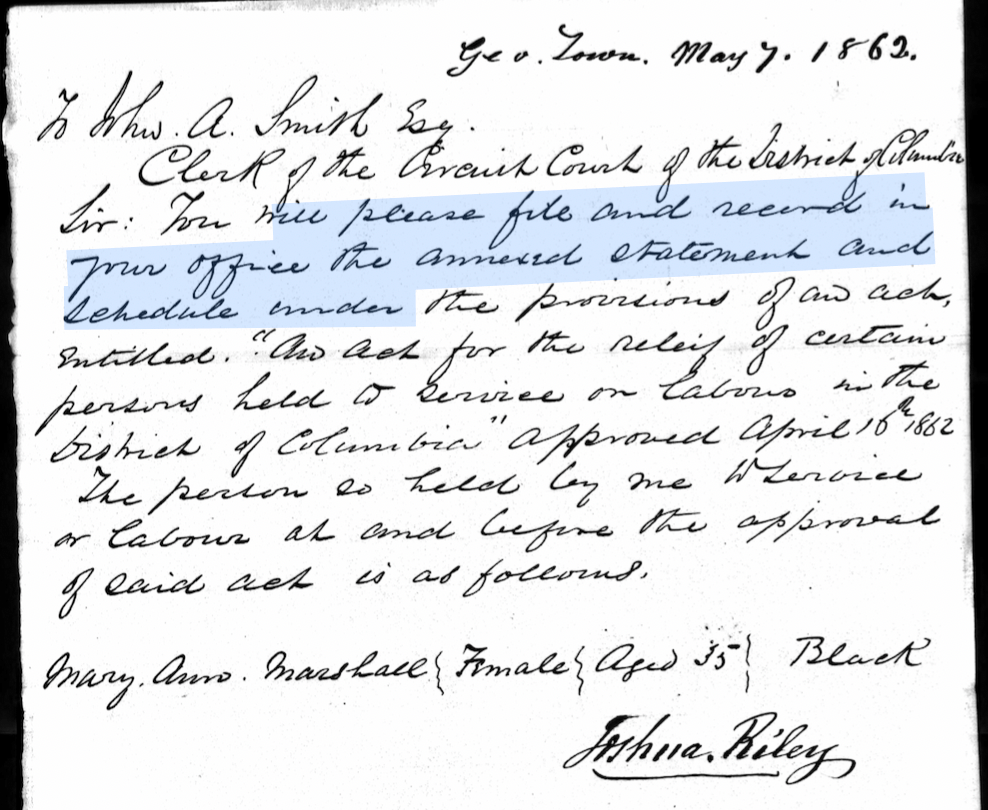
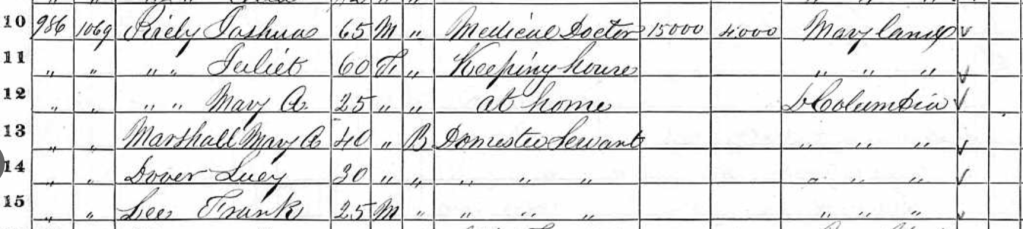
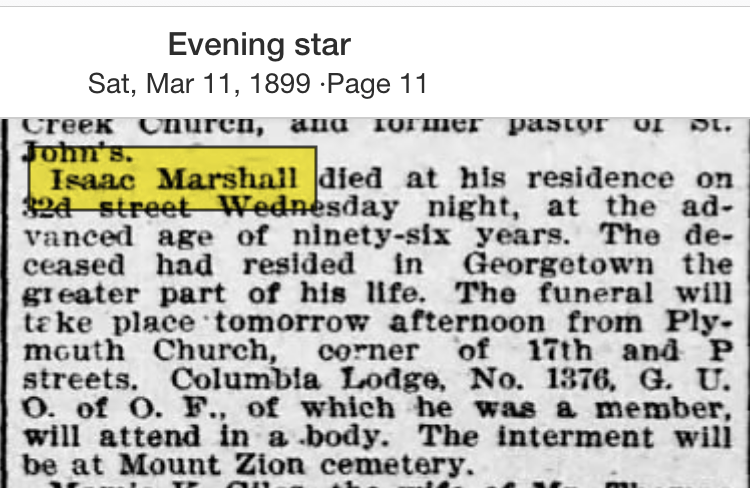
We may safely rule out as wife of Richard Low another slave of Samuel B Anderson, Chloe Marshall, born around 1812, and emancipated on April 16, 1862 in the District of Columbia (Enslaved persons in DC were emancipated, by act of Congress, about 20 months earlier than those in Maryland). Samuel B Anderson had purchased, he notes, Chloe from Thomas Clagget of Prince George’s County in 1850: she “hires herself”, he records, as a house servant for $100 per month, which suggests she was working her way towards purchasing her freedom. The Freedman’s Bureau marriage records indicate that Chloe, maiden name “Scott”, had been for decades married to Isaac Marshall. Issac is listed in September 1840 as having escaped from Thomas Clagget near Upper Marlborough, the same enslaver from whom his wife Chloe was purchased by Samuel B Anderson. (In 1860, Thomas Clagget owned 91 slaves.)

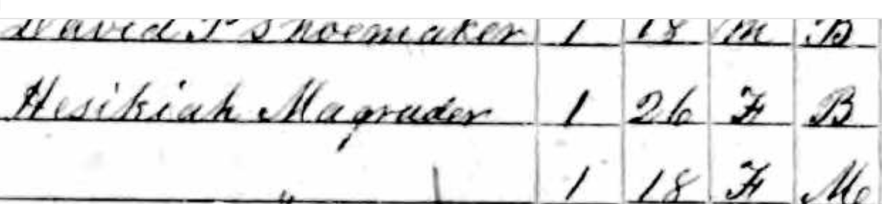
Isaac was emancipated in April 1862 from H (?) Magruder in the District of Columbia, along with an Emily Marshall, perhaps his daughter. The 1870 census records Isaac (a “wood sawyer”) and Chloe residing together, with a nine year old girl, also named Chloe Marshall, perhaps a granddaughter. From at least 1866-1870 Isaac Marshall resided in Georgetown, at 33 4th street (now Volta Place), a few doors from Isaac Williams, who as we have seen was also a former slave of Samuel B Anderson. We may infer that close relations continued between former enslaved persons owned by Samuel B Anderson, even if we have not reconstructed the precise kinship relations between them,

To summarize, in July 1853 the wife of Richard Low was being held in slavery near the Depot train station on New Jersey Avenue by Samuel B Anderson. She was probably later rotated out back to one of the Samuel B Anderson farms in Brighton, Montgomery County or Upper Marlborough, Prince George’s County. She may have been Fanny Williams or Maria Lee, or another woman, who might have died, been sold, or escaped in the years since 1853.

The Children of Richard Lowe

What became of James and Laura, the likely offspring of Richard Lowe and the unknown woman?

The 1880 census lists a James W Lowe on Howell street in Philadelphia, born 1842 in Maryland, married to Henrietta. The 1900 census lists a James W Lowe, laborer, residing at 1316 Addison Street in Philadelphia, born Jane 1846 in Maryland, married to Elizabeth Lowe. He may well be the same person as the James Lowe emancipated by Samuel B Anderson in 1864, and likely fathered by Richard Lowe.

I do not yet see a clear reference to Laura Lowe in the records.

Tracing Isaac Williams

I am unsure of what became of Fanny Williams, who may have been the wife of Richard Low, but her son Isaac Williams, later married Mary E Dorsey in Washington DC, on 15 August 1875; in 1880, the couple lived in Georgetown at 24 Fourth Street, (now Volta Place) with Mary’s father Levi Dorsey. Isaac Williams died in Boston, Massachusetts, October 21, 1926, and was funeralized in Georgetown’s Mount Zion Methodist Episcopal Church.

His obituary in the Evening Star lists their children as: William Williams, Elizabeth (Williams) Churchill, Dorsey Williams, and Fannie (Williams) Anderson, which suggests that Fannie may have been named for her grandmother Fannie Williams, Isaac’s mother. Isaac and his wife Mary Dorsey Williams are buried in Georgetown’s Mount Zion Cemetery ( section, E7 grave 172).

Death notice of Isaac Williams, 23 Oct 1926, Evening Star

Their shared headstone reads:

IN MEMORY OF
ISAAC WILLIAMS
BORN IN WEST WASHINGTON, D.C.
DIED IN BOSTON, MASS.
OCTOBER 21, 1926
HIS WIFE
MARY E. DORSEY
DIED DECEMBER 7, 1903
AGED 44 YEARS

The headstone seems to have been part of the gated Williams family plot in Mount Zion, before many headstones were relocated after 1976. This large headstone, evidently near its original location, remains intact.

Other Possible Kin?

There were several other free and enslaved people with the surname Lowe in the District of Columbia area, who may be related to Richard. These include the free man Jeremiah Lowe, born about 1805, married to Elizabeth. Their children include Charity, Phoebe, Michael. The 1850 and 1860 census records Jeremiah and Elizabeth as freepeople in Washington Ward 2, and also in the 1870 census, with Jeremiah listed as a “hod carrier.”

Also, the compensated emancipation petition of Selby Scaggs in DC in 1862 records the emancipation of a “Dennis Lowe, color Black, age 35 years (b 1829), both leggs (sic) off just below the knee very healthy, good ox cart driver and garden hand,: Dennis had been acquired by “purchase about five years ago [c. 1857] of Henry Hillary of Prince Georges County Maryland.

In addition, a Catherine Lowe, residing at H St between 24th & 25th Streets, worshiped in Georgetown at Mt Zion Methodist Church and was buried in Mt Zion Cemetery, after her death on June 27, 1876.

I am not sure if any of these individuals were kin to Richard Low.

In any event we will continue to work on tracing the stories of “Perfectly Black,” Richard Low, so vividly brought to life through the poetry of CeLilliane Green.

Remembering Joe Auslander, 1930-2025

Joseph (“Joe”) Auslander died peacefully at his home in Washington, D.C., on April 7, 2025, halfway through his 95th year. Moments before, he had fallen asleep sitting at his computer while working on a mathematical problem.

Joe was born September 10, 1930, in New York City, to Dr. Jacob “Bi” Auslander and Rebekah Zeltzer Auslander. He attended P.S. 9 and the High School of Music and Art on the Upper West Side, then Queens College and MIT, before getting his PhD in Mathematics from the University of Pennsylvania. He joined the mathematics department at the University of Maryland-College Park in 1963 and remained an active participant in the intellectual life of the department into his retirement, attending a departmental conference two days before his death.

Joe was a committed advocate for younger mathematicians, especially those from historically under-represented backgrounds. A true citizen of the world, Joe had deep friendships and collaborations with mathematicians around the globe. In addition to his long research career in the field of topological dynamics, he was fascinated by the history and philosophy of science and mathematics, publishing on the enduring problem of “what makes a proof a proof?

Joe’s coming of age was shaped by the passionate anti-fascism of his friends and extended family, including a large circle of cousins. He shared their love of classical music, art, literature, storytelling, and Jewish-inflected humor. He himself was a masterful teller of jokes. He remained active in progressive politics throughout his life, with particular attention to the pursuit of a just and compassionate peace in the Middle East. He was a life-long consumer of the New York Times and of its crossword puzzles. He loved to cook and presided, with his wife Barbara, over many dinner parties with friends old and new. An amateur clarinetist, he particularly loved Mozart and Haydn, and above all Beethoven.

For the last 37 years Joe was married to his beloved wife Barbara Meeker, emerita professor of sociology at the University of Maryland. His earlier marriages to Ruth Epstein Auslander and Harriet Little ended in divorce. He is survived by Barbara, sister Irene “Judy” Auslander Saks, children Mark and Bonnie Auslander, daughter-in-law Ellen Schattschneider, grandchildren Nina and Milo, brother-in-law Alan Saks, niece Eva Saks, numerous cousins, the mathematical community, and a host of friends.

Donations in Joe’s name are welcome to the Project NExT fund for emerging mathematicians of the Mathematical Association of America: maa.org/support-maa/donate/

Family Eulogies

Joe’s sister Judy Saks shares memories at the memorial gathering, New York City, May 17. Photo: Bill Swersey

A family memorial gathering, in remembrance of Joe, was held at the home of Joe’s beloved cousin Vicky Margulies, on Saturday, May 17, 2025, on the Upper West Side, the neighborhood where Joe and his sister Judy grew up (An earlier memorial service, primarily for colleagues and friends, was held at the Mathematical Association of America in Washington DC on May 9). We heard from Joe’s sister Judy Auslander Saks and Joe’s cousin, Paul Resika. Lois Smith (surviving partner of Joe’s late cousin David Margulies) read one of Joe’s favorite poems, W H Auden’s, “Musee des Beaux Art, alluded to in Mark’s eulogy. Cousin Sarah Swersey played the Sarabande from J.S. Bach’s partita for flute in A Minor, BMV 1013.

We gathered in front of Joe’s portrait, thoughtfully placed by Vicki above a linen of great family sentimental significance; this was one of a group of linens featuring gryphons (dynastic symbol of the Hapsburgs) purchased by Joe’s father “Bi” (Dr Jacob Auslander) in 1936 in Vienna, during his failed attempt to retrieve his parents from Radautz, Bukovina on the eve of the Holocaust. (Mark has written on these linens in an on line essay). Bi gave one set of linens each to his wife Rebekah and her sisters in New York City Celia Shapiro, Sonya Resika, and Runya Margulies. At the service, cousin Lucy Kerman explained, that she also has inherited part of this set, which means Bi must have also given a linen set to her grandmother ( Rebekah’s eldest sister) Frieda Zeltzer Zukerman in late August 1936, as he returned home through London, where the Zukermans were living at the time.

The service concluded with eulogies by Joe’s son, Mark Auslander, and Joe’s daughter Bonnie Auslander.

Mark at Joe’s memorial service, New York City. Joe’s nameplate, which was on his office door at the University of Maryland-College Park Department of Mathematics for over half a century, is visible n front of his memorial portrait. Photo by Eva Saks.

Chimes at Midnight: My Father in Motion

Mark Auslander
(New York City, May 17, 2025)

My most powerful memories of my father Joe are of him in motion, physically and mentally. This includes, as we shall see, his love of mathematics— although I hasten to reassure those less mathematically inclined that I will also address many of Dad’s other motion-related loves, which were, in alphabetical order: Baseball, Beethoven, Contrariness, Friendship, “It Happened One Night,” the New York Subway System, Radicalism, Running, and Shakespeare!

Let’s start with contrariness. One of Dad’s earliest memories was of the family gathered at 520 110th Street, listening on the radio to the 1936 abdication speech of Edward VII. When it came to the King’s famous line, “You must believe me”, Dad said loudly and defiantly, “I don’t believe you,” and walked out of the room, even though he was frightened, because it was, after all, the King!

Joe more or less grew up on the New York Subway system, and told us that his early mathematical thinking often took place on the subway, within Manhattan or going out to Queens College, which he attended before transferring (reluctantly) to MIT. Appropriately for one who fell in love with mathematics while riding the subway, Dad devoted his career to the mathematical subtleties of motion, although this was motion, he often told me and Bonnie, abstracted away from the physical forms of movement which we encounter in everyday life.

In his youth he was entranced by Galois Theory, at the heart of which are different ways a “field” of numbers can be transformed into itself, replacing one number by another while maintaining its underlying algebraic nature. (I like to think that the physical motion of the subway train, hurtling from underground to elevated tracks and underground again, in Dad’s mind evoked this exhilarating motion across the hidden structural levels of the mathematical universe.)

To explain Dad’s mathemical work more deeply, I (of course) turn to Shakespeare. Joe’s favorite line in literature was Sir John Falstaff’s response to his old friend Justice Shallow in Henry IV, Part 2 (p 129): “We have heard the chimes at midnight”. Dad noted this line has divergent meanings. At the surface level, it recalls the two men’s joyous escapades as schoolboy scamps, staying up so late carousing that they could hear the midnight bells ringing. Yet, coming late in the play, the line equally foreshadows Falstaff’s tragic end. When the former Prince Hal assumes the dignified mantle of the Crown, and abandons his inconvenient friend, Falstaff will die in despair. The midnight chimes proclaim that our day has nearly run its course.

The double meanings of the line, “We have heard the chimes at midnight” appealed to something fundamental in my father’s makeup, a simultaneous appreciation of the joyous and the ephemeral, of optimism interwoven with pessimism (which we have just heard in Auden’s Musee des Beaux Arts). His friend and Party comrade Naomi Stern recalled that at age 19, as they rode the subway together each morning out to Queen’s College, Joe’s face would radiate exultation as he expounded on the mysteries of Galois Theory, which Galois, amazingly, developed before his tragic death at the age of twenty-one in 1832.

Yet, at the same time, Dad would often share with Naomi his apprehension that as he approached Galois’ final year of age, twenty-one, he was yet to make a world-shaking mathematical discovery. Was it, he worried, too late for him? Were the midnight bells already tolling?

In a curious way, “chimes at midnight” also resonated with Dad’s love of the mathematical field known as “dynamical systems.” A dynamical system involves motion with some degree of regularity or periodicity, undergoing patterned movement, trajectories, or orbits that return to more or less their initial configuration. The classic example is the swinging movement of a pendulum clock, which regulated the London chimes that tolled for Falstaff. Similarly, we might think of the vast rotating cycles of solar systems or galaxies. The so-called “minimal” dynamical systems that Joe and his collaborators studied have the property that all their potential trajectories in time come as close as possible to describing all possible states that the system can attain. Much of Dad’s work aimed, in effect, to strip things down to the most simple possible set of hypotheses about a dynamical system, in order to generate a staggering array of possibilities as to how that system might unfold over the vast reach of time. This pursuit was for him extraordinarily beautiful, providing the observer with exquisite visions of how, from the simplest of conceptual seeds, unimaginable complexity can unfold.

Hence, his sense of wonder over Falstaff’s line. “We have heard the chimes at midnight.” The same minimal periodicity, the regular stroke of twelve chimes, governed by the same pendulum, could generate multiple outcomes—taking us back in time to our lost, mischievous youth or propelled forward to the future mysteries of the infinite.

Around the time he officially retired from teaching, Joe developed a second career, as a philosopher of mathematics, engaged with a different kind of motion. He wrestled with the thorny question of how mathematical proofs are discovered and made into widely accepted “truths.” Dad rejected the Platonic idea that proofs already exist “in the mind of God”; rather, as a humanist he understood mathematical proof as a profoundly human endeavor, that reflected the deepest human yearnings for beauty and elegance, aspirations which were most profoundly expressed in the collective action of mathematicians. He wrote often on a philosophical paradox: mathematical knowledge is largely objective but only comes into existence through the concentrated energies of the subjective human mind, most especially when in dialogue and in debate with other minds. Thus, the constant motion of ideas was for him foundational to the entire enterprise of mathematics and science itself.

For Joe, a mathematician and philosopher of motion, physical movement invariably triggered journeys of imagination. From 1972, when we lived for year near the Kermans in Berkeley, Dad was an avid runner, and kept up his commitment to jogging for the next 53 years, right up until the final week of his life. Jogging occasioned journeys through the memory palace of his capacious mind. For decades, he loved to do five miles runs around quarter mile university tracks. As he ran each lap, often accompanied by his loyal dachshund Dorabella or Dory, he would narrate aloud everything you would see if you were running five miles south down the Hudson, from the George Washington Bridge at 178th street, to the Auslander apartment at West 84th and Riverside Drive, block by block.

Baseball for Dad involved both physical and philosophical motion, given that no other game quite so perfectly encapsulates the dialectic between the “minimal” and the infinite. Only in baseball, after all, does the field of play extend out into the furthest reaches of the cosmos, the distance to which a home run could theoretically fly, only to bring the runner, racing cyclically around the diamond, precisely back to where he started.

Joe’s experiences of classical music also involved constant motion. He would often bring along the sheet music of a Mozart, Haydn, Beethoven or Schubert chamber work to live performances. so we could all follow the score together. This was especially dramatic when listening to Beethoven string quartets. Beethoven, he would often say, created us as members of the modern world. In this he was heavily influenced by lifelong conversations with his beloved cousins, Joseph Kerman and David Margulies. Beethoven, he explained, constantly sets up virtually impossible problems, and then proceeds one by one to solve them. Dad seemed to act this dynamic out with his hands in motion across the pages of the score, clenched at first and then by the final movement of a quartet, flying lightly across the page, his hand open, the problem finally resolved in triumph.

Dad’s life long romance with progressive and radical politics was also tied up the theme of motion, as well as more than a dash of contrariness. He thought one of the greatest moments in radical history was Galileo’s response when. faced with the torture devices of the Inquisition, he waas asked to recant that the earth revolved around the sun in orbit. Galileo defiantly whispered: Eppur si muove” (“And yet it moves”).

Dad eventually abandoned the rigid Party-dictated dogma of his youth, but retained most of all a love of the people he met along the way, in Monthly Review study groups or in marches. He would often bring protestors, far from home, at anti-war and civil rights marches, back home to to be fed and to spend the night, before taking them back to the bus station.

Speaking of busses, Joe had a life-long romance with intercity bus travel, wrapped up in his and his sister Judy’s shared love of the 1934 film “It Happened One Night” —a title that emphatically, he often noted, was not about an erotic coupling between Clark Gable and Claudette Colbert, but rather about the joys of two minds meeting late at night on a cross-country bus trip, suspended somewhere magically between departure and arrival.

For me and Bonnie growing up, international travel with Dad was a particular challenge, given his love of charter flights, which involved intricate rendezvous in dark parking lots and quasi-clandestine bus trips through sketchy neighborhoods. Joe of course loved all the eccentricities and complex arrangements, which heightened the likelihood of a fascinating chance encounter with a stranger with whom he might converse and strike up a new friendship.

Indeed, for decades Dad said, when asked what his life’s goal was, that on his final day of life he wanted to make a new friend. That’s all I want, to make a new friend on the day that I die. (A statement that surely encapsulated his signature mixture of joy and tragedy!) Making friends was certainly something he excelled at, meeting people in checkout lines at Safeway or concert queues or even in the hospital ICU. I wondered if things would really work out that way, especially as he got out less and less. But then on his last Saturday, my sister Bonnie and her boyfriend attended the “Hands Off” protest march on the National Mall, and on the way home met an elderly woman activist, Valentine, who was lost and clearly hadn’t eaten. Bonnie of course invited her to come home for dinner, especially appropriate on Shabbat. Dad sat next to her and they had a delightful time. He learned about her early career as a fashion model, then as a lawyer, then at advanced age a Peace Corps volunteer in Senegal. And then on his very final day, on Monday morning, he was in the alley behind the house, and made friends with Nelson from the Philippines, who is a chef at the next door restaurant. More new friends, to the last.

When Dad fell asleep at his desk, there were two sheets of paper before him next to his computer, on which he had scribbled some mathematical thoughts, perhaps related to one of his collaborative papers in process. These were related to lifting a map of “S”, what is known as a “semi-group” in his special field of topological dynamics. Lifts are essentially transformations from one topological space to another, in a way that preserves the underlying conditions of the original map or constellation of elements, with distant echoes perhaps of his early mathematical love for Galois Theory. Yet again, a very simple set of propositions about a system in motion can, rather miraculously, generate unimaginably complex unfolding states.

So I like to think that in his final moments, Joe’s imagination was once again in motion, lifting up a map from one plane of existence to another. The expensive delicate ship…had somewhere to get to, and sailed calmly on. As he left us, in his final slumber, about to begin his ultimate transformation, perhaps he could sense the vibrating intimations of the great music of the spheres. That distant music that surrounds us and awaits us all, playing intricately and ubiquitously, if only we could learn to listen for it. We have heard the chimes at midnight.

Shabbat shalom, father.

Mark welcomes participants to Joe’s memorial gathering, May 17, 2025. Phot: Bill Swersey

_______________________________________________________

“A Perfect Eulogy”

Bonnie Auslander (delivered in Washington DC, May 9, 2025)


Ever since my father died what appears to be the perfect death on April 7th, I’ve been searching for the perfect eulogy.

My first thought: a lineup of Jewish jokes. The villager complains of his crowded house to the rabbi, who advises him to bring in a cow, a sheep, and a goat, and then gradually remove them. Now the villager realizes how much room he has. The Yeshiva football team facing Notre Dame—not only bigger and brawnier, but somehow fluent enough in Yiddish to decode the plays. The dying rabbi whose students take turns praising his wisdom, ethics, generosity, and deep knowledge of Torah —only to have him crack open one eye to ask, “And of my great modesty you say nothing?”

We’d each tell a joke, laugh, and move on to the next person. Joe’s favorite Jewish jokes as his memorial.

My next idea for the perfect eulogy: a list of Joe’s funny sayings. When talking about our dachshund Dory with her long, inquisitive snout, Joe said she wasn’t training to be a seeing eye dog but rather a “smelling nose dog.” He never visited the National Gallery—only the “National Calorie.” And as a lifelong lover of cities he created the concept of the “Parking Space Museum,” meant to preserve those legendary spots that had achieved near-fabled status.

The perfect eulogy for my father would be just a collection of envelopes, napkins and scraps of paper covered in his math equations—that distinctive bird-scratch handwriting of his. (See the program.)

The perfect eulogy for my father would be a live performance of the Schubert string quintet in C major, composed in Schubert’s final months. Some of us would cry a bit during the wrenching Adagio movement. We’d dab our eyes, pocket our crumpled tissues, and walk out.

The perfect eulogy for my father would be a protest march—on the Mall, at the White House, around the Washington Monument. Vietnam, Reagan, Bush, peace in the Middle East —Mark and I joined him for many of them. Joe loved to say that he’d been as a radical in his youth and only moved further left as he got older.


The perfect eulogy for my father would consist of Joe bringing together two people who didn’t know each other but who really should. My father was absolutely brilliant at this. To resist his desire to introduce you to someone he thought you should be friends with was as futile as the ocean turning its back on the moon.


And once you surrendered to his wishes, and finally met the new person, you wondered why you’d even bothered to resist, because the new person was in fact just as wonderful and interesting as he’d promised they would be, and after all isn’t a tide a lovely thing to be swept along by?


And naturally, at Joe’s perfect eulogy, we’d all be in shorts and sandals. My father prioritized comfort above formality—whether teaching classes, giving speeches, attending conferences…or weddings, or yes, even funerals. True, it’s cool today, but D.C. mugginess is just around the corner. Why be uncomfortable?


Alas, each of these perfect eulogies falls apart when examined them more closely.

Joe never told jokes just to tell them. I was a kid who collected joke books, so naturally this drove me crazy. “Dad, tell me a joke! Please!” He’d smile, then frown, then flatly refuse. I eventually understood that jokes needed the right context and the right audience—like seedlings requiring perfect conditions to grow. So the joke memorial won’t work, and for the same reason the collection of Joe-isms won’t either.

The scribbled envelopes and scrap paper has potential, but the caterers have already claimed the napkins for the reception.


The Schubert quintet is amazing, of course, but you really need to see him conducting it with a televised baseball game going on in the background. Music on, announcers off.

The protest is tomorrow, not today—I trust I’ll see you all there. I don’t need to tell you that the fight against authoritarianism is more urgent than ever..


The two-people-meeting-each-other-for-the-first-time as a eulogy is sweet, but we really won’t know if you’ve met someone new till the reception is over.

As for the shorts and sandals—it’s too late for you to change now.


So, that’s it, a failed mash-up—Jewish jokes and Joe-isms scrawled on napkins while Schubert plays, everyone protesting techno-fascism and making new friends–while wearing shorts and sandals.


What’s left? Food. Which reminds me of Dad’s favorite joke:


A nervous young man prepares for his first date. He’s worried about what they’ll talk about. His father advises, “Stick to safe subjects: food, family, and philosophy.”

Sitting across from his date, he remembers the first category. 

”Do you like lokschen?” he asks. (Those are noodles.)

“No,” she replies firmly.Flustered, he moves to the second topic. “Do you have any brothers?”

“No,” she says again.

Now truly desperate, he recalls the final category—philosophy!

“If you had a brother,” he asks hopefully, “do you think he would like lokschen?”
*


Speaking of food—let’s talk about chocolate. The perfect eulogy to my father would feature mountains of chocolate desserts.


Joe’s chocolate obsession was legendary in our family. In fact, when his aunts Celia and Runya heard the teenaged Joe was dropping by, they wouldn’t turn on the kettle or set out a nosh. No, they would rush to hide the chocolate cake.


I’ve been talking about Joe in the past tense. But, if Joe were here, like Tom Sawyer, sneaking back to watch his own funeral, he would not, in fact, BE here, listening to me, his own daughter! That is because, at this late stage in the proceedings, Joe would already be out in the reception area, trying to get his mitts on the food.
The catering staff would be chastising him, saying, “Please sir, the service isn’t over yet,” and asking him to wait a bit longer, and he’d be ignoring them at first, and then maybe trying to get to know them a bit, asking them about themselves, but also he’d continue eating because why should he, Joe, have to wait, and why does it matter WHEN the food gets eaten if it’s meant for the company, of which he is manifestly the most important member?

So the chocolate eulogy fails like all the others.


Or, maybe not….if we file out in a few minutes and see the chocolate desserts, well, defiled, we’ll know Joe was at work. He was here, and then he wasn’t. Oh, look, here are some crumbs, dark and delicious.


We’ll have to do our best with what he’s left behind.

Bonnie at Joe’s NYC memorial, May 17. 2025. Picture by Eva Saks.

____________________

Addendum to Mark’s Eulogy

Mark’s eulogy for Joe in Washington DC (May 9) contained the following paragraphs, which were not included in the May 17 New York City service:

  1. So far as I can recall, the first mathematical concept Dad explained to me and my sister Bonnie, in our early childhood, was Zeno’s Paradox, which dates to the fifth century, BC. Zeno, assuming time to be composed of a series of discrete moments, claims that motion is impossible, since an arrow in flight would have to traverse an infinite range of points, and thus never get anywhere. A variation of the Paradox asserts that if a tortoise is given a slight head start in a race with the hare, the hare will never catch up, since during the time that any forward movement is taken by the hare, the tortoise will advance to some degree, and so on and on, so that hare can never actually surpass the tortoise.

The best part of this story, explained Dad, was how this assertion was refuted, long before the invention of calculus. When faced by Zeno’s argument in debate, the philosopher Diogenes simply stood up and walked away, thereby demonstrating the existence of motion and the absurdity of formalist philosophizing. Dad thought this hilarious, that the very first real proof was just walking away, literally refusing to be trapped in what he characteristically dismissed as a “sillypuss argument” The Zeno-Diogenes story appealed deeply I think to Joe’s natural contrariness, to his tendency, from earliest childhood, to resist accepted dogma or convention.

  1. Joe’s love of travel, which he pursued happily with his life partner Barbara for decades, was of course intimately bound up with his love of the worldwide community of mathematicians, his second family. Mathematics was for him the most fundamental international language, and he lived for the give and take with mathematical minds on every continent. On nearly every trip he took he found a way to connect with local mathematics departments. That was true when he visited Japan, and sites throughout Europe, and Israel and the Occupied Territories, all the way up to his recent trip with Barbara to Chile and Argentina.

In 1988, Dad came to stay with me in Mtizwa Village, in the Ngoni kingdom in eastern Zambia, during my doctoral fieldwork in anthropology, He spent the long afternoons working on a problem in topological dynamics, sometimes drawing the problem out in the sand, to the delight of local children. On his final day in Zambia, he presented this work as a paper at the University of Zambia in Lusaka, the capital city. I remember how thrilled he was when a young Zambian mathematician pointed out that he had made a mistake in one of his equations on the chalkboard; how wonderful, he remarked on his way to the airport, that someone was paying such close attention that he caught my mistake! That alone was worth, he said, traveling halfway around the world!

3. On Sunday mornings, his favorite routine was to walk his dear wife Barbara up the hill to her church on Columbia Road, and then jog back home, sometimes through Rock Creek Park. It occurs to me that over the course of the 53 years he ran, Joe must have averaged at least 10 miles per week, so that would exceed running around the entire circumference of the Earth at the equator, 25,000 miles. Only appropriate for a true citizen of the world like Dad.

4. [On Joe’s final passing} And yet, wasn’t there also a bit of fundamental mischievousness in his departure— singular and contrary to the end, just walking away, right out of the room?

_____

Family History

See a family history of the Auslander and Zeltzer sides of Joe’s family, written by Mark Auslander on the occasion of Joe’s 90th birthday in 2020: https://joeauslander90.blogspot.com/2020/09/joes-family-history-zeltzers-and.html


Mathematical Notes

Joe’s doctoral dissertation at the University of Pennsylvania 1957 was on Mean L-stable Systems, advised by Walter Helbig Gottschalk In 1988, Joe published Minimal Flows and Their Extensions (Volume 153) (North-Holland Mathematics Studies, Volume 153)

Minimal Flows and Their Extensions (Volume 153) (North-Holland Mathematics Studies, Volume 153) (9780444704535) by Auslander, J.

Joe’s Erdos Number was “Two”, due to his collaboration with Yael Dowker, often considered the “Mother of British Ergodic Theory,” who had an Erdos Number of “One”, having co- published with Paul Erdos, the famed Hungarian mathematician. Joe was friends with Erdos and had many fascinating conversations with him, but never co-authored with him.

Joe at a topological dynamics conference, 1997
Joe’s mathematical collaborators (larger font indicates more co publications)
Joe with Ethan Akin, one of his principal collaborators
Joe with his collaborator and University of Maryland colleague Ken Berg
Joe speaks at a memorial conference for colleague Dan Rudolph, 2010.
Joe with Jiangdong Ye, July 2004
Joe with colleague Alica Miller, University of Maryland conferrnce, 2006

Here, the participants of the 2002 Penn State-U Maryland workshop on dynamical systems and related topics gathered at Joe and Barbara’s house

Joe with close friend and colleague Jack Feldman (UC-Berkeley), 2002
From left, Eli Glasner, Francois Blanchard, Joe Auslander

Joe Auslander, Will Geller, Kathleen Madden

Yitzakh Katznelson with Joe:

Tributes from Mathematicians

Doron Levy (Chair, Department of Mathematics, University of Maryland-College Park) shared these remarks at Joe’s memorial gathering on May 9 at the Mathematical Association of America

Joe Auslander – A professor, a colleague, a friend

  • For those of you who do not know me, my name is Doron Levy and I am the Chair of
    the Department of Mathematics and the Director of the Brin Mathematics Research
    Center at the University of Maryland.
  • The news of Joe’s death came as a shock to all of us. Joe was not a young person,
    but somehow, all of us – those that came to the department after Joe (which is
    everyone) – and those that left while he was still around – we all though, somehow,
    that Joe will be in the department forever.
  • After we heard from Anima about Joe’s contributions to Mathematics, I am here to
    tell you a little about the Joe’s contributions to the Math Department and to the
    department’s life.
  • This is not a simple task. Joe arrived to Maryland in 1963 that is before I was born.
    When I moved to Maryland in 2007, Joe has already retired, or so I thought.
  • In fact, as you all know, Joe never retired. Yes, he may have stopped teaching or
    oTicially serving on committees, but his presence in the department was felt in
    many ways. You see, there are colleagues that retire and we never see them again,
    then there are people that are active members of the department that we still do not
    see…. Joe, on the other hand, never left the department. He was, literally in the
    department the day before he died, attending the annual dynamics conference as a
    participant.
  • My main interactions with Joe were during the past 6 years, the period I have been
    serving as department Chair. Joe always showed interest in the department and the
    department business, much more than many other colleagues. He reached to me
    many times, asking to contribute in any possible way, including volunteering to
    serve on committees, very actively participated in faculty matters, providing
    feedback about promotions and about hires, and even recently speaking with me
    and raising the idea of organizing a symposium on AI & Math. It will not be an
    exaggeration to say that Joe participated pretty much in every aspect of the
    department life.
  • But all of that, one may say, is routine. Joe’s impact on the department was
    significantly bigger than that. Before Joe’s generation (actually the decade of his
    arrival) there was essentially no research expectation of faculty. Joe was part of a
    transition generation wherein the baseline expectation was to publish a PhD thesis
    and a few articles and no further activity. Joe was one of the very few faculty from
    that generation who continued to be involved and interested in research say after
    PhD + a handful of papers. A name that comes to mind as a top researcher is
    Seymour Goldberg who studied operator theory (a topic that was once big in the
    department). During that time the department was known for Riesz coming to visit
    and give lectures. The next generation is Ron Lipsman’s wherein one was expected
    to be research active throughout their career. And so on. Joe’s was the tipping point
    in the transformation that the department has undergone in becoming a top
    research department.
  • Another piece in the department’s history that we can certainly attribute to Joe is the
    central role he played in the creation of the dynamics group. We heard a lot about
    the strength of the dynamics group, their program, and some of the prominent
    visitors they had over the years in the words of Anima, and Joe certainly played a key
    role in attracting these people to Maryland and elevating our dynamics group to
    where it is now.
  • Our former department chair, Scott Wolpert, told me that “Joe always had
    something he was thinking about.” And this is absolutely true. You would never see
    Joe in the corridor without him telling you something that was on his mind.
  • Hillel Furstenberg from the Hebrew University who knew Joe well, wrote: “the
    aesthetics of mathematics was just an instance of his broad humanistic outlook.”
    Precisely what that means, probably means diTerent things to diTerent people, but
    for me, having been around Joe and considering him as one of the main pillars of the
    department, created an intriguing sense of harmony, a feeling that we are all small
    parts of something much bigger.
  • Earlier in the semester I discussed with Joe plans to hold a one day conference next
    year to honor is upcoming 95th birthday. Joe looked at me and asked – and what will
    you do if I die before the conference? I said – we will have to hold then a memorial
    conference instead. He laughed and we both agreed that we will do it one way or
    another. So this is something we plan to put together. Stay tuned.
  • On behalf of the members of the Math Department and the University of Maryland, I
    would like to thank Joe for all he has done to promote our department, for all he has
    done to bring us together, and for all he has done to provide the leadership, vision,
    and hard work that brought the department to where it is in now. We miss you Joe.

Other Tributes from Mathematicians

Idris Assani (University of North Carolina): My sincere condolences to you and your family for your loss. Joe was a good friend of mine who has thoroughly supported my career for many years. He was a really good person with high moral qualities. I always made a point to visit him when I had a chance to come to Maryland.  He will be sorely missed.

Bill Goldman (University of Maryland-College Park): I have known Joe personally since I first came to the University of Maryland in the 1980’s. However, I first heard of his research as a graduate student a few years earlier.  Although we work in different fields, we share common interests.  At one point  he even suggested we coauthor a paper together. 

I knew many graduate students working in his field of dynamical systems.

I was impressed by his generosity and friendliness in supporting their research  and their futures as mathematicians.

Joe loved faculty meetings, even after he retired. The academic community  meant a lot to him.  He strongly valued the freedom to express diverse opinions and discuss alternate viewpoints. 

My office is a few doors down from the lounge and the auditorium, and Joe would often stop by, since I usually leave my door open. We conversed  about a wide range of topics. When I hosted visitors, he would often strike up a discussion and determine whether they had any common friends. We had several wonderful dinners at Joe and Barbara’s house and enjoyed their great hospitality and food. 

I will miss him. 

Bill Goldman

Family and Friends

Joe and Barbara wedding, October 1988
Joe’s beloved cousin Paul Resika painted this early portrait of Joe, c 1947 when Joe was about seventeen years old:
Joe with son Mark, c 1985
Bonnie, Mark, Barbara, Joe
Joe lived in the Cairo Apartment building on “Q” street in DC n the 1980s (note that he often wore shorts!)

Joe’s father Dr. Jacob “Bi” Auslander resided in Vienna, Austria from c. 1910 until he emigrated to the United States in 1923. Bi’s sister Cilli Auslander attained her doctorate in Chemistry from the University of Vienna in 1920 and then returned there after the War.

Joe visits aunt Cilli Auslander in Vienna in 1989, shortly before her death.

Joe was very close to his “Zeltzer” family cousins, on his mother Rebekah’s side of the family, many of whom are seen here at a gathering in the Swersey’s Shadowbrook Farm in Steventown, NY, summer 2009.

From left: Joan Shapiro Uchitelle, Joe Auslander, Judy Auslander Saks, Vicky Margulies, George (Dick) Zukerman, Pearl Cookie Solomon, Alice Shapiro Swersey, David Margulies.

Shadowbrook Farm Rear: Paul Resika,Dick Zukerman, David Margulies.  Front: Pearl Solomon Judy Saks, Joan Uchitelle, Vicki Margulies, Alice Swersey (Photo: Bill Swersey)

Joe was deeply influenced by his older cousin George (Dick) Zukerman, a great bassoonist and impresario. Here they are near Dick’s home at White Rock, British Columbia
Lou Uchitelle, Joe Auslander, Paul Resika (at Alice and Burt Swersey anniversary)
In 1992, Joe and Barbara visited daughter in law Ellen Schattschneider during her anthropological fieldwork in Japan, Here, with the Yamauchi family in Namioka, Tsugaru, Aomori Preference, Japan
Joe adored his niece Eva Saks, and in January 2005, he and Barbara visited her home in Los Angeles, which doubles as a rescue for Sheltie dogs.

Joe kept in touch with his Russian cousins, descended from his mother’s sister Pauline Zeltzer Klein and her husband Sol Klein, who moved from New York to Moscow in the Soviet Union in the early 1930s. Joe and his first wife Ruth attended the International Mathematical Conference in Moscow in 1965 and got to see many of the Russian cousins. ‘

Dinner in July 2023 celebrating the US trip of Pauline and Sol’s son Josef Klein, his wife Vika Klein and their daughter Anya. From left, Barbara, Joe Auslander, Josef Kelin, Vika, Mark Auslander, Anya’s son Stepa, Anya, cousin Lucy Kerman (daughter of Joe Auslander’s first cousin Joseph Kerman).

Another Russian cousin is Igor Tregub, descended from Riva Zeltzer, sister of Joe’s maternal grandfather Josef Zeltzer of Novye Derogi, Belarus.

Igor stayed with Joe and Barbara in August 2022. (The art work in the background is all by Joe’s cousin Paul Resika.)

From the time he lived in Berkeley in 1972, Joe regularly wore shorts, sometimes to the discomfiture of his first wife Ruth and restaurant hosts. Here he is the study of the R street house.

Joe was a life long reader of the New York Times, and often called up or wrote to friends and family to advise them of interesting pieces he had come across in the Times. Here he is reading the Times during a hospital stay in August 2023.
Joe loved to read short stories aloud at family gatherings. At his 92 birthday party, he read aloud an early Soviet comic story (cake baked by next door neighbor Mikko).

Granddaughter Nina graduates from Oberlin. with Barbara, Barbara, grandson Milo.

Joe with grandson Milo and daughter Bonnie.

Joe with grandson Milo, eating pizza in the outdoor patio behind the R Street house, .August 2023. Joe and Milo shared a great love of baseball.

Joe loved to preside over dinner parties in the R street dining room.

Joe’s 94th birthday, September 10, 2024, attended by cousin Zhenya, visiting from London (descended from Joe’s mother’s sister, Pauline Zeltzer Klein) . Also present Barbara, Bonnie and her partner Jonny.

Joe loved the National Gallery of Art. On the moving sidewalk connecting the West wing and East wing of the museum, January 2025.

Joe had a life-long love chocolate cake. Here he consumes a slide of a half chocolate cake baked by Bonnie, created by his daughter Bonnie to celebrated his 94.5 birthday in March 2025, which turned out to be his last birthday celebration.

Late in life Joe developed a tradition of getting his hair cut by barber Ernesto in the Van Ness shopping center. He would go for haircuts at the change of each season and in preparation for the new year. (Ernesto had regularly cut the hair of Joe’s son Mark since 1970)

Joe with barber Ernesto, December 23, 2023.

While living in Berkeley, CA in 1972, Joe became an avid runner and continued to jog regularly for the next five decades.

One of Joe’s favorite runs was through through Rock Creek Park; here he is just in front of Georgetown’s Oak Hill Cemetery in the lower stretch of Rock Creek Parkway

Joe jogging in Stead Park near their “R” street home, on Christmas Eve 2023.

Joe loved the street life around their row house on the 1600 block of “R” street in Northwest Washington DC. Here we see Joe, Barbara, Mark and Ellen walking on “R” street towards 17th street.

Joe avidly read daughter’s Bonnie poetry and took great delight in her many accomplishments. Here, father and daughter are on the platform of his local Dupont Circle Metro stop.

Joe was a great advocate for his son Mark, especially Mark’s 2011 book, The Accidental Slaveowner, to which he introduced countless friends. Here are Mark and Joe in the living room of the “R” Street house on Christmas Day 2024.

Mark, Barbara, Joe on Christmas Day 2024 at R street:

On January 2, 2025, Joe, Mark and friend Paul Emmanuel visited Allen Uzikee Nelson’s sculpture, “Here I Stand: Remembering Paul Nelson’ in the Petworth neighborhood of Northwest Washington DC. Joe was a great admirer of Paul Robeson, and was very moved by this oudoor sculpture, inspired by the Kota or Honwre reliquaries on display in the Smithsonian National Museum of African Art:

In Search of Pattie (Patsy or Margaret B) Brooks and Harry Brooks, Enslaved and Free in Georgetown, District of Columbia

The 1836 register of the Methodist Episcopal Church (later Mount Zion Church) in Georgetown, District of Columbia, lists as a member “Pattie Brooks”, recorded just below the name of Gracie Ducket, who was enslaved by Samuel Whitall, who leased the property known as Belle Vue (later known as Rittenhouse Place, and after that, Dumbarton House).

Register, Mount Zion Methodist Church, 1836 showing Patty Brooks and Grace Ducket

The 1860 census records Pattie Brooks, mulatto, servant, as a free woman of color, born 1810, residing in dwelling 531 in Georgetown Ward 2, within the household of the Black woman Charity Lemon, age 70, with Laura Bell, also Black, age 60. Pattie resides two households away from the free couple (Rev) Louis (Lewis) Cartwright and his wife Julia Cartwright, the daughter of Gracie Ducket who at that point was still enslaved by Lydia Whitall, the widow of Samuel Whitall. (Gracie would be freed two years later by the will of Lydia Whitall in early April 1862).

1860 census showing Patty Brooks near Lewis and Julia Cartwright

Four years later, in 1864, the Georgetown Directory records Patty Brooks residing at
23 West Street (later P Street) in Georgetown. She is the widow of “Harry Brooks.”

1864 Georgetown Directory Patty Brooks, colored, widow of Harry, home 23 West St (P St)

In her 4 January 1868 Freedman’s Bank application, Pattie Brooks indicates that she was born in Montgomery County, Maryland, residing at 22 West Street between (?) Montgomery Street (later 28th street). She is widowed, with no children. She opened her account with $130. She was, she reports, formerly enslaved by George Peter and his wife Sarah.

1868 Freedman’s Bank application by Patty Brooks for $130

Major George Peter (1779-1861) was the son of Robert Peter (the first mayor of Georgetown) and Elizabeth Peter. George became the leading slaveowner in Montgomery County, owning about 100 persons in 1860. Sarah Norfleet Freeland) Peter, 1805-1846, was George’s third wife. George evidently owned property in Georgetown as well as Montgomery County. Both George and Sarah Peter are buried in Oak Hill Cemetery, adjacent to Mount Zion Cemetery. George’s brother Thomas Peter famously married Martha Custis Peter, granddaughter of First Lady Martha Custis Washington, and resided in Tudor Place in Georgetown.

As of this writing, I am unsure how and when Pattie Brooks attained her freedom from George and Sarah Peter. Nor is it clear if her late husband Harry Brooks was ever free, or if he was enslaved throughout his life. Since Pattie is listed as a widow in the 1864 city directory, Harry must have died before that year.

The 1870 census records Pattie Brooks as head of household, in Georgetown, residing with Nellie Brown, 17, and Maria Johnson. 60. She lives next door to the Lemon family, including Charity Lemon, with who she resided a decade earlier in the 1860 census. Pattie lives three households away from Rev. Lewis and Julia Cartwright, a household which now includes Gracie Ducket, who, as noted above, had been listed just above Pattie Brooks in the 1836 Mount Zion Church register. Gracie Ducket and the Cartwrights are buried in Mount Zion.

The 1874 and 1875 Georgetown city directories record her as Patsy Brooks, living at 23 West Street (later P Street).

Pattie appears to be the same person as Margaret B Brooks, recorded in the death records of undertaker Joseph Birch, as residing at 23 West Street (later P street) in Georgetown, born 1892, died 8 August 1876, buried in Mount Zion Cemetery. In early American English, Pattie or Patty were hypocoristics (pet names) of Margaret and Martha, through a common transposition of the letter “P” and “M.”

If Pattie Brooks were still enslaved in 1850, she might have been the 40 year old enslaved woman in the estate of George Brooks in Medleys, Maryland in the 1850 slave schedule. Alternately, it is possible that Harry and Pattie/Margaret appear in the 1850 census as the free couple of color, Hary (b 1795) and Margaret Brooks (b 1805) in District 1, Dorchester County, on the eastern shore of Maryland, with evident children James Brooks. Wesly Brooks, Hester Brooks, and Sarah Jane Brooks. This seems unlikely, given that Pattie Brooks was worshipping in Georgetown in 1836 and residing in Georgetown in 1860, but cannot yet be ruled out.

I am unsure if Harry and Pattie (Margaret) Brooks were related to Sarah Brooks, who had been enslaved by Joseph Nourse, evidently at the time he owned Belle Vue. In slavery and freedom Sarah worked as the cook at the Highlands (later the Sidwell Friends campus). She died in 1875 and who is also buried in Mount Zion Cemetery.

Puzzling over a genealogical connection to Samarkand, Uzbekistan

I am puzzling over a connection through ancestry.com indicating that Abduvohid “Abdu” Abdurasulov, born in Samarkand, Uzbekistan, and I are share about 2 per cent DNA. This could indicate we are second or third cousins, or this might, because of the complexities of relative endogamy, mean that we are related to one another in more than one way, at a greater genealogical distance. Abdu is ethnically Tajik, but Ancestry’s algorithms indicate that about ten percent of his DNA is consistent with Eastern European Jewish background. He believes that the connection is likely to be through his great great grandmother, Sharofat Sadikova, whom he understands came from Eastern Europe and settled in Samarkand many decades ago.

Samarkand, on the ancient silk road across central Asia, has an centuries-old Jewish community, sometimes known as the Bukharan Jews. However, I am assuming our connection is more recent, through the mass evacuation of Jews to Soviet Central Asia, from Eastern European sections of the Soviet Union in 1941 and 1942, in advance of the Nazi invasion of the Soviet Union. About 1.1 million Soviet Jews are known to have been evacuated to central Asia; of these, at least 300,000 are believed to have perished from disease, starvation or exposure.

I know of several relatives on my father’s side of the family who were evacuated, but I am not sure if any of these constitute my connection to Abdu. These are:

My father’s mother’s sister Pauline Zeltzer Klein, and her children Eva and Joseph Klein, were evacuated from Moscow to Adzitarovo (Адзитарово), in the Karmaskalinskiy rayon, Republic of Bashkortostan, about 1,400 km east of Moscow. (This is several kilometers west of Kazakstan). They stayed in a house that had been previously occupied by a Tatar family, who had evacuated further east into central Asia. The Kleins stayed there until the tides of war turned, and then returned to Moscow, where Pauline with difficulty reclaimed rights to her old apartment, where she and her husband Sol continued to live for the rest of their lives.

  1. My father’s mother’s father’s daughter’s son, Hirsh Osofskiy (1883-1943), his wife Gesia, and their eleven year old son Efim, were evacuated in 1941 from Babruysk, Belarus to Kazakstan. Since the Wehrmacht occupied Babruysk on June 28, 1941, I assume the family fled the city before then (At least 20,000 Jewish residents of Babruysk were subsequently massacred by the Nazis). Hirsh and Gesia perished during the war in Kazakstan, but their son Efim was cared for by Kazakh shepherds and survived. He later returned to Babruysk after the War and his descendants continue to reside in Moscow. Efim’s son, however, shows no genetic connection with Abdu.
  2. My second cousin once removed (my father’s father’s father’s daughter’s son’s son) Bruno AUSLÄNDER, (1921-2018) was evacuated to Uzbekistan during the war. I am uncertain how precisely he reached Uzbekistan. His parents, Nathan and Netti, and brother Joseph resided in Radautz (Radauti), in Bukovina, Romania, up until the time they were deported by Romanian fascists in October 1941 on death trains into Transnistria (fascist occupied Ukraine), where they rather miraculously survived in Moghilev during the deportation era, before returning to Radautz, Bukovina at the end of the war. Bruno must have somehow made his way into Soviet controlled territory and from there been evacuated east. This must have been perilous; as is extensively documented, many Romanian Jews from Bukovina who traveled north of the Bug river were murdered by the SS Einsatzgruppen (mobile killing units) in occupied Ukraine. Bruno, we know, married a Soviet woman, Valea, A registration card indicates he made his way to Tashkent in Uzbekistan in 1941-1942, He survived the war and was back in Radautz by 1945 with her parents and brother. He eventually settled in Canada. (About 150,000 Jewish evacuees are documented in such registration cards in Tashkent, digitized by Yad Vashem and the US Holocaust Memorial Museum).

However, I suspect our connection is in fact through my mother’s side of the family, about whom we know much less. Abdu and I appear to have DNA matching cousins on my mother’s side, so that is probably where we concentrate our efforts. A cousin reports that my mother’s brother, the late Louis Epstein, has DNA connections to Abdu on both Louis’ mother’s and father’s side, which is intriguing.

My mother’s mother Yetta Epstein ( who gave her maiden name as “Anderson”, which appears not to have been her real maiden name) evidently emigrated from Pavoloch (Zhitomir, Ukraine) to Baltimore, Maryland, USA, around 1913. My mother’s father Isadore Epstein, emigrated from Babruysk, Belarus in 1911 to New York. (By coincidence, by father’s mother’s family and mother’s father both came from Babruysk.) Both Yetta and isadore must have left many relatives behind in Ukraine and Belarus, but do not appear to have spoken of these connections extensively to their children.

The USHMM and Yad Vashem databases list several Jews from Pavoloch, Ukraine who were evacuated to Uzbekistan. These include:

Samoil Gerchenko, born in 1898 to Grigoriy. who is listed on a Tashkent registration card.

Shika Ruzhinskii, born 1896, son of Mikhail, also listed on a Tashkent registration card.

Boris Samonin, born 1900 son of Osvey? also listed on a Tashkent registration card.

I do not know if any of these persons were related to Yetta or her sister Bessie. The cards do not indicate if any of these individuals survived World War II.

In terms of possible relatives of my mother’s father, Isadore Epstein from Bobruysk, the USHMM database lists thirty-one Epstein’s evacuated from Bobruysk to Uzbekistan, according to the Taskent registration cards. (One Epstein from Bobruysk, it is interesting to see, was Nathan Epshtein, who somehow made it to Nantes, France, and was then murdered in Auschwitz). Perhaps one of these Epshteins evacuated to Tashkent was related to my mother’s father Isadore Epstein and was married or related to Abdu’s great great grandmother Sarofet Sadikova.

I see on social media that there are various Epstheins currently living in Tashkent but I am not sure if I am related to any of these. I also see that the USC Shoah Foundation site lists about twenty survivor interviews with references to time spent in Samarkand, Uzbekistan but I have not requested access to these yet.

Looking at things from Abdu’s side of the family, the USHMM database of Holocaust Victims and Survivors (and the JewishGen compilation) lists about 11 individuals with the surname Sadikova or Sadikov (the male version of the name) from the Tashkent registration cards. These are:

Brana Sadikova, born 1911, from Barancha [Altai Republic?]. daughter of Iosif

Ester Sadikova, born 1897 (prior location not listed), daughter of Leib

Sfirsa Sadikova, born 1906, from Moscow, daughter of Boris

Fania Sadikova, born 1888, from Belets, MSSR. Moldova, daughter of Abram.

Anna Sadikova, born 1913 from Bel’tsy, MSSR. Moldova, daughter of Dersh

Khaia Sadikova, born 1908 daughter of Bentsion, from Orgeyev, Orgeyevskii, MSSR (Moldova)

Sima Tsadikova, born 1904, daughter of Shmul from Kishinev [Chișinău, Moldova.}

Anna Tsadikova, born 1900, daughter of Isaak, from Odessa [Ukraine]

Angel Sadikov, born 1906, son of David, from Orgeyev, Orgeyevskii, MSSR (Moldova) , Soviet Union

Mortko Sadikov, born 1896, son of Mendel, from Barancha [possibly Altai Republic?]

Moisei Sadikov, born 1912, son of Mendel, from Ketrosa (I believe Chetrosu, Moldova)

Of these, I am not seeing an obvious connection to my known family members. Six of those listed are from Moldova/Bessarabia. From 1941, Moldovan or Bessarabian Jews were deported to Transnistria, along with Jews from Bukovina, including my father’s father’s family. Bel’tsy, listed above, was near the notorious Răuţel camp, where many Jews died under horrific conditions. I know that my father’s father’s sister Julia AUSLÄNDER, married a man, Joseph Pagis, from Kishinev. I believe my father’s mother’s mother’s family, the Weinsteins, has roots in Odessa.

One scenario might be that an Epshtein from Bobruysk married a fellow evacuee named Sadikova, and that is the source of our link.

The fact that my mother’s brother’s Lou Epstein has DNA links to Abdu on both his father and mother’s side suggestions more than one evacuation route might be salient. These would include the Epstein/Epshtein evacuation history from Baburysk to Tashkent, with the possible added connection through my mother’s mother’s family from Pavoloch in Ukraine. (Abdu had been under the impression that his great great grandmother Sarofet had roots in Ukraine.) Perhaps future research will cast light on this enigmatic aspect of our family history.

In Search of the Family of Joseph Anderson, c.1857-1904

My Mount Holyoke College students and I have been intrigued and moved by the story of Joseph Anderson, an African American laborer buried in Mont Zion cemetery in north Georgetown, Washington DC. Like Moses Boone, Joseph Anderson was interred without this brain, which had been extracted by a Smithsonian anthropologist in 1904 for the “racial brain collection.” As of this writing, the brain remains in the biological collections of the National Museum of Natural History. We hope progress is being made towards repatriation, in eventual consultation with descendants.

Joseph’s Ancestry

The precise circumstances of Joseph Anderson’s birth and parentage are somewhat murky. His 1895 marriage license to Laura V Chinn in Alexandria, Virginia lists his birthplace as “Canada” and his birth year as 1865. His parents are listed as “Henry” and “Henrietta”. Five years later, in the 1900 census he lists his birthplace as District of Columbia, birth date December 1862. He may also appear in the 1870 census, as born in Virginia, although this maybe a different Joseph Anderson.

If Joseph really was born in Canada, that might suggest that his parents had escaped on the Underground Railroad and eventually made their way to safety in Canada. That could be consistent with a free Black couple Henrietta W Anderson, 20 (b. 1840, in the District of Columbia ) married to Norman Anderson, barber, 36 (born Virginia) [who is perhaps the same person as “Henry” in the 1895 marriage record of Joseph] —residing in the 1860 census residing in Appleton Ward 2, Wisconsin, living with their son, two year old William Anderson, born in Canada, 1858. So perhaps the family moved in and out of Canada at some point, and Joseph, like William was born there. Two decades later in 1880, Henrietta, widowed, resides in Georgetown DC. as a housekeeper in the household of the Black male laborer, Robert Robertson, at 189 N. 26th street. I am not sure what became of Henrietta and Norman’s son William (note that the name William is repeated through the subsequent family line.)

Joseph Anderson in the DC Area

On 7 June 1892, Joseph Anderson married Mary E Harris in the District of Columbia , but, according to her divorce filing. he deserted her after a month. Joseph later remarried, to Laura V Chinn on 7 March 1895, who had been working as a domestic in the District. (Mary Harris Anderson charged that Joseph had failed to first obtain a divorce from her, and she sought court permission to return to her maiden name.)

In 1900, Joseph and Laura Chinn Anderson were residing at 1117 L St, NW. Joseph was working as a barber, like his apparent father or stepfather Norman Anderson, Joseph and Laura resided with Laura’s parents, John F Chinn and Laura Chinn, and her brothers Clarence Chinn and Raymond Chinn (mentioned below).

Joseph Anderson’s death certificate indicates he had been a patient (“inmate”)
at Freedman’s hospital for seven days, before dying of acute interstitial meningitis on 30 July 1904. The extraction and autopsy of his brain presumably took place soon after his death. He was buried in Mount Zion on August 1, 1904.

Joseph Anderson and his wife Laura Chinn Anderson evidently only had one child, William James Anderson (Sr), evidently born January 3, 1900 (four years before his father’s death).

After Joseph’s death, Laura supported herself and her son as a dressmaker. and by taking in lodgers On May 1, 1906, she had another son, William Ralph Grayson, evidently out of wedlock. On December 29 1931, William married Celeste Johan Biscoe. William Ralph Grayson died 4 February 1990 in the District of Columbia. The couple was evidently childless. (His 1990 obituary, it is interesting note, references him as the son of John F and Laura Williams Chinn; although the 1939 obituary of their daughter Laura Chinn Anderson Robinson, refers to him as her own son.)

On February 28, 1912, Laura Chinn Anderson remarried, to the carpenter Wellington C. Robinson, who died May 5, 1927. Laura died October 4, 1939 at her residence 1925 2nd St, NW.

Let us return to Joseph and Laura Anderson’s son, William James Anderson, Sr. He married Leah (Lee) Lewis (of Berkeley, Spotsylvania, Virginia) on 3 Aug 1922. in DC. They are recorded as a couple with children in in the 1930, 1940, and 1950 censuses. In 1960, William J Anderson plasterer, and his wife Leah B Anderson, resided at 1630 and a half, 10th st, NW. Leah died in the District of Columbia 11 Sep 1996. I am not sure of the death date of William James, Anderson, which must have been at some point after 1960.


William James Anderson, Sr and Leah B Lewis Anderson had at least nine children:

  1. Mary F Anderson, b 1924, who in the 1930 census is living with her parents William and Leah Anderson at 941 Florida Avenue. In 1950, she was still unmarried at age 27, residing in a basement apartment on 13th street, NW. She might be the Mary F Anderson in the 1954 city directory residing at 1458 Columbia Rd, apt 201.
  2. William James Anderson, Jr. 9 DEC 1927- 29 NOV 1975. In 1930 and 1940, he was living with his parents and siblings. He married Ruth Naomi Campbell (1929-2017) on 28 Dec 1945 Children included Vermel Anderson. July 1, 1960  –  March 16, 2023, William James Anderson III, d. before 2017 and Leona Anderson, d. before 2017
  3. Harvey Anderson. b. 1930. In 1960 Harvey Anderson Sr. and his wife Lillian Anderson were residing on G Street West, with two year old Harvey Anderson (Jr) in the home of Harvey’s uncle Theodore Butter, at342 G St SW, #2.
  4. Rogers Anderson, b. 1934
  5. Lillian R Anderson, b 1936
  6. Frank M Anderson, b 19387 Samuel M Anderson, b 1941
  7. Samuel M Anderson, b 1941
  8. Marcellus Anderson, Sr. 1943-2012 (Temple Hills, Maryland; buried Lincoln Cemetery. )
  9. Burnell Anderson, b 1945

Collateral Chinn Relations


Joseph Anderson’s in-laws, the Chinn’s, were members of an extensive African American family with roots in Virginia and the District of Columbia.

Joseph Anderson’s wife Laura V Chinn’s siblings, the other children of John F Chinn and Laura Williams Chinn, included:

  1. John Franklin Chinn (Jr), b 1868 Virginia, died 20 Apr 1945. Enlisted in US Army 1896. Married Mary. Married Emily Jackson. On May 20 1907, married Mary Schureman. Children included: Henry S (1884–); Bertha Beatrice (1889–1931); Arthur Franklin (1892–1953); Ethel Martha (1893–); Crystal C (1897–)’. Also appears to have married a Laura Williams, and had a son Raymond Chinn, b, 16 MAR 1894 in Alexandra, Virginia, and died 11 February 1962 in Philadelphia, PA.

2. Raymond Chinn, b 1885, married Lurray Allen.

11 Feb 1962


3. Ulysses Chinn, b 1885,


4. Magnus Chinn, b, 1876. Enlisted in US Army 1896


5. Clarence Chinn, 1882