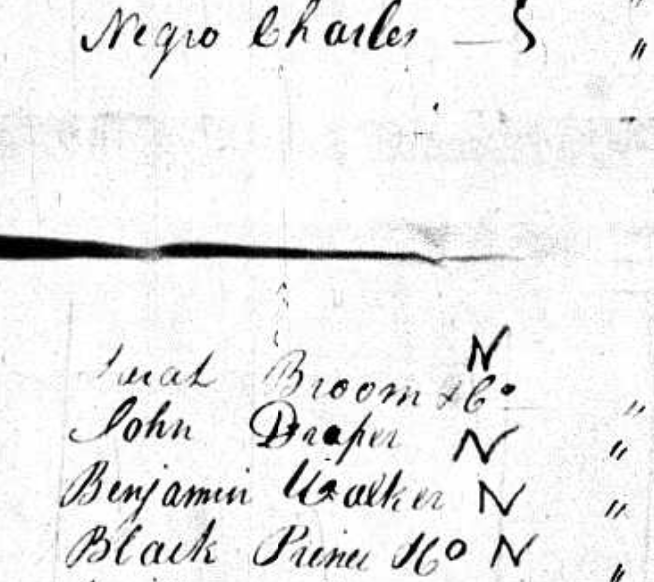
In Search of Dick, a free man of color from Bennett’s Point, Queen Anne’s County, Maryland

As we continue to trace persons enslaved by Richard Bennett III of Bennett’s Point, Queen Anne’s County, on the Eastern Shore of Maryland, I have been intrigued by the case of “Dick,” the only enslaved person whom Bennett manumitted in his September 1749 will. As I have previously noted, Bennett devotes a paragraph to this manumission and to gifting Dick his carpentry tools and apparel:

Will of Richard Bennett III, Sept 1749. Sets Dick Free.

“Item, I do give my Negro man Dick the carpenter his freedom and hereby manumit and set free and at full iiberty my said Negro man Dick, and do him hm all the chest of tools and other tools of every sort which he usually works with, and do also order my executor to give the said Negro Dick one suite of Cloathes made of narrow cloth of shilligngs stocking of hard, two shirts of Irish linen of one shilling and five p? of yard and two shirts of spring ozenbuggs? line, one part of good shoess and one part worsted stockings. one castor hatt and two Romal hankerchiefs. ” (p. 476)

It seems likely that Dick is the same person referenced sixteen years earlier in Criminal Court proceedings in adjacent Kent County, as having been improperly married to a white woman, Amy Nabb, a “spinster,” without due authorization. The court in its August 1734 session sanctions neither Dick nor Amy, but rather the Anglican Rector of Shrewsbury Parish, Rev. Richard Sewell, who one year earlier (22 July 1733) had performed the wedding ceremony:

“Richard Sewell of Shrewsbury parish [on the] twenty second day of July at the parish afd [aforesaid] in the County afd within the same Jurisdicion did joyn Negro Dick the proper slave of Richard Bennett Esq.r and Amy Nabb of the same parish and CountySpinster then within the same parish residing in Marriage without any publick cation according to the rubrick of the Church of
England of their intent to Marry at any Church or Chappel
..”

Rev. Sewell acknowledged the charges against him, and the Court fined him as follows:

Kent County Court. Verdict of Richard Sewell for marrying Negro Dick with Amy Nabb, spinsiter. August 1734

The afd (aforesaid) Richard Sewell be find [fined] the sum
of five thousand pounds of Tobacco Debt according to Act of
Assembly in such case made and provided as a fine for
joyning the afd Negro Dick and Amy Nabb in Marriage
Contrary to the Act of Assembly thereof in such case made
in form afd confest and also pay the sum of two hundred
and ninety eight pounds of Tobacco costs accruing on the
premisses afd to the officers of this Court &c”
(Source: Archives of Maryland. Vol 567, pp, 551-52. Kent County Criminal Court Records, 1728-1734
https://msa.maryland.gov/megafile/msa/speccol/sc2900/sc2908/000001/000567/html/am567–552.html

The first church in Shrewesbury Parish, one of the oldest Anglcian parishes in the Province of Maryland, was constructed around 1693 at the head of Turner’s Creek, and rebuilt in brick in 1729. The parish had initially been within the bounds of Cecil County, but is now located in Kennedysville, in northern Kent County, about 45 miles north of Bennett’s Point, the principal residence of Richard Bennett III after his marriage to Elizabeth Rousby.

In 1697, Rev Richard Sewell was appointed by Governor Rev. Francis Nicholson to what were known as the two parishes of Cecil County, North and South Sasafrass, which encompassed Shrewsbury.

Richard Bennett III asserted that all his enslaved people were instructed in the Catholic faith, so it is a little puzzling that Dick was married in an Anglican ceremony; perhaps Rev Sewell was the only local clergyman willing to perform the nuptials.

In any event, Rev Sewell appears to have been well situated in the county. His daughter Mary Anne Sewell married Thomas Hepbourn around 1745 and bore at least four children. i do not see any other criminal complaints recorded against him during his long tenure in the parish.

The Shrewsbury Parish records (MSA SC 2513-1, M 339) record weddings, births and deaths in the parish during the 1730s, but I see no reference to the matrimony of Amy Nabb and Dick. Perhaps, given the legal complexities, the reference was deleted from the register.

Who was Amy Nabb and how did Dick know here?

Richard Bennett owned extensive land in Kent County, including in Shrewsbury Town, evidently near the church where the 1733 wedding was conducted. In 1692, Bennett acquired Worton Manor on Steel Pond Creek in Kent County, a property he subsequently resurveyed and expanded; it is possible that Dick was placed at one of Bennett’s Kent County properties the 1730s and met Amy Nabb there, or they may have had a different connection.

I have not yet seen another reference to an Amy Nabb in Eastern Shore records.

I see two Nabbs in Kent County late 18th century records:

  1. Elisha Nabb, who served in Maryland’s Captain John Dane’s Company (Queen Anne’s County) during the American Revolution, who is listed in the Kent County assessment records in 1783 (Elisha Nabb. KE 1st District, p. 10. MSA S 1161-7-1 1/4/5/50) and in the 1790 census, when he owned 8 slaves; he subsequently moved to Havre de Grace.

2, Margarette Nash in the 1790 census in Kent County, owning five slaves.

Perhaps, Amy Nabb was a daughter of John Nab or Nabb, who died in Queen Anne’s County in 1710 or his brothers Charles Nabb and Richard Nabb, all sons of John Nabb who died in 1707. Charles Nabb married Elizabeth Wyat on 20 Apilr 1737 in Queen Anne’s County. James Nabb, whose will is dated 1 December 1756, names his wife Elizabeth his executor. In turn Elizabeth Nabb (widow of James Nabb) died in 1768 and leaves her estate to be divided among her children, none of them named Amy. Joseph Nabb, who died in 1776, mentions his daughters Rebeccah and Mary (?) but no Amy.. The 1776 Maryland census for Queen Anne’s County lists a Sarah Nabb, in the Town Hundred (MSA Box 2, f. 19, p. 4. MSA S 1419-11-11773)

What was the relationship between Dick and Richard Bennett III?

Since “Dick” is a nickname for Richard, the same first name as Richard Bennett, and since Dick was the only slave of Bennett’s to be privileged with manumission (and accorded matrimony with a white woman by Reverend Sewell) it seems a reasonable hypothesis that Dick was the biological son of Richard Bennett III and an enslaved woman.

Presumably, after the 1734 court ruling the marriage of Dick and Amy ceased to have any legal force: I do not know if they continued to cohabit. Any child birthed by Amy Nabb, as a white woman, would have been considered freeborn and not enslaved. It is possible that Dick sired children with an enslaved woman or women on the Bennett plantation or elsewhere; if so, all the children mothered by enslaved women would have legally been considered enslaved.

What happened to DIck?

The 1776 Maryland census does not list a free Black man “Dick” in Queen Anne’s County, but does list a free Black man “Dick” residing in Mill Hundred of adjacent Talbot County (Box 2, f. 23, p. 5. MSA S 1419-1-11835)

Regularized freedom certificates were not issued in Maryland until 1805, which was probably too late to record Dick, who might have been born around 1710. The Register of freedom certificates in the state may well have recorded his descendants. (See QUEEN ANNE’S COUNTY REGISTER OF WILLS (Certificates of Freedom) MSA CM856-1 and MSA CM856-3)

I would be grateful for any guidance as we search for records of the free man Dick and his descendants.

In search of the enslaved man Jack Gooby, from Bennett’s Point, Queen Anne’s County, and his descendants

I have been trying to trace enslaved people held at Bennett’s Point on Morgan’s Neck in Queen Anne’s County, Maryland, referenced in the 1749 will of Richard Bennett III. (Our information on these enslaved people is limited because it appears that no probate inventory of Bennett’s estate was taken, perhaps because neither he nor his principle heir and executor, Col. Edward Lloyd III (1711-1770), has substantial debts to settle.

One of those named in the will is the enslaved house servant Jack Gooby. In his original will Richard Bennett III bequeaths “Jack Gooby that attends the house” to his cousin John Rousby (who inherited the property on Morgan’s Neck where Bennett had resided). However, in the third codicil to his will Bennett makes an alteration: “My negro Jack Gooby that attends in the house, given by my will to cousin Mr. John Rousby, I now give to cousin Edwd. Tilghman.” (Bennett also bequeaths, “To Mr. Edward Tilghman, for his trouble in writing this will & other services, 100 pounds”)

This was Edward Tilghman, Sr, “Of Wye,” 1713-1785, a prominent planter and politician who served as High Sheriff and Justice of Queen Anne’s County, Colonel in the Maryland militia, member and speaker in the Maryland Assembly, and representative of the colony to the “Stamp Act Congress’ of 1765. He owned Whitehall Plantation, which he passed on to his son Edward Tilghman, Jr in 1772; around 1774 he also seem to have transferred 24 slaves to his children.

Jack Gooby then appears over three decades later in the will of this same Edward Tilghman (of Wye), Sr, testated in 1785. Tilghman asserts that Gooby had, back in 1749, requested that he be willed to Tilghman, and asks that Gooby be treated with special consideration by his future owners:

Will of Edward Tilghman, 1785, giving Jack Gooby choice of masters

“As by his own request he was bequeathed to me as I have been informed my man Jack Gooby I desire may choose his own master or mistress among my Children. I do give bequeath him to whomever he desires. I desire he may be treated with something (sic.) more Tenderness than slaves generally are depending upon his Gratitude for doing whatever he can towards his suppo

rt. He is ailing I believe.” (Queen Anne’s Wills 1777-1785 vol 1, p. 281.)

Tilghman also notes in the will, “I give and bequeath unto my Daughter Susannah five hundred pounds lawful money and the mulatto girl Polly who waits in the House daughter of Jack Gooby over and above the share of my personal estate as atd (attested?)” I have not seen a reference yet to who Jack chose as master or mistress, although it may be that he chose to be transferred to Susanna Tilghman (later Susanna Jones) in order to remain close to his daughter Polly.

Thomas Goody: Possible Kin of Jack Gooby?

Beatriz Hardy (Goucher College) notes that the Black man Thomas Gooby is repeatedly referenced in the 1769 and 1770 diary of Jesuit Father Joseph Mosley, as serving as godfather to fthe baptisms of five Black children. Fr. Mosley, SJ, was during this period assigned to St. Joseph’s Tuckahoe and St. Peter’s Queenstown on the Eastern Shore, which included many Black enslaved and free communicants (Source; Archives of the Maryland Province of the Society of Jesus at Georgetown University’s Special Collections)

25 July 1769: Mary ngo (negro), godfather Thos. Gooby ngo and godmother Sue

25 July 1769 Isbabell Ngo, godfather Thos. Gooby ngo and godmother Betty ngo

25 July 1769 Frances ngo, godfather Thos. Gooby ngo and godmother Marina

4/15/1770 Isabella N., godfather Thos. Gauby and godmother Elizabeth

5/6/1770 Richard N., godfather Thom Gouby N. and godmother Judith N.

Thomas Gooby at the time of the baptisms in 1769-70 was age 72, the oldest enslaved person on a Blake family plantation on the Wye River in Queen Anne’s County. I believe this was the former plantation of Charles Henry Blake, who was married to Henrietta Lloyd II, half sister of Richard Bennett III, who served as a testator to Charles Blake’s will in 1732. (Source: Beatriz Betancourt Hardy, “The Papists..have shewn a laudable Care and Concern: Catholicism, Anglicanism and Slave Religion in Colonial Maryland, ” MARYLAND HISTORICAL MAGAZINE, VOL. 98, NO. I (SPRING 2003).

Perhaps Thomas Goodby was the father, uncle, or cousin of Jack Gooby.

Kennersley and Swan Point Connections?

I am not sure what became of Jack Gooby or his daughter Polly (Gooby?) after 1785. Shortly after her father’s death, Susanna Carroll Tilghman married Richard Ireland Jones, who legally acquired her property. On her land on Southeast Creek he began to build in the late 1780s the plantation house known as Kennersley or Kinnersley, which still stands on Southeast Creek Road, Church Hill in northern Queen Anne’s County.

Susanna appears to have died around 1800 (I have not found clear information on her death). She and Richard Ireland Jones had only one child, Arthur Tilghman Jones Sr, 1787-1849,who, according to secondary sources, inherited both land and slaves from his mother. (I have not located Susanna’s will or other probate records in Queen Anne’s or Kent County records).

After the War of 1812, Arthur Tilghman Jones Sr ,filed for compensation for the escape on a British naval vessel from his Swan Point ( Kent County MD) farm, on September 16, 1814 of the following freedom seekers; Jacob Murray, Delilah Murray, George Horner, Abraham Lyles, John Chambers, Hannah Lyles, Elijah Lyles, and Polly Chambers. The British ship had traveled along the Patapsco River after the attack on Baltimore and anchored at Swan Point, where it boarded these self-liberated people.

The freedom-seeker Polly Chambers was 17 years old at the time of her escape, so born around 1797. One wonders if she might be the daughter of, or otherwise related to, the mulatto “girl” Polly Gooby, who, as noted, had been inherited by Susanna Tilghman (Jones) in 1785. If Polly Gooby was, for instance, 15 at the time of Edward Tilghman’s death, she would have been born around 1770.

Also escaping in the same event was 18 year old John Chambers, perhaps the husband or brother of Polly Chambers. John served in the Second Company of the (British) Colonial Corps of Marines. “In December 1814, he participated in the British invasion of Cumberland Island in Georgia, which liberated many enslaved people. I believe the Corps was then stationed in Bermuda, until they were disbanded. During 1815-16, John Chambers was one of about 800 former Black troops settled by the British on designated land in southern Trinidad, establishing the so-called “Merikin” community. “By 1823, however, Chambers had moved to the Fourth Company’s hospital for “mal d’estomac,” now understood as hookworm.” (Source:https://msa.maryland.gov/megafile/msa/speccol/sc5400/sc5496/001600/001610/html/001610bio.html) Weiss, John McNish, The Merikens: Free Black American Settlers in Trinidad 1815-1816. London: McNish & Weiss, 2002). I do not known if he was an ancestor of the prominent politician George Michael Chambers, 1928-1997, who served as Trinidad and Tobago’s Second Prime Minister,and who was the son, I believe, of George Basil Chambers.) I am not sure if Polly also settled in Trinidad.

In 1822, Susanna’s son Arthur Tilghman Jones, suffering extensive debt, sold 19 enslaved people, some or all of whom had been inherited from his mother Susanna: Solomon, William, Charles, Metus, Frank, Dick, William, Mitty, Kitty, Emory, Anna, Sally, Bill, Edward, Betsey, George, Charles, Metus, Bill. I am not sure if any of these individuals were kin to Jack or Polly Gooby.

Other Possible Jack Gooby Descendants

Various enslaved and free persons of color with the surname Gooby on the Eastern Shore may be direct or collateral descendants of Jack Gooby and his daughter Polly.

  1. The will of Arthur Emory in Queen Anne’s County, 8 March 1807, proved 7 April 1807, manumits a Lucy Gooby, with her freedom to commence 8 March 1824.
  2. The 1850 census in Queen Anne’s County, District 3, records a free man of color, Charles Gooby, born around 1810, residing in the household of the white farmer James Burris.
  3. Robert Gooby, born around 1832, enlisted in Baltimore on 21 September, 1863 in United States Colored Infantry Regiment 7, Company G, He mustered out in Indianola Texas on 13 October 1866. On 5 December 1866, his former owner Miss Louisa Tilghman claimed compensation for his enlistment during the Civil War. Louisa writes she had inherited Joseph from the estate of her father, William Gibson Tilghman, 1785-1844, of Baltimore, who was the son of Richard William Tilghman, 1739-1809, son of William Tilghman, 1711-1782, brother of Edward Tilghman, who had inherited Jack Gooby from Richard Bennett in 1749 and who passed Jack Gooby on to one of his children in 1785.

Robert appears in the 1870 census in Talbot County living with Annie Gooby, age 50 (born about 1820), his likely mother. He is married to Betsy Gooby, with children Alice and William.

  1. In the same USCT regiment is Private Joseph Gooby, perhaps Robert’s brother, born around 1830 in Talbot County. Joseph Gooby also enlisted on 21 September 1863, and served in the United States Colored Infantry Regiment 7, Company C (unlike Robert who served in Company G). He was mustered out of the Army on May 3, 1865, from the US General Hospital in Norfolk, VA, on account of disability: he had sustained a wound to his hip, evidently in the Battle of Chaffin’s Farm and New Market Heights, September 1864, in the Siege of Petersburg. leaving him paralyzed in one leg.

As she did with Robert, his former owner Louisa Tilghman also claimed compensation for Joseph, noting that she had acquired him in 1844 though the division of the estate of her father William Gibson Tilghman in Baltimore.

1866. Miss Louisa Tilghman files for compensation for Joseph Gooby’s enlistment.

After the war, Joseph was one of the founders, with other USCT veterans, of Unionville, Maryland. On 12 March 1869, Joseph opened a Freedman’s Bank account in Baltimore, giving as his residence Easton in Talbot County and noting that in case of illness or death, his wife Mary was to have access to the deposited funds.

In 1875 (or earlier) Joseph married Mary E Roberts; their children included born 1876, Kate Goodby, b 1877, Emma Gooby, b 1879, Henriette Gooby, b 1879, Tilghman Owens Gooby, b 1880, Mary E Gooby, 1885, Anna Gooby, 1889, Laura Gooby, 1893, and Lillie Gooby, 1895.

Joseph Gooby, Freedman’s Bank account application, 1869, Baltimore.

Joseph Gooby died in 1901, and was buried in Saint Stephens Church Cemetery in Easton, Talbot County

The first name of his Joseph Gooby’s son, Tilghman Owens Gooby, emphasizes a connection to the Tilghman family. Tilghman Gooby appears in 1910 in the Baltimore City Directory as a porter. He later appears in the 1940 census, married to Rachel Ennels. Their children included Joseph Gooby, 1926-1995; Robert Owen Gooby, 1937-2012, Samuel Gooby, and Emma Gooby.

It is hoped that future research will cast more light on the descendants of Jack and Polly Gooby and others formerly enslaved by Richard Bennett III of Bennett’s Point.

Acknowledgements: Many thanks to William Kelly and Chris Haley, Legacy of Slavery in Maryland Project, Maryland State Archives, for research guidance. Dean Bea Hardy (Goucher) is an invaluable source of insight into Richard Bennett III and his Eastern Shore Catholic contemporaries.

Sources.

Kelly, William. Black Freedom Seeking During the War of 1812: From the Chesapeake, Cumberland Island, and Beyond Part 2, National Park Service.

Weiss, John McNish, The Merikens: Free Black American Settlers in Trinidad 1815-1816. (London: McNish & Weiss, 2002).

Guide to online resources about Barry Farm

Cindy Claure-Veizaga has created this guide to online resources about Barry Farm in Anacostia, Ward 8. Washington DC. This serves as a supplement to the student-authored website, Southeast Voices: History and Memory in Barry Farms, Ward 8 (Holding on to Home: The Untold Story of Barry Farm)

See all student-authored online community research exhibits for Dr. Auslander’s Raceaand Racism (Anth 210) Fall 2025, American University at: https://markauslander.com/2025/11/25/community-research-projects-race-and-racism-anth-210-fall-2025-american-university/

1. Barry Farm Documentary: Community, Land, and Justice in Washington DC. A History of Community Building and Displacement

Overview The video introduces Barry Farm as a site with a long history of community building and subsequent displacement in Washington D.C From indigenous communities to formerly enslaved people building a thriving Black community, and later a public housing complex, the area hasundergone continuous shifts. The rapid pace of gentrification continues this cycle, displacing residents and tearing down homes (1:12-1:41).
—Barry Farm: A “Gold Mine” for Developers.

Residents express their sadness and disbelief at the demolition of their homes. One community member states, “Now you’re just here the demolition and homes being torn down… this is like a lot of land, this is like a gold mine to the developers” (2:00-2:10). This highlights the economic forces driving the displacement, where land is seen as a commodity rather than a home.


The Origins of Barry Farm: From Plantation to Freedmen’s Village

The film delves into the origins of Barry Farm, revealing it was once a plantation owned by a slave-owning planter named Barry (3:28-4:53). After the Civil War, the Freedmen’s Bureau
purchased this land and sold plots to formerly enslaved people. This allowed them to build a life for themselves, though residents note, “this wasn’t even that, this was people who purchased the land right, they weren’t given the land… I still feel like it was really their birthright to be able to be landowners because that was one of the many things that had been denied them for so longeven though they work the land themselves” (7:15-7:39).


A Thriving Black Enclave and Homeownership
Early residents of Barry Farm, including reverends, teachers, builders, and farmers, created a“thriving black enclave” (12:11). They built their homes and cultivated their land, creating asuccessful neighborhood. The video emphasizes its legacy as “a black ownership community inD.C” (12:54-13:00). A descendant of Emily Edmondson, one of the founding members who escaped slavery, reflects on the freedom he now has to walk the same streets his ancestors had tosneak through for freedom, saying “it just resonates with me that not long after they had to sneakthrough those streets for freedom I had the freedom and I could just walk those streets”
(13:51-14:01).

The Public Housing Era: A Haven and A Home
In the 1930s and 40s, a public housing complex was built on Barry Farms due to segregation,offering housing to African Americans who migrated to D.C. Residents describe it as a “perfectcommunity, a haven” (16:43) where “everybody took pride and kept their homes up” (16:47-16:59), highlighting the strong sense of community and support.

Civil Rights Activism and the Fight for Dignity
Barry Farms was the core of Civil Rights activism. Students from the dwellings successfully
challenged segregation in D.C. public schools (24:09-24:30). The “Band of Angels,” led by Miss Etta Horn, fought for the rights of welfare recipients, ending intrusive home investigations and advocating for dignity. A resident recalls the feeling of activism “it made you feel wonderful, it made you feel good you were doing something” (27:54-28:00).

The Rise of Go-Go Music and the Junkyard Band
Barry Farm became an “epicenter for Go-Go” (31:40-31:43), with the Junkyard Band emerging from the neighborhood. Members of the band, who started with homemade instruments, credit their roots, “wouldn’t be no junkyard without Barry Farms because we are very fun”
(32:00-32:05).

Go-Go music provided a unifying force, bringing people together. (31:12-31:15)


Neglect, Stereotypes, and Displacement
Decades of neglect led to the deterioration of the dwellings, and Barry Farms became unfairly“synonymous with drugs and crime” (35:58-36:01). Despite the negative stereotypes, residentsmaintained a strong sense of community, stating, “it’s still overall a good place, a lot of peopleneed these houses, it was a lot of families here that were my family over there, family, family”
(36:34-36:45).

This section concludes with the heartbreaking reality of mass displacement, a
“nightmare” (40:39-40:41) with residents unsure if they will ever return.


A Fight for Preservation and Sacred Space
In 2019, residents organized to preserve some of the remaining homes as historic landmarks, advocating for their history to be remembered and their stories told. One resident passionatelystates, “what remains of Barry Farms is too important in the development of this city to go thebulldozer” (46:07-46:13). While only five dwellings were preserved, it was a significant step.

The section ends with a powerful reflection on Barry Farm as a “Sacred Space” (47:39-48:16), aplace where “blood, sweat, and tears” (48:24-48:34) were shed, and where joy and triumph were also found.


2. We Shall Not Be Moved: Stories of Struggle from Barry Farm–Hillsdale
Stories of Struggle from Barry Farm–Hillsdale
(on line exhibiiton: Anacostia Community Museum, Smithsonian)

Barry Farm–Hillsdale was founded in 1867 as a place where formerly enslaved African
Americans could own land and build independent lives. For generations, residents created
homes, churches, schools, and political networks rooted in self-determination. Even after
demolition in 2019, the community’s legacy of resistance and organizing endures.


Building Freedom After Emancipation

Land ownership was central to freedom at Barry Farm–Hillsdale. Residents built homes and
institutions with limited resources, shaping a strong sense of independence and political
awareness. Longtime resident Pierre McKinley Taylor recalled early life without basic
infrastructure, “When we first moved on Nichols Avenue we didn’t have running watter… Youeither had a well or you had a system.”

Place, Memory, and Community Roots
An 1867 map shows Barry Farms–Hillsdale as a connected community of families, churches, and schools. Leaders such as Frederick Douglass Jr. and Solomon G. Brown lived alongside working families. Churches like Mt. Zion AME and schools such as Howard School anchored civic life, reinforcing how land and place shaped belonging.
Voting Rights and Women’s Political Action
Residents viewed voting as essential to full citizenship. In 1877, men and women from Barry Farms–Hillsdale signed a petition to Congress demanding women’s suffrage. Their action linkedlocal struggle to national movements and showed a belief in shared political responsibility acrossgender lines.


Fighting for Basic Services
For decades, the neighborhood lacked running water, paved streets, and sanitation. Residentsorganized repeatedly for essential services while adapting to neglect. Reliance on wells andrainwater was both a necessity and a reminder of unequal treatment by the city.

Resisting Redevelopment and Displacement
Beginning in the 1940s, officials labeled Barry Farm–Hillsdale a “slum” to justify demolition. Residents rejected this narrative and fought back. Activist Ella B. Pearis remembered confronting Congress directly, “They said this was a slum… We went to congress… We defeated them.”


Challenging Segregation
Residents protested discrimination in employment and public spaces. During the 1940s, pickets targeted White-owned businesses that refused to hire Black workers. Activist Norman E. Dalelater believed his military draft was retaliation, revealing the personal risks of resistance.

Integrating the Anacostia Pool
African Americans were barred from the Anacoatia Pool, forcing children to swim in the
dangerous river. In 1949, youth from Barry Farm–Hillsdale challenged segregation through
repeated attempts to enter the pool. After arrests and clashes, the pool reopened in 1950 as an
integrated facility without incident.

School Desegregation and Its Limits
Families from Barry farm–Hillsdale challenged segregation through Bolling v. Sharpe. While theSupreme Court ruled segregation unconstitutional, residents knew legal change was not the same as social equality. Gerald B. Boyd explained: “There is a difference between desegregation and integration… integration… is mental.”
Black Power and Community Control
In 1966, Stokley Carmichael spoke at Barry Farms Dwellings, popularizing the phrase “BlackPower.” The message resonated with residents who already practiced autonomy throughorganizing and mutual aid. They rally connected the neighborhood to a national movement for political independence and cultural pride.
Women, Welfare, and Housing Justice
Women led some of the most powerful organizing efforts. The Band of Angels fought for safe housing, welfare rights, and health care access. Lillian Wright summarized their philosophy,

“Since we live here, we are best qualified to advise… how the funds should be spent.”
Youth Leadership and Community Care Residents invested in young people as a form of resistance. Founded in 1966, the Rebels with a cause provided jobs, recreation, and mentorship to more than 1,500 youth. Their work offered alternatives to criminalization and strengthened community pride.
Environmental Justice and Health
In the 1990s, residents confronted toxic pollution from the Navy Yard contaminating the
Anacostia River. Activists like Dorothea Ferrell demanded accountability, linking Barry
Farm–Hillsdale to broader environmental justice struggles affecting Black communities.
Demolition, Loss, and Preservation

In 2019, Barry Farm Dwellings were demolished, displacing residents and erasing historic
structures. Yet organizing continued. Advocate Daniel del Pielago reflected, “An organized
group of people can win something, even if it wasn’t what we ultimately wanted.”


Why These Stories Matter
Barry Farm–Hillsdale’s history shows how Black communities resist erasure through collective action. Centering residents’ voices reminds us that struggles over housing, land, and power are ongoing and that this community’s legacy continues to shape fights for justice today.

Barry Farm–Hillsdale: Uplifting a Living History, Ensuring a Just
Future

Barry Farm–Hillsdale is a sacred site in Washington, DC, rooted in Black land ownership andcollective struggle since 1867. What remains today, five historic buildings and streets named forabolitionists, stands as evidence of generations who built community, resisted displacement, and
demanded justice.Preserving this site ensures that Black history is not erased amid rapid
gentrification.


Land, Memory, and Belonging
The land that became Barry Farm–Hillsdale has long been a place of belonging, from the
ancestors of today’s Piscataway people to formerly enslaved African Americans seeking freedom after the Civil War. Residents built schools, churches, and businesses, forming a self-sustaining community known as Hillsdale. Land ownership was not only economic security, but a foundation for dignity and identity.


Displacement and Survival
Government actions repeatedly disrupted the community. The construction of Suitland Parkwayin the 1940s displaced hundreds of residents, and public housing development replaced land taken from Black homeowners. Despite this, residents continued to organize, desegregate schools, and fight for fair treatment, proving that community life endured even under structural violence.


Organizing for Justice
Barry Farm–Hillsdale was home to national leaders in civil rights, welfare rights, and housing justice. Tenant leader Etta Mae Horn helped found the National Welfare rights Organization and advised Dr. Martin Luther King Jr. during the Poor People’s Campaign. The community’s legacy shows how local organizing shaped national movements for economic justice.

Culture as Resistance
Culture has always been central to Barry Farm’s resilience. From the Goodman League
basketball program to the formation of the Junkyard Band, residents created spaces for joy,
creativity, and connection. These cultural institutions remain active today, carrying the
neighborhood’s history forward and linking past generations to present-day DC

Barry Farm as a Sacred Space
Community members describe Barry Farm not just as housing, but as home. Junkyard Band
member Vernell “Wink” Powell captured this feeling, saying: “Barry Farm, to me, was like one big old grandma house.” His words reflect the care, familiarity, and shared responsibility that defined daily life in the community


Preservation Is About People

Preservation at Barry Farm–Hillsdale is not only about saving buildings, it is about honoringlives, dreams, and struggles. As ANC Commissioner Ra Amin stated during a preservation hearing, “Historic preservation is more than just buildings. It’s about people, it’s about dreams.” This perspective centers residents as the heart of preservation efforts

3. Website: Designing a Just Future

https://www.dclegacyproject.org/


The DC Legacy Project envisions the Barry Farm site as a living museum and active community space. Through design workshops and public engagement, former residents and allies imaginedspaces for learning, healing, organizing, and entrepreneurship. These plans emphasizecommunity control, cultural production, and economic opportunity rather than erasure

Why This Resource Matters
The Design Resource Booklet shows how history, design, and community organizing come
together to resist displacement. By centering resident voices and collective memory, the projectinsists that Barry Farm–Hillsdale remains a place of pride, resistance, and possibility past, present, and future


4. Barry Farm: Past and Present Part 1 (Youtube Video)
The Historic Significance of Barry Farms

https://www.youtube.com/watch?v=vp8mOTJKq9M

Barry Farms holds a profoundly significant place in American History as the first free Black
community established in Washington, D.C after the Civil War (1:18-1:26). It was the initial
place in the district where black individuals could own property, a pioneering “model
community” (1:26-1:53).


The Origins: From Plantation to Community
The community’s name directly reflects its origin: it was once part of a large tobacco farm
owned by James Barry in the mid-19th century (3:06-3:27). This substantial 375-acre tract was later purchased by General Howard and the Freedmen’s Bureau. The intention was to sell one-acre lots to newly freed slaves, allowing them to work in the city or cultivate their land (3:37-3:57).


Early Life and Self-Reliance in Barry Farms
Barry Farm exemplified the industry and aspirations of African Americans (4:01-4:07).
Residents lived in clapboard cottages and raised animals, demonstrating remarkable self-reliance (4:10-4:21). Despite the primitive circumstances, it served as a powerful “reputation of the stereotype that blacks were ignorant and lazy” (5:05-5:14). It became a “shining example of what could happen if you only gave African-Americans a chance” (5:21-5:25).

The early residents were true heroes, clearing land, building homes with minimal tools, and walking long distances to work (6:06-7:10). Many paid for their lots through a purchase-lease program where money was deducted from their pay (7:12-7:27). Moving to Barry Farm required “a tremendous leap of faith and an absolute demonstration of rock solid courage” (7:53-8:00).

This was due to the dangers posed by hostile white attitudes and even violence from slaveholders
(

8:18-9:12). The Decline and Challenges Faced
Over time, the community faced significant challenges. The city was “incredibly cruel and mean” (9:27-9:28) to Hillsdale, including Barry Farm, leading to overcrowding and the construction ofpoorly maintained public housing (9:33-9:57).
Infrastructure developments like the Baltimore Railroad and I-295 cut off the community’s
access to the Anacostia River (10:57-11:33). This hindered their economic ventures like fishing and selling goods. The video states that “government encroachment” and “private business encroachment has eaten up the edges of Barry farm for highways and businesses”

(11:55-12:00). Community Spirit and Nostalgia
Despite the hardships, the early Barry Farm community was described as “beautiful”
(12:20-12:20). Residents recalled a time when “if you leave your back and front door open
nobody will walk in and steal anything” (12:32-12:38). Another thing to mention was that
neighbors were “just like family, they looked up to one another” (12:40-12:44), and it was a
“calm clean quiet community” (12:53-12:58).

There was a strong sense of unity and mutual support, with families communicating, working together, and participating in co-ops and youth activities (13:30-14:00). A former resident fondly remembers, “everybody was calling that’s my cousin or that’s my friend it’s my schoolmate and they confide in each other very well and I would love to see that again” (15:54-16:07).


Notable Figures and Their Impact
Solomon G. Brown (19:33-22:50), an incredibly influential figure from Barry Farm, born in
Washington D.C in 1829. He was a self-taught “renaissance man” (20:44-20:46), excelling in
poetry, natural science, biology, and geography.
Brown was a respected scientist and one of the longest-serving employees at the Smithsonian Institution. He also represented the community in the territorial government, elected by both Black and White residents. He was instrumental in bringing city services like sewers and water to the area.

One young resident expressed admiration, stating, “I would be like Solomon G Brown cuz
Solomon G Brown he came from like he came from nothing for real he came from like scratch”(22:06-22:12), highlighting his journey from poverty to prominence.
Frederick Douglass (23:59-26:50): Though he later moved to Cedar Hill, Frederick Douglass
and his family had a significant presence in Barry Farm. His sons, Charles and Frederick
Douglass, lived in the community since 1867 and were instrumental in its early organization. Charles Douglass became a School Board president, and Douglass Elementary School was named for him. The Douglasses’ involvement underscored the community’s prominence.

Samuel Edmonson (26:54-29:29): A key figure in the Pearl Escape, a significant slave escape attempt in 1848. Samuel Edmonson, from Barry Farm, played an integral role in planning andexecuting the escape, demonstrating immense courage and a fight for freedom. His story is seen as an example for young people seeking change in their lives (29:13-29:26).


General Howard and the Freedmen’s Bureau
General Howard was appointed by President Abraham Lincoln to lead the Freedmen’s Bureau(30:44-31:00). His role was to help resettle displaced people and educate newly freed men and women (31:51-32:05). Faced with immense opposition, Howard established a trust with SenatorPomeroy and hardware magnate Elvin to purchase the Barry Farm land (32:15-33:25).

A crucial aspect of this initiative was that the land was purchased by three African-American colleges (Howard and Lincoln mentioned), and the money from the sale and rental of lots went back to fund these institutions, including Howard University (33:55-35:10).

This “wonderful experiment” (35:11-35:12) also saw Howard establish Black educational
institutes throughout the South (35:16-35:24), leaving a lasting legacy of education for Black people (35:25-35:36).

Preserving the Legacy: A Disconnect with the Past
The documentary highlights a concerning “disconnect” between the current generation and the rich history of Barry Farm. Many young people living in Barry Farm today are “not even
connected with the fact that the soil that they’re living on was freemen soil” (16:36-16:41).
There’s a desire to advocate for developers to “Salvage this history” (18:41-18:45), but simply naming buildings after historical figures like Solomon G. Brown isn’t enough if the community doesn’t know their stories or their significance (19:26-19:32).

As one young person expressed, “I had to find him on the internet. I didn’t even learn about him in school. I wonder why he is not an out Tex” (22:49-22:54). The film implicitly calls for a reconnection with this vital past to inspire future generations.

Artwork by Izzy Bradbury and a Poem by Nadia Liban, honoring Atwai Bassett

My students Isabella (“Izzy”) Bradbury and Nadia Liban at American University have created two works of expressive art honoring“Atwai” (Deceased) Pochahsquinest Bassett, (1936-1968). Izzy created the multimedia collage piece “At Last!” and Nadia wrote a poem, “I can still see the stars.”

We hope this page will serve as a resource for others learning about MMIW/MMIP and for those interested in promoted art, poetry, and creative expression in support of the MMIW movement.

Background: During Fall semester 2025, students in both sections of my Race and Racism (Anth 210) course at AU have been working to assist the family of Atwai Bassett in reconstructing her life in Chicago, under conditions of Federal Relocation, until she went missing in late spring 1968. I have reviewed what we know of her life in a blog post, using her full name, and some of my students have created a website in her memory. Another student created a website reviewing the entire MMIW Movement. [Now that she has been properly re-interred back in the Yakama Nation, we are following tradition and not identifying her by her full name, but instead using the Ichiskin term “Atwai” (Deceased) for the time being.]

“At Last!” by Izzy Bradbury (a painting/collage)

:At Last” . Artist: Isabella Bradbury, 2025

The title for the art work is ““At Last!” honoring the beloved song of the 1940s that became the signature song of American blues and soul artist Etta James. “At Last!” is also the title of Etta James’ debut studio album, released on Argo Records in November 1960. The album captures the incomparable energy of the city of Chicago on the eve of the 1960s. This is a song that the Atwai certainly would have heard living in Chicago and perhaps danced to.  Hear the song at: https://www.youtube.com/watch?v=1qJU8G7gR_g

The phrase, “At Last” also references our great relief that in September 2025, through the combined work of family members, MMIW researchers, and allies, Atwai at last came home to the land and people who cherish and hold her dear forever.

Visual description of art work: A silhouette outline of the Deceased is shown framed within the American flag and the Yakama Nation flag, which includes an Eagle sacred to the peoples of the Nation, as well as the outline of the state of Illinois, where Atwai lived from 1957 to 1968. Collage images within the outline of Atwai shows scenes from her imagined or reconstructed life in Chicago, including the skyline as it is seen from the Loop or Near North boulevards she often walked on, the American Indian Center that was just a few doors from her hotel in Uptown, some of the wonderful musical artists she might have encountered living on the South Side of Chicago, or heard on the airwaves, the kind of hip clothing including boots she might have worn,  beaded work and Native American jewelry to honor her heritage and the Pan-Indian ideas that were emerging in Chicago on the eve of the Red Power movement. 

Artist’s Statement:  Though this art piece I seek to honor Atwai Bassett, humanizing her and exhibiting her interests in an artistic way. I used her ethnic identities as the background, American, Yakama Nation tribe, and one of Illinois; showing the broader context of her story. But Martha was more than that,  as she had a life with hobbies, interests, and goals, which the public deserves to be more informed about. For the Bassett family, I wanted to make a physical representation of all that Martha had probably enjoyed being a young woman in Chicago. She is at the center of the art as a silhouette, her interests being the main focal point of the collage. (Izzy Bradbury)

A Talking Circle

Reflections by Students

Observations by Nadia: This piece immediately situates Martha Basset within a layered historical context, using the backgrounds of the American flag, Yamaka beadwork motifs, and Chicago’s skyline to visually map the intersecting identities she carried throughout her life. The collage mirrors the conditions caused by the Indian Relocation Act, a policy that pushed thousands of Native people–including young women like Martha–into urban centers with promises of opportunity without structural support from the government. The mixture of beadwork, cultural textiles, and city imagery shows that while she lived in Chicago, her Indigenous identity traveled with her, shaping her life in ways the public rarely acknowledges. In this sense the background becomes not just a setting, but a commentary on how policies were created to uproot families and place Native women into environments where they would become vulnerable.

The silhouette at the center, filled with music icons, fashion references, and a sense of everyday joy–is a refusal of the way Missing and Murdered Indigenous Women (MMIW) cases are often portrayed: reduced to statistics, stripped of humanity. Instead, Izzy fills Martha’s outline with items that feel lived-in, warm, and personal. These elements collectively remind the viewer that Martha was not just a victim, but a young woman with interests, tastes, and aspirations. In bringing the personal and the political together, the piece states that Martha’s story is not only a tragedy, but a statement to resilience, community, and the urgent need to remember her fully.

Observations by Can Yao: At Last!” made me feel the important role of art in memory and politics. The artist uses clipping, drawing and flag methods to present Atwai’s story before our eyes. A young girl with life and dance, dreams, hobbies, and a bright future.

This artwork really touched my heart. The various scenes inside, such as the city’s lights, music, culture, and clothing and accessories. These details can enable us to have a profound understanding of the girl Atwai. This girl who had vanished from history has been brought back to life by the work. A person with family, friends, and a future. On the other hand, the comments of Nadia and many scholars also resonated with me. It made me deeply realize once again that art is not merely a tool for commemoration. Instead, it can bring those who have been neglected back into the public eye once again.

Especially in today’s world where the MMIW/MMIP issue remains very serious, art can serve as a tool for us to speak out for justice. “At Last!” is not just about the past, but also about the future: Atwai has finally “returned home”, but this journey home also reminds us of that memory, respect, and action must all continue.

Observation by Hiba Irmak Kir (Class TA): This artwork offers a compelling reflection of what we currently know about “Atwai” Bassett, even though many aspects of her story remain unknown. The collage—bringing together the cultural landscape of the 1960s along with racial and national symbols, highlights the fragmented nature of American socio-political life. While a sense of coherence is often projected through top-down political narratives, Atwai’s life and cultural engagements reveal the fragmentation and ambivalence of American ideals as experienced from below. Her life stands as powerful evidence of the significance of Indian American heritage and its intersections with African American and gendered forms of resistance to entrenched structures of power.

Reflections by Family, Friends, and Allies:

Emily Washines (Yakama Nation, MMIW advocate): Having artistic expression for our MMIW is a part of helping bring awareness as well as processing the life and events of those we’ve lost. 

Januwa Moja (DC artist, community advocate): To the students who worked on this project (MMIW) Sometimes you have to take a chance and follow your heart to give voice to the voiceless. The collage that was created did just that. You shined a light on a topic that has gone dormant in the mainstream.  May you continue to use your art as an opportunity to speak your truths and  stand in your power. 

Glenna Cole Allee (artist, San Francisco, glennacoleallee.net): My gaze is led around the collage by the painted areas that overarch it. I notice that the edge of the painted flag is in tatters… or is it on fire? And the stars upon the flag have become like flowers. They contrast with the golden stars sparkling in the dark blue sky. 

The collage, partially framed by the painted areas, has many elements of an alter: images that evoke personal possessions, turquoise, beads, and styling clothing that Atwai Basset may have treasured in her time, and music she may have moved through life to. But these elements seem caught up in a wavelike, turbulent sense of motion, rather than still and as they would be if posed upon an alter. This momentum suggests that Atwai Basset’s life was caught up and carried by tumultuous forces.

The collage does also feel like a portrait: animate, as if some watchful spirit is behind all of those bits and pieces. For me this makes it very moving; it is an evocative work, in the truest sense.

Ellen Schattschneider (Anthropologist, Brandeis University, Emerita) writes: I greatly appreciate the interplay of printed images (some of which are partly familiar) and drawn lines, textile surfaces, all framed by what I see as a human shape/torso that seems to hold all of this in its embrace.  The turquoise jewelry “eyes” give the figure an animating depth, leading the view to expect this person will soon have something to say.  This figure is simultaneously intensely private, while at the same time being fully engaged in larger public historical moments–thank you for thisdeeply evocative image!

Jean Comaroff (Anthropologist, Harvard University, Emerita): As somebody once myself drawn to seek my fortune in Chicago, I was deeply moved by this montage, by its juxtaposition of intimate objects, vibrant culture, and urban emptiness. It suggests a place where migrants realize rich possibilities but can also fall victim to failure and alienation; a place of hope, and sometimes of despair. At a time when the city’s migrants have become prey to new forms of violence and disappearance, this work reassures us that there are those watching who will never look away or forget.

 Debbora Battaglia, (Professor Emeritus of Anthropology and Research Associate, The Smithsonian National Museum of Natural History.): I am deeply moved by the energy of recovery that powers this beautiful painting and rings so truly through the poem. Mutually augmenting, that pulsing of image and text is the creative armature of hope for a future of resounding empathy, for Atwai Bassett as for all who are living in vulnerability, undefeated.

Poem by Nadia Liban

I can still see the stars

I left the river and the hills behind,
the cedar scent still clinging to my sleeves,
my mother’s voice is humming somewhere in my bones.
The city came to me with its promises,
its music pouring from open windows
its people moving fast enough to make me believe I could move with them.
Some days I almost do.

There is a rhythm this city beats to.
In the markets, in the sidewalks, in the way the sun slips between tall buildings
or the force of the chilling winds searching for someone it remembers.
I learn new songs on borrowed radios, dance in borrowed rooms,
find pieces of myself stitched to sounds
I didn’t grow up with but still recognize.
I am not a stranger everywhere.

At night, I trace the constellations I remember,
the same ones my mother taught me–
her hand warm around mine,
guiding my finger across the sky
as if she could draw a future there.

The world is big enough to hold everything I was and everything I’m trying to be.

Sometimes a drumbeat finds me–
In passing cars, in upstairs apartments,
in the steady pulse of my own heart.
Then I know:
I am not lost, not broken, not alone.
My story is still breathing,
Woven from mountains and sidewalks,
from old socks and new dreams–
a life larger than fear, than distance,
large enough to shine.

Poet’s Statement (by Nadia Liban) : This piece is meant to humanize Martha’s life through her possible point of view. It explores the in-between of leaving home and finding belonging in a new place. I try to imagine the emotions a young Indigenous woman like Martha might have carried while she navigates a new city. Rather than focus on loss, the piece centers memory, identity, and the small moments—like a mother guiding a child’s hand toward the stars—that continue to anchor someone even far from home. It blends nostalgia with hope, honoring her humanity through the textures of everyday life.

Community Research Projects (Race and Racism, ANTH 210), Fall 2025 American University

“At Last” (Honoring Atwai Basset’s Life in Chicago), Isabella Bradbury, 2025

During Fall 2025, students in Dr. Mark Auslander’s Race and Racism course (American University) undertook small group community research projects, exploring the dynamics of racism, anti-racism, resilience, and resistance in our immediate environs. Many students were deeply concerned by current efforts to reshape historical memory in museums, including the Smithsonian museums. Others partnered with friends in the Yakama Nation to research and honor the life of a woman who had been listed as missing in Chicago since 1968. Other projects explored community struggles and cultural creativity in Ward 8/Anacostia in Southeast DC, and other neighborhoods of the city, as well as racial and environmental justice struggles elsewhere.

Specific project groups include:

I. Missing and Murdered Indigenous Women & and the Martha Bassett Case

Disappeared but Not Forgotten The Crisis of Missing and Murdered Indigenous Women and Girls

—Honoring the Life of “Atwai” (Deceased) Bassett, of the Yakama Nation (Washington State) Community partner: Emily Washines (Yakama Nation):

Artwork and Poetry Honoring “Atwai” Bassett

II. Crises of Public Memory: The Smithsonian and Beyond

The Politics of Historical Memory in Smithsonian Institution Museums (8:10 am section)_

–—Unseen DC: The Contested Archive> Addressing Censorship, Culture, and the Future of the Smithsonian (11:20 am section)

–“From Censorship to Celebration: Re-situating Amy Sherald’s Work from the Smithsonian to the Baltimore Museum of Art

—Imagining a Museum of Black Women’s Experience, in conversation with The Go-Go Museum in Ward 8 (The Celebration of Black Women: Successes and Shortcomings)

III. Memory and Cultural Expression in Ward 8 and “Subaltern DC”

Southeast Voices: History and Memory in Barry Farms, Ward 8 (Holding on to Home: The Untold Story of Barry Farm)

Youth and Inclusion at the Capital Hill Boys Club Intergenerational Gallery Ward 8

Poetry as Resistance: Returning Citizens and Creative Expression (Community Partners; Free Minds; More than our Crimes):

– Visualizing Poetry as Posters (Community Partners; Free Minds Collective:_ 11:20 a.m.

The Art of Luis del Valle (Ward 8): Visualizing Immigration Detention in Washington DC

IV. Partnerships for Justice

The Federalization of Law Enforcement in the District of Columbia (and the Post Racial Myth)

Food insecurity, Housing, and Race. (Community partners: A Wider Circle and NW Community Food)

Environmental Justice is Love. Camden County, Georgia and Environs (Community Partner: Newton Florist’s Club)

History and Memory in Mt Zion/Female Union Band Society Cemetery: The Enigma of Mary Burrell (Georgetown, DC)

The Ahmadiyya Muslim community in Pakistan and worldwide

Objects in Motion: Student Anthropology Projects (USC Capital Campus, Fall 2025)

Overview: During Fall 2025, students in Dr. Mark Auslander’s “Global Studies and Cross Cultural Analysis” course (ANTH205), at the University of Southern California’s Capital Campus (Washington DC) pursued research projects on objects of exchange (primarily international exchange) that have come to rest in the nation’s capital. As a class, we have been especially interested in how social and cultural relations are produced through the exchange of material objects (or in some instances, the exchange of non-human animals) that bind together distant persons and communities, in some cases in relations of general equality and in other instances in hierarchical relations of domination or subordination. Many, although not all of the exchange media in question came to DC because its status as the seat of national government, and are tokens of international diplomatic relations between the United States and foreign governments (or in some cases, international communities that acted outside of the rubric of nation-state systems per se.). We have been interested in the dynamics of full gifts, in which ownership was permanently transferred, in loans, and in commodities, as well as exchanges that are difficult to characterize as one thing or the other.

Interpretive Framework: Our point of departure is Marcel Mauss’ foundational work of anthropology, The Gift (1923-25), in which he famously argues that social relations between similar or dissimilar social groups are built up through exchange processes. In small scale, pre-capitalist societies the gift process functions as a “total social fact” that infuses all significant aspects of the social universe. Gifts are characterized, across the great range of human cultures, by three core requirements: the obligation to give, the obligation to acknowledge the gift, and the obligation to reciprocate (nearly always, to reciprocate with an object that is different from the original gift, but usually of roughly the same value as the original gift). Gifts can bind together persons and collectivities in egalitarian ways, or in ways that are ranked or socially stratified. As the Inuit proverb has it, “As whips make dogs, gifts make slaves.”

Gifts are complex bridges between donors and recipients, embodying the spirit of their origin points and the destination points, and signifying the often fraught relationships between gift-givers and gift-receivers. We have been fascinated by the extent to which in modern, capitalist social worlds, including internationally, gifts continue to create, maintain, or transform human social relationships, especially across great distance and over extended periods of time. How do objects, in motion and in rest, help to shape people’s memories of the past and their visions of the future?

Project Context: Working in small research groups, the students faced challenges during the semester. The longest Federal Shutdown in US history meant that access to key Federal institutions, including the Smithsonian museums, the National Archives and the Library of Congress we limited or restricted. We also operated during a period of the federalization of law enforcement in the District of Columbia, as basic questions about law, community, and the shape of democracy itself were being actively contested and debated.

The projects also reflect the students’ deep interest in issues of power, inequality, poverty and social struggle, which characterized all the classes they took at the Capital Campus (with Drs. Lessersohn, Jacobs, Dinneny, and Chastain, as well as Dr. Auslander) . During the semester we engaged directly with people and communities in precarious situations, including incarceration, post-incarceration, housing insecurity, and food insecurity. Throughout, we gave serious attention to artistic and cultural creativity under extremely difficult circumstances.

The students, pursuing their first semester as University of Southern California students in Washington D.C. before relocating to Los Angeles, thus had a front row seat to history in the making. These projects reflect their experiences here in DC during a pivotal four months in the nation’s history.

Student group research projects include, listed, more or less, in chronological order of gifting:

Gifts by the Japanese Shogunate to Commodore Matthew Perry’ in Japan in 1854 (Smithsonian National Museum of Natural History)

Opium and Opiates as Wartime “Gifts” (from the Civil War to the present)

Memorial markers in Mt Zion/Female Union Band cemeteries in Georgetown, District of Columbia, for Gracie Duckett and the Cartwright family from 1870.

-The Resolute Desk given by Queen Victoria in 1880 to President Rutherford B. Hayes (The White House)

The canoe given to the Smithsonian Institution by Queen Kapi’olani of Hawaii in 1888 (Smithsonian National Museum of Natural History)

-The Trojan archaeological artifacts given by Sophia Schlieman, ‘Heinrich Schlieman’ss widow to the Smithsonian Institution in 1893 (Smithsonian National Museum of Natural History)

Sultan Abdülhamid II’s (Ottoman Empire) photographic albums, presented to the Library of Congress in 1893-94. (Library of Congress)

Harriet Tubman’s Shawl (Gifted by Queen Victoria) in 1897. Smithsonian National Museum of African American History and Culture

-The gift of Cherry Blossom Trees from Japan and the City of Tokyo to Washington DC in 1912. West Potomac Park, and the Militarization of Cherry Blossom Imagery in Wartime Japan, 1931-1945.

Papal and other donations within the Basilica of the National Shrine of the Immaculate
Conception
(from 1920 onwards)

The International Friendship Doll exchange between Japan and the United States (1926-1927), including Miss Japan (Miss Nihon) in the Smithsonian National Museum of Natural History

Japanese Stone Lantern, West Potomac Park, given in 1954 by the City of Tokyo

–The Netherlands Carillon in Arlington Virginia, given by the people of the Netherlands to the people of the United States in 1954

–The loan during the Kennedy Administration in 1963, of the Mona Lisa from the Louvre in Paris France to the National Gallery of Art

-The international loans of giant pandas from the People’s Republic of China to the National Zoo from 1972 to the present

The proposed gift of a 747 Jumbo Jet from Quatar to the White House (2025)

Please share your questions, your reflections on these research projects, and suggestions for further research with Prof. Mark Auslander at markauslander at icloud.com

Remixing Zanele Muholi’s Ntozakhe II: The Echos Project of the Capital Hill Boys Club of Anacostia DC

This weekend (November 21-23) the Umbrella Art Fair (International Square, 1850 K Street, NW Washington DC) features a dazzling installation presented by the Capital Hill Boys Club Intergenerational Gallery. The project emerges out of the celebrated National Gallery of Art exhibition, Afro Atlantic Histories, April 10 – July 17, 2022
https://www.nga.gov/exhibitions/afro-atlantic-histories which originated in a major show at the Museu de Arte de São Paulo and the Instituto Tomie Ohtake in Brazil in 2018, incorporating 130 art works from across four centuries of the African Diaspora.

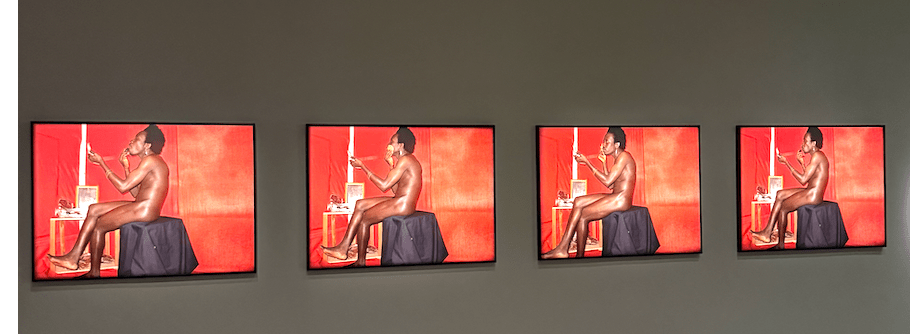
Zaneele Muholi. Ntozakhe II (Parktown)

The exhibition poster feature Zanele Muholi’s Ntozakhe II (Parktown) a striking image of the artist in blackface with an elaborate wig and head-tie, eyes slightly raised. Large format versions of the poster burst upon DC public spaces through the Metro public transit system. At the conclusion of the show, nine of these posters were presented by the National Gallery to the CHBC Gallery, allowing for collaborative projects between professional artists and local schoolchildren, honoring Muholi’s original work through acts of artistic intervention and reinterpretation.The series was first presented in June 2024 at the CHBC Gallery at 16th and Marion Barry, SE (Anacostia, Ward 8_, and is now on view at the Umbrella Art fair.

The original image, Ntozakhe II (Parktown), is part of Muholi’s photographic series of digitally altered self-portraits “Somnyama Ngonyama” (translated by the artist as “Hail, the Dark Lioness”), The projects consists of carefully posed images taken in locations around the world, through which the artist-activist gives voice to a vast number of black South Africans, primarily LGBTQ, regularly consigned by dominant social institutions to the shadows. (I have previously written about the overall project and its evocation of Nguni royal praise poetry at:
https://markauslander.com/2021/10/30/panegyric-imagery-in-zanele-muholis-somnyama-ngonyama/

The artist has remarked that Ntozakhe II (Parktown) is inspired in part by the Statue of Liberty, a work famously presented to the United States by the people of France in honor of Emancipation, later re-conceptualized as a celebration of immigration. Like other images in the “Somnyama Ngonyama” series,the work plays creatively and critically with a long history of colonial blackface and minstrelry, reclaiming a proud and defiant stance of Black feminine and queer subject positions. Other works in the Somnyama Ngonyama series, most notably those titled “Bester” honor Muholi’s mother, who worked as a domestic laborer. It is possible that a trace of his maternal figure informs Ntozakhe as well. The name Ntozakhe, in isiXhosa and isiZulu can be translated as “One who comes with their own belongings,” suggesting a proud lineage that will result in significant inheritance.

Untitled, Brian Bailey Jr., 2024

Proceeding left to right, the first remixed work in the project is Untitled, by Brian Bailey Jr. Over 20 abstract forms, of varying colors, cover the subject’s face, although Zanele’s striking eyes remain visible. I have the strong sense of the swirling energies of a rotating Yoruba Egungun mask in performance, sequined and mirrored cloth trips rising in rotation, cycling the flows of ancestral power and the invisible world into the domain of the Living.

Figura de Poder (2016–2020) by Daniel Lind-Ramos. Mirrors, concrete blocks, cement bag, sledgehammer, construction stones bag, paint bucket, wood panels, palm tree trunk, burlap, leather, ropes, sequin, awning, plastic ropes, fabric, trumpet, pins, duct tape, maracas, sneaker, tambourine, working gloves, boxing gloves, acrylic. National Gallery of Art, Washington. New Century Fund. 2022.6.1. © Daniel Lind-Ramos.

Bailey may have drawn particular inspiration from one of the most striking works in the 2022 exhibition, Daniel Lind-Ramos’s Figura de Poder (2016–2020) created from found materials of the Afro-Puerto Rican community in Loíza, northeastern Puerto Rico. The work itself does appear to evoke Egungun shapes, consistent with the Ogun festival and other Yoruba-inflected performances.

“Bloom” Naje Fields, 2024

The second reworked poster, “Bloom,” by Naje Fields, may be in conversation with the CHBC mural “Bloom” by Nonie Dope, which transforms bullet holes into blooming flowers. Fields’ interpolations incorporates raised upholstered pieces, including a green swatch across the forehead and floral designs that, like Dope’s imagery, seem to replace bullet holes with signifiers of new life. The net effect, my students thought, was akin to a flowering bush or tree, promising renewed growth emerging out of sites of violence and trauma.

Abdul Brown, Abnormal/Untitle 1, 2024

The third poster, one of two by Abdul Brown in the installation, energetically splatters multiple hues across the face, a queer-friendly celebration of the Rainbow Nation, with blue lips, and a bright yellowed head tie. The toga, subdued in the original monochrome image, is now covered in rich rivulets of color. The Afro largely retains its blackness, outlined in yellow, with swatches of blue and green. A bolt of blue crosses diagonally above the head, from the blue frame’s top to its right edge.

Untitled. Tamara Mceachin and Tyrone Graves, 2024

The fourth, by students Tamara Mceachin and Tyrone Graves, plays on the design of the Stars and Stripes, an acknowledgement of the original image’s citation of the Statue of Liberty. One white star hangs us a kind of earring, while white and red stars adorn the voluminous hair. Simple lines of red, white and blue describe basic features of the face and the folds of the toga. The net effect is to re-inscribe forcefully the presence of Blackness at the heart of the American experiment.

Lewis Waters,

The fifth poster, by Lewis Waters, reworks Muholi’s head to render her skull fully shaven, a classical image of Black beauty. In the lower left, emerging out of a green forest, we we glimpse the burning eyes of a Black Panther, a kind of doppelganger of the Muholi head that seems to recall a noble African heritage. Behind the head is a silver linked chain evocative of the history of the slave trade and enslavement; the chain appears to be broken in the upper right by a red swatch, perhaps evocative of the blood of cleansing revolutionary violence. Emerging from this broken link is red and yellow mass reminiscent of fire coalesced into a huge clenched fist, another homage to revolutionary histories. In the upper left, we glimpse a white man, perhaps an enslaver or a perpetrator of another sort, racing in horror towards the self-liberating Black woman, his stetson flying off his head. The enslaver is surrounded by dripping patches of red, recalling, presumably, the blood shed in colonialism and the Middle Passage. We glimpse, perhaps, a trajectory from the Underground Railroad through continuing struggles for liberation.


Unttitled. Mark Garrett and Jazlyn Brown, 2024

The sixth poster is by gallery co-director Mark Garrett and his student Jazlyn Brown. My students read the image as homage to the Marvel super-heroine Storm or Ororo Monroe, a high-level mutant member of the X-Men, a descendant of African priestesses who controls the weather and who for a time was consort of the Black Panther of Wakanda. Here, she wears a metal collar and a kind of metal armature, which could be read as instruments of enslavement, but which here seem to be conductors that condense bolts of lightning from the sky. Her Black face is framed by triangles of red and green, symbolic of the black, red and green of pan-Africanism. Perhaps her body functions as an enormous cosmic battery, pulling in the voltages of the cosmos and then shooting out through her eyes laser-like towers of light into the heavens. Her eyes are obscured, but one senses she possesses supernatural vision, seeing far beyond conventional powers of sight, far into outer space.

Abdul Brown, Abnormal 2. 2024

The seventh image is again by Abdul Brown, filled his signature multicolored aesthetic of exuberant swaths of paint blotches and dripping patterns. Again, one senses the revelation of an overpowering aura radiating off the figure’s face. The head wrap is prominently in white and the capacious afro remains in black, with multicolored filaments of paint dripped across.

Untitled. Taniya Graves. 2024

The eighth image, by Taniya Graves, moves us dramatically into an Afrofuturist frame. The blackness of Zanele’s face and body become the night sky of the universe, filled with stars and swirling galaxies. The symmetrical white eyes of the face are juxtaposed with an off-center white blue splotch that might evoke the Magellanic Cloud, the brightest objects of the southern hemisphere sky. A white drizzled line, an evident home to Abdul Brown’s signature drip style, bisects the cloud and traverses the figure from the “L” of the upper word “National” down to the base of the figure’s neck. Five hearts adorn the woman’s torso, perhaps evocative of the power of love that permeates the Afrocentric universe.

Deitrich Williams, Mapping Like She Freed the Slaves, 2024

Afrofuturist mythology is further developed in the series’ final, ninth remade poster, by gallery co-director William Dietrich, titled, “Mapping Like She Freed the Slaves”. The heroine now wears an “X” patch, further suggesting, as in the sixth poster, membership in the X-Men league of supernatural mutants. Her lower half is silhouetted by bands of yellow and red, suggestive perhaps of a sunset that is about to give way to the cosmic mysteries of the night sky. Her head-tie is a collage made out of torn, reassembled images from early comic books that celebrate, like image six the magical X-mutant Storm. One has the sense of concentrated consciousness, the power of Black Mind that explodes outwards into the aurora borealis, shimmering fireworks of greens, reds, and yellow that illuminate the firmament in the splendor of the northern lights.

Taken together the series of nine remixes takes us on an extraordinary journey, enabled by the gift of Zanele Muholi’s singular gift and the generosity of the National Gallery team. The CHBC team’s commitment to collaborative partnership, binding established and emerging adult artists with high-schoolers, speaks to a profound commitment to generational continuity. In that sense, the project embodies the central spirit of the Nguni concept of “Ntozakhe”, the title of the founding, repeated image. As noted, naming a newborn “Ntozakhe” signifies that the child will in time be bequeathed a great inheritance, worthy of their substantial lineage. Similarly, the gallery’s co-directors and resident artists seek to bequeath to their posterity gifts of artistic inspiration, to travel throughout the generations forever. In the shadow of the forces of racial capitalism, that have for centuries sought to corrode lines of social continuity in the Black community, the whole project is a stunning performance of revitalized lineage- from the ancestors to their posterity.

The curatorial decision to start the installation with the swirling enigmatic Afrocentric energies of the Brian Bailey Jr iteration, I would suggest, can be read as a kind of invocation of the muses, that launches us into this dreamlike pilgrimage through history, time, and space. We plunge into the violence and healing struggles of the Black American experience, with glimpses of the Middle Passage, the Underground Railroad, and the contemporary scourge of gun violence. All this proceeds under and through the watchful eyes of the Statue of Liberty, an ambiguous signifier of the promise of freedom so long denied to Black America. Out of this tumultuous history enters the magicality of Africa-informed superheroes, illuminating the far reaches of the universe. In the final images, the series explodes into vast cosmos of the future. Into this ever-expanding skyscape, the luminous figures that Jim Chuchu terms the “Afronauts”— oscillating between the ancient ancestors and their distant descendants—go traveling.

It is my deepest hope that this incomparable series can be preserved as a whole in an institutional collection, so that future generations can travel, following Zanele’s footsteps along this stellar road of Black beauty and incandescent light.

Celebrating the Murals at the Capital Hill Boys Club Gallery

Recently, my USC-Capital Campus students and I visited the Capital Hill Boys Club Intergernational Art Gallery at 16th and Marion Barry Avenue, SE in Washington DC’s Ward 8. (We had been inspired by Elizabeth O’Gorek’s excellent article, “A Hub For Artists: Capital Hill Boys Club Art Gallery” (East of the River) July 16, 2025
https://eastoftheriverdcnews.com/2025/07/16/a-hub-for-artists-capital-hill-boys-club-art-gallery/)

We were warmly hosted by co founder Mark Garrett, and learned about many of their remarkable programs, including an artist-in-residence program, an after school arts program for elementary school children, and a community mural program.

The center is based in the former Hope Laundromat building, which had been a shooting gallery surrounded by an open air drug market. Garret and gallery co-founder Dietrich Williiams and their colleagues have created a remarkable, vital, nurturing safe space for community people of all ages.

Inside the center, my students had a chance to hang out with some of the after-school program members as they drew animals and told stories.

The team had built fences around the property, which have been filled with murals over the past year. We found many of these outdoors murals (some created during February’s Anacostia Mural Fest) well worth contemplating, and were grateful to Mr. Garrett for sharing his insights in the art works.

As the “Love Power” mural illustrates,the community is conscious of being in the shadow of the seat of national government, which looms over the horizon but which also freezes them out in so many ways. Yet, Love conquers. Here, music, perhaps Go-Go (celebrated in the nearby Go-Go Museum), is the heartbeat of the city, pulsing out of the boombox, tracing the silhouette of the city skyline.

Violence is certainly a theme in some of the work. This sculptural assemblage from a children’s plastic slide has bullet holes in it, shot by gang member friends of the artist ts his request to give it a look that reflects the lived realities in the neighborhood:

The young people we talked to are certainly very conscious of gang violence and the dangers of drive-bys. Many in the neighborhood recall the tragic year of 2020 when many women and children were lost collaterally in gun-related violence. Yet they emphasize they are standing strong. In Nonie Dope’s mural, “Bloom” (created for the Anacostia Mural Fest 25)  flowers bloom around the outline of a person killed, evidently in a drive-by shooting. The “Boom” from the guns has become “Bloom”, and the bullet holes have become flowers. 

The Sisters Wall is in the rear area of the yard.  One of the murals proclaims “Rooted and Resilient”

Many young women in the community very deeply moved by the tragic story of the ballet dancer Michaela de Prince, who had been a war orphan in Sierra Leone, then became a ballet dancer in the US and Europe, and died under undisclosed circumstances at aged 29, in 2024. The artist Kyanna Cole (@kycode83) paints her as a winged angel, her wings made out of glittering ice or glass-like forms. Below are the shattered shards of a reflective mirror, evocative of the spreading gossamer wings. Above her head floats a crown or halo. DePrince (born Mabinty Bangura) recalls in her memoirs that as a child she was deeply stigmatized due to her skin condition of vitiligo, who led to pigment loss on sections of her skin; here the artist celebrates the condition with mulicolored hues across the dancer’s face and arms.

A possible interpretation is that DePrince functions here as a kind of guardian angel, looking over and protecting all the girls and young women who gather here to pursue their love of art.

The front section of the fence, flanking the front gate, is dedicated to LGBTQ+ themes, including the mural “Love looks like us”, The colors of the rainbow radiate out from a heart enclosing multicolored young lovers.

Continuing the LGBTQ+ section, Rae Akino’s Andromeda The Milky Way, honors Grammy-winning poet and musical artist Meshell Ndegeocello ( Michelle Lynn Johnson; Meshell Suhaila Bashir-Shakur), who came of age in Southeast DC and who has self-identified as queer. The mural’s background seems to be drawn from the Adinkra symbols of the Akan people of West Africa, often found on textiles, with the name of the singer-songwriter embedded in the lower left. Meshell’s face is highlighted by yellow circle, in which see the Adinkra patterns transform into the shapes of the US Capitol, the Supreme Court, and perhaps the American flag. The work’s title honors Ndegeocello’s well known composition, Andromeda & the Milky Way: https://www.youtube.com/watch?v=VzKXLtA2gqk The lyrics include the lines: “Take me down to your river/I wanna get free with you…this Love/Is written in the stars/Meant to be/ Forever, forever.” Perhaps the title alludes to the fact that our own galaxy, The Milky Way, and the nearest galaxy to us, Andromeda, are headed to collide and merge with one another in about 4 billion year. Perhaps “the river” in the song references the Anacostia river, near the neighborhood she grew up in, or perhaps it is the river of stars that stretches across the firmament.

[It is often stated that the performer adopted the name “Ndegeocollo” as a KiSwahili term meaning, “Free as a Bird” “Nedege” does mean bird but “eocollo” does not appear to be a recognizable KiSwahili phrase. Speculatively, perhaps the name is a hybrid neologism meaning something like “Bird Cello,” referencing the artist’s renown skill as bassist. ]

The well known DC artist Sydney Buffalow, has created this mural, from I believe her Moon Mama series celebrating the deep connection between women and lunar powers.

The gallery co founder Mark Garrett painted this image of “Mayor for Life” Marion Barry’s Jaguar, which used to cruise up and down tis very street,  now facing the avenue that know bears the mayor’s name.

A mural by Karla Style (@karlaeezy) , “The Eyes of the City,” depicts Mayor Barry with the three stars of the DC flag above him, and the eyes of DC all on him. (The artist explains that she didn’t actually realize she was painting the late Mayor until his widow explained to her that the visage was that of Marion as a young man. (see: https://www.washingtonpost.com/dc-md-va/interactive/2025/murals-corner-anacostia-dc-artists/)

An unhoused gentlemen took me into the adjacent yard where he now sleeps at night, to very proudly me show the murals painted there, including Tarika Campbells (@TarikaArt) “We are Cultured”.   A woman has an image of the Capitol dome rising out of her mind; above her are musical notes and a couple dancing, next to Egyptian pyramids, perhaps alluding to the ancient Egyptian roots celebrated by many Afrocentric thinkers in Washington DC.  He told me, “We have our own regular Smithsonian right here!

Amphibious Assaults: Why are Dancing Protest Frogs “Good to Think”?

by Ellen Schattschneider and Mark Auslander

We just read Christie Thompson’s delightful interview with L.M. Bogad (author of “Tactical Performance: The Theory and Practice of Serious Play”) on the long political tradition of absurdist protest and “tactical frivolity” that is exemplified by the Portland Frog Brigade, Operation Inflation, and the other dancing costumed frogs and fanciful critters that have been taunting agents of the Trump regime in recent weeks. As anthropologists deeply interested in animal-human transformations, we have been wondering why frogs in particular have proved so particularly beloved by those protesting ICE and other Federalized law enforcement in our current moment of crisis? As many commentators have noted, the hilarious inflatable costumes highlight the absurdity of the regime’s claim that Portland and other progressive urban areas are “war-ravaged” and worthy of invoking the Insurrection Act. Yet, why are animals, and why frogs, of all taxonomic genera, so well “suited” (pun intended) to Trump 2.0 protests?

Protest at ICE Portland. Stephen Lam / San Francisco Chronicle / Getty Images
https://www.nbcnews.com/news/us-news/dancing-frogs-unicorns-protest-portland-war-zone-rcna236887

Our point of departure is Claude Levi-Strauss’ classic observation that animals and plants are not just good to eat but “good to think.” Animal symbolism, from a structuralist perspective, offers particularly rich affordances for characterizing human social dynamics. This is not so much because of the intrinsic qualities in individual species, but because, frequently, differentiation between species highlights structural contrasts between different human social groups. Levi-Strauss urges that in unpacking the logic of totemism, we should pay attention not simply to surface “relations” between elements, but rather to ”relations between the relations.” For instance in some Pacific Northwest Coast societies, it is not so much that human members of the Eagle or Turtle clans directly resemble eagles or turtles, but that the underlying relationship between predating raptors and vulnerable reptiles is structurally comparable to the contrast between (higher ranked) wife-takers and (lower ranked) wife-givers in the human realm. For the Nuer, a Nilotic people of South Sudan, “twins are birds,” not because human twins can literally fly, but because the contrast between the great majority of fauna, which are terrestrial, and birds that fly above in the sky, is analogous to the contrast between ordinary people, who enter the world through single birth, and twins, who through the miracle of excessive “kwoth” or spirit, enter the mortal domain through multiple birth. Human twins are like birds in that birds defy the usually classificatory scheme that animals creep upon the ground, just as twins defy the usual tendency of humans (unlike most mammals) to be born one at a time.

Might this basic structuralist insight help illuminate the current choice of the frog in facing off against incipient fascism? In the most immediate sense, frogs are generally prey for predatory species including herons, snakes, raccoons, and of course people. So for protesters who wish to highlight the fact that they are not in fact a threat to their would-be oppressors, a preyed-upon species is entirely appropriate. Prey is to Predator as playful protesters are to armed uniformed jackbooted squads. Hence, it would be less effective for the protesters to be costumed as a snarling wolf or a venomous snake. How interesting in this light, that the Revolutionary War flag of the coiled rattlesnake, “Don’t Tread on Me,” has been adopted by far-right extremists and guns rights advocates. The frog, in contrast, is at the opposite end of the predator/prey spectrum. Hence, the particular horror ignited across the country when an ICE officer inserted a chemical irritant into the air vent of frog protester’s inflated costume, practically guaranteeing that the frog motif would be taken up totemically by dissidents nationwide.

In general, contrastive symbolism works best when there is an underlying resemblance between the opposed pairs. As it happens, frogs bear some physical similarities to humans, especially when they are leaping and look momentarily bipedal, even though they are usually thought be uglier than people: hence, the classic folkloric motif of the princess kissing the frog who turns into a prince (a protean mytheme which probably plays upon the near miraculous transformation of tadpoles into frogs). Green inflated frogs with large rounded heads bear an exaggerated visual resemblance, as well, to paramilitary officers clad in camouflage green tactical outfits and visored helmets, a point highlighted in many of the viral photographs and videos of stand-offs between the prancing frog brigade and the grimacing line of armed ICE agents.

Endlessly protean, moving improbably from egg to tadpole to frog, hopping from water to land and back again, puffing up their throats to utter the loudest of collective calls, frogs have long served as natural channels of chaotic magicality. Heinrich Cornelius Agrippa, in his 1533 edition of De occulta philosophia libri tres (Three books of occult philosophy) recalls the ancient wisdom of Pliny:

“Pliny reports that there are red toads that make their home in briars, and are full of sorcery and do wonderful things. For the small bone that is in its left side, when cast into cold water, makes it immediately become hot. It restrains the attacks of dogs. Added to a drink, it arouses love and quarrels. When tied to someone, it arouses lust. On the other hand, the little bone that is in the right side cools hot water, and it will not become hot again unless the bone is taken out. It cures quartan fevers, when tied in a fresh lamb’s skin, and prevents other fevers and love and lust. And the spleen and heart of these toads make an effective remedy against the poisons that are drawn from those animals” (Quoted in Anthony Grafton, Marked by Stars Agrippa’s Occult Philosophy)

Summoning up reservoirs of magical metamorphosis and healing energy, the frog at the front of the protesting crowd is the cure to all that ails us: as mere individuals at the present moment each one of us is a quivering mess of anxious fear, but through the frogs at our vanguard, we are transformed (poof!) into the brave Prince staring down the Dragon.

Indeed, the raucous inflatables resonate with the magicality of premodern masquerades, which for millennia have channeled the cosmological energies of animals and supernatural beings. In ritual masking traditions the world over, performers lend their physical bodies to the intangible spirits of the mask. In the modern protests, the masked critters —plump frogs, cute bunnies, dancing unicorns— evoke the frisson of childhood animated cartoons. It is as if the entrancing energy of Saturday morning TV shows, a treasured dreamtime of childish safety and delight, is being summoned up to defuse the brutal nightmare of looming totalitarianism. The intrepid wise-cracking spirit of Kermit, everyone’s favorite alter ego, manifests himself as a fearless guardian in the face of every schoolyard bully we’ve ever known. As Kermit bursts through the TV screen of Sesame Street and the Muppet Show, we behold a particularly potent effort to undo a populist figure who has shown an uncanny genius in commanding global airwaves and social media feeds.

At the heart of the current struggle, as Henri Lefebvre and David Harvey would remind us, is the question of rights to the city. Are the urban areas of tomorrow to be ruthlessly homogeneous, subject to panoptic state surveillance and the capricious rule of an all- powerful sovereign, who delights in tormenting all adversaries high and low, serving the interests of an impossibly privileged oligarchy? Or is the city to be the site of irreducible heterogeneous difference, in which power flows not from a unitary center but from innumerable sites of creative practice anchored in the practical lived experience of the masses?

Hence, perhaps, the deep visceral appeal of children’s most beloved ritual of reversal, Halloween itself. As the dark shadows of winter loom, children, subordinate to the whims and dictates of their elders for the rest of the year, have one magical night in which their wishes are paramount. On Halloween, children take over the streets of their environs, empowered by their costumes and their chorused playful cries of “trick or treat.” Some of that magic seems summoned up in the costumed front line of protesters, in Portland and across the nation, joyously and absurdly speaking truth to power.

In so doing, they reenact one of the oldest narratives of liberation from bondage. When all hope seemed lost way down in Egypt’s land, when his people were oppressed so hard they could not stand, the Lord commanded his servants to “Stretch out your hand with your rod over the streams, over the rivers, and over the ponds, and cause frogs to come up on the land of Egypt.’ (Exodus 8: 6) Amphibians, unique in their ability to traverse underwater and terrestrial domains, move instantly from the invisible to the visible. Now, facing down the new agents of Empire, a new irrepressible flock of frogs comes up over the land. They are hilarious, absurd, unarmed, unarmored, portly, inflated. True weapons of the weak. Yet they carry with them the oldest of dreams, that the Last shall be First, and those who had been bowed down with fear shall spring up with the joy of a million frogs, and propel themselves, irrepressibly, back into the light.

“I give and bequeath to said Ann Beall, the negro girl Bettey that plays with her”: Slavery, Sentimental Kinship, and Slow Violence in British Colonial America, 1749

My students and I have been pondering a fascinating line in the September 1749 will of Richard Bennett III, who died in Queen Anne’s County, Maryland, on Maryland’s Eastern Shore:

Bennett wills to Ann Bell (actually Beall), whom he identifies as “a little girl that lives with me under the care of her aunt the said Ann Brooke” a estate of 249 acres, and then adds:

“I give and bequeath unto the said Ann Bell [Beall] the negro girl Bettey that plays with her, and one hundred pounds sterling and one hundred pounds current paper money. The said land and plantation and the said legacy of the Negro Girl and money to be under the care and management of the said aunt Ann Brooke until she comes of age or marriage.” (Liber 28, folio 466. 25 Sept. 1749, p, 474)

Selection: Will of Richard Bennett III, 1749l, Queen Anne’s County, Register of Wills

At the time of his death Richard Bennett III was reckoned the wealthiest man in Maryland colony and perhaps the wealthiest man in British colonial North America. He is sometimes referenced as North America’s first multimillionaire. His lengthy will was subject to extensive subsequent litigation and laid the foundation for the wealth of many Maryland families of historical importance.

Our fascination here, however is in the wording of the final passage of the paragraph, in which Bennett bequeaths to the little girl Ann Beall, evidently motherless, who lives with him, the “negro girl Bettey that plays with her.” What kind of emotional and ideological configuration is evoked in this phrasing? And what in turn, can we infr about the lives of these two young women, Ann Beall and Bettey, linked by this legal instrument?

In itself, there is nothing particular unusual in a white child being willed a enslaved child, of roughly the same age. The practice of pairing free and slave same-sex children appears to have been common in slave-owning societies in North America and the Caribbean, in part to ensure that the white child would have a paired enslaved person to serve as a companion and domestic, perhaps in time as a valet or maid in waiting. Elsewhere in this same will Bennett bequeaths to the three white children of Charles Browne (married to his cousin Priscilla Brooke Brown) a twelve year old male slave child and an eight year female slave child.

Elsewhere, I have written of the case of Lt William Joseph Belt of Calvert County, Maryland, across the Chesapeake Bay from Queen Anne’s County, who at this death in 1859 bequeathed each of his four sons an enslaved boy, and to each of his four daughters, an enslaved girl. In my book, The Accidental Slaveowner (2011), I discuss comparable probate cases, in which one might argue the enslaver, writing his will, is in effect deploying enslaved children as pawns or counters in reinforcing the bonds of white kinship.

Yet although the patterns is familiar, there is something particularly striking about the phrase, “the negro girl Bettey that plays with her.” In many cases in which enslaved children are bequeathed in wills, they are identified as the child of a named enslaved mother. This was consistent with legal code that based the station of slavery on the state of the mother: the child of an enslaved mother was perpetually enslaved, regardless of whether or not the child’s father was free. Since on many plantations more than one bond-child bore the same first name, the addendum of the mother’s name served to legally differentiate enslaved children, an important matter when division of the estate was worked out by the estate’s administrators.

Here, however, the enslaved girl Bettey is only identified by the fact that she plays with the orphaned white girl Ann. Bettey’s status as a play companion was presumably emphasized by Bennett, in part, to disambiguate Bettey from other enslaved girls in his voluminous estate.

One may, as well, infer a certain sentimental indulgence on the part of Richard Bennett, in his own mind. Ann Beall, cared for by her aunt Ann Brooke (for whom she might be named) is being gifted the Black child who she has a close emotional bond with, as one might bequeath a pet or plaything to a young person who had become attached to an object of affection. (Having said that, as my colleague Stephen Clingman notes, it is intriguing that the enslaved Bettey is in effect assigned agency by Bennett- it is she “that plays with” the white girl Ann.)

We might note that this is not the only act of sentimental charity in the will that makes use of enslaved people. The document begins with the declaration that Bennett bequeaths “To cousin George Parker of Accomac Co., [Virginia], all my lands, as Bennetts Cr. in Nansemond Co., my livestock, & negroes, to raise L 30 Virginia silver currency yearly to be paid to the wardens of the Lower Parish Nansemond on 25 March for the poor.” The Poor, that is to say, the white poor, of the parish (where his grandfather, as it happens, resided) are to be cared for in perpetuity by the labor of enslaved persons in the local Bennett estate.]

There is a kind of sentimental kinship at play in Bennett’s performative utterance, ensuring that the free girl Ann and her enslaved counterpart Bettey will be bound together for life. They are it would appear in Bennett’s eyes already sisters of sort, by virtue of innocently playing with one another. The legal act of bequeathing makes this quasi-kinship affective relationship an irrevocable jural fact on the ground, transferring Bettey from the category of playmate to property/plaything.

We might read this transformation of Bettey from Ann’s playmate to her property as an instance of what Rob Nixon terms “slow violence,” the gradual, often unremarked-upon imposition of potent relations of power, unfolding in ways that are often mystified or, in psychoanalytic terms, disavowed by actors. At the manifest level, the act of bequeathing is framed as preserving girlish friendship among age-mates. In a legal sense, of course, Bettey was already enslaved, so the transition is only from her being property of Richard Bennett to being new property of Bennett’s ward Ann Beall, under the supervision of Ann Beall’s aunt Ann Brooke , until Ann Beall comes of age. Through the will’s phrasing the underlying structural violence of the relationship between enslaver and enslaved is somewhat displaced or muted, recast as one of mutual affection. All of this is consistent, as I have argued in my book The Accidental Slaveowner (2011), with a common structure of feeling in the enslavement system, in which the plantocracy often sought to cast chattel bondage in a sentimental ethos of mutual care, deference, and putative kindness.

This transaction may also be conceived of as a special instance of The Gift as classically theorized by Marcel Mauss. Bennett imbues the gift (in this instance the slave girl Bettey) with an aspect of himself, so that the gifted entire comes to embody the enduring relationship between himself and the recipient, with ward Ann Beall, a bond that would last after Bennett’s death. The gift relationship is complicated by the fact Bettey is also a commodity, who can, once her new owner comes of age, be sold by Ann Beall on the market or used as security in a loan or mortgage.

Manumission of Dick, and Gifts of Clothing to Slaves

Bennett only frees one enslaved person in his will, his enslaved carpenter, Dick, with the following provisions:

“Item, I do give my Negro man Dick the carpenter his freedom and hereby manumit and set free and at full iiberty my said Negro man Dick, and do him hm all the chest of tools and other tools of every sort which he usually works with, and do also order my executor to give the said Negro Dick one suite of Cloathes made of narrow cloth of shilligngs stocking of hard, two shirts of Irish linen of one shilling and five p? of yard and two shirts of spring ozenbuggs? line, one part of good shoess and one part worsted stockings. one castor hatt and two Romal hankerchiefs. ” (p. 476)

Will of Richard Bennett III, 1749, Paragraph manumitting Dick the Carpenter.

In the previous item, Bennett instructs his executors to provide all his negroes and mulattos in the province of Maryland with articles of clothing, including coats for the males and petticoats for the females.

Who were the parties?

It should be noted that Richard Bennett’s enormous wealth was in part due to his advantageous marriage around 1700 to Elizabeth Rousby (1682-1740), who controlled the plantation and lucrative commecial port known as Morgan’s Neck (later Bennetts Point), on the southeastern side of the Chesapeake Bay, having inherited it from her childless aunt and uncle Frances and Peter Thayer. The Bennetts never had children and after Elizabeth’s death in 1740, Bennett continue tor reside on the property until his own death in 1749.

Perhaps because he was childless, Bennett had multiple cousins residing with him at Bennett’s Point. I am not sure at this point of all their connections, but a close reading of several wills and associated document of the period indicate that Ann Beall (the little girl to whom Bettey was willed) was the daughter of Elizabeth Brooke (b. 23 Nov 1707) , deceased before 1749, and Nathaniel Beall, who died 20 February 1757 (Frederick, Maryland). Nathaniel does not seem to have been able or willing to care for his daughters Ann and Priscilla Beall, and hence must have entrusted their care to his late wife’s sisters, Ann Brooke and Priscilla Brooke Browne.

Elizabeth Brooke Beall’s surviving sister Ann Brooke later married William Carmichael (d. 1769), and was evidently the stepmother of the prominent American secret agent, diplomat and delegate to the Continental Congress, William Carmichael, Jr. who died on a mission to Spain in 1795. Perhaps in gratitude to her wealthy beneficiary she named one of her own sons, Richard Bennett Carmichael (1752-1824).

Elizabeth and Ann Brooke’s sister Priscilla Brooke by the time of Richard Bennett’s death was married to Charles Browne. As noted in Richard Bennett’s will, Ann Beall was cared for by her aunt Ann Brooke, and her sister Priscilla Beall was cared for by her aunt Priscilla Brooke Brown.

As of this writing, I have not been able to locate the probate inventory records for Richard Bennett’s 1749 estate in the Queen Anne’s County Register of Wills records. The inventory would normally list the names, ages, and appraised values (and in some cases family relations) of all enslaved persons in the estate.

It may well be that Bettey was the biological daughter of Richard Bennett, or that there was some other biogenetic relationship between Ann Beall and Bettey, as this was not unusual in slavery-based households. One recalls the famous instance of Sally Hemmings, the enslaved half sister of Martha Wayles Jefferson, who was transferred from the estate of of John Wayles, the shared father of Martha and Sally, to Thomas Jefferson. Thus, Martha’s half sister Sally accompanied her from the Wayles household to the Jefferson household, where Sally as is well known, in time bore some of Jefferson’s enslaved children.)

What Happened after Richard Bennett’s Death?

Ann Beall was reasonably well set up in life by Bennett with a gift of the 249 acre property known as Poplar Ridge, “in the borough of Wye River in Talbot County where Edwd. Griffin is my tenant”. Her aunt and guardian Ann Brooke, with whom she would continue to live until her marriage or her majority, was willed the estate of Stagwell, “purchased from Andrew Price & pat. for 526a, Stagwell Addition 129a adj., the rest of Bennett’s Choice on the crk. leading to Seths Landing, & the negroes & livestock.” So Bettey would have been removed from the main Bennett household and taken to Stagwell, near Queenstown. This site, which passed into the Carmichael family through Ann Brooke’s marriage to William Carmichael, was located on what is now Carmichael Road near Wye Fields Lane and Stagwell Road in Carmichael, Maryland. This is about 12 miles northeast of Bennett Point, where the Richard Bennett household had been located.

Hence, what was likely conceived of by Richard Bennett as a sentimental gesture, presumably had real life consequences for little Bettey, most likely separating her from her mother and siblings in the Bennett household. The will also states that Ann Brooke, who oversaw Ann Beall, was to receive “negro girl Easter & negro boy Benn that attends in the house”, so Bettey would be brought up with these two individuals, who may or may not have been her kin.

Easter and Benn, willed in 1749 to Ann Brooke (later Ann Brooke Carmichael), appear four years later in Ann Brooke Carmichael’s will, which was proved 15 January 1753 (Queen Anne’s County Register of Will, Liber 28, folio 510), She wills to her cousins “Ann Beall and Mary Beall, negro boy Ben, and negro woman Easter (that always waited on me) and her issue, equally divided.” If Bettey was still alive, she thus would have been reunited with Ben and Easter, and perhaps lived with Easter’s eventual children.

“Our” Bettey may be the same Betty who is referenced in a manumission act by the grandson of Ann Brooke Carmichael, William Carmichael on 26 November 1818. A newly freed woman “Betty” is listed as “Daughter to Betty, mother to Hannah & Jenny” (Queen Anne’s County Folder 11,2,, witnessed by Wm. Clayton & E.P. Wilmer. Entered in Liber TM #2, folio 24-5, 30 Nov 1818. Series: c251.) This William Carmichael (1775-1853), son of Richard Bennett Carmichael, was an attorney and Maryland state senator who manumitted at least 66 of his enslaved people, between 1811-1839, one of the largest manumissions in Maryland history.

One of these Bettys might be the Betty Mathy listed as heading an all Black free household in the 1820 census in the adjacent Anne Arundel County, District 4, Maryland, consisting of a free Black woman over 45, a free Black man over 45, and a free Black man between the ages of 26 and 44.

It is hoped that future research may cast light on the story of the enslaved child Bettey and her family, in the Richard Bennett household and then under the control of Ann Brooke Carmichael and her ward Ann Beall.

Acknowledgements: I am grateful for guidance on Queen Anne County probate records from Ms, Barb Pivec, President Emeritus, Queen Anne’s County Historical Society.