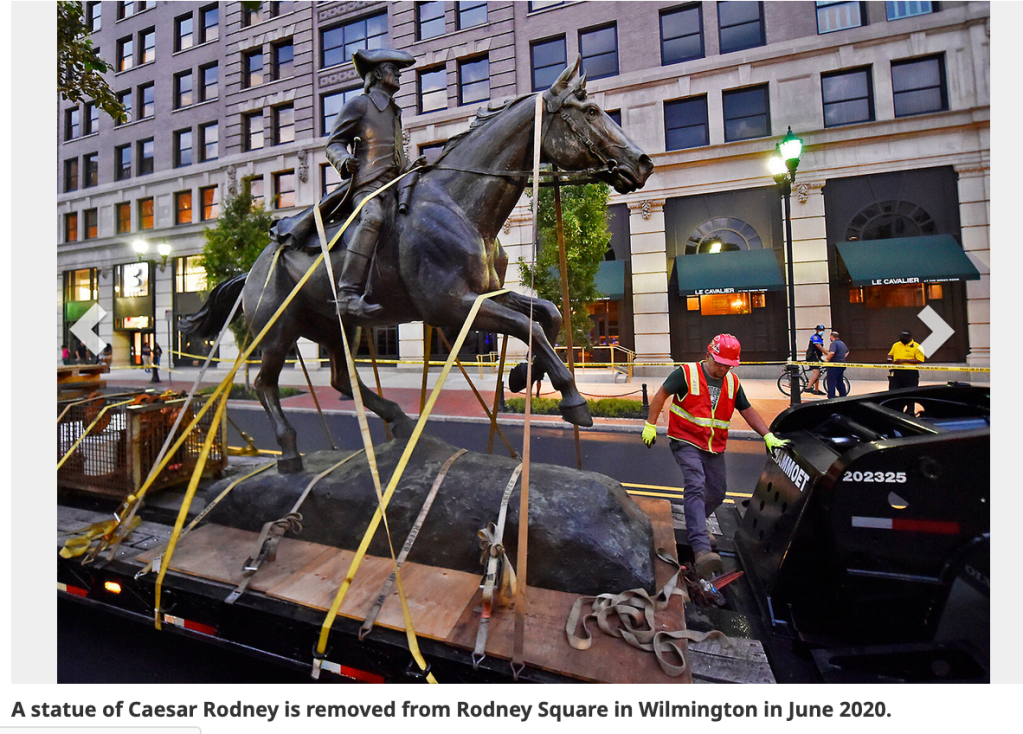
As recently reported, the Trump administration has been eager to locate temporarily the statue to Caesar Rodney, a Delaware signer of the Declaration of Independence, to Freedom Plaza near the White House in Washington DC. Rodney was a prominent slaveowner, and his statue consequently was removed in June 2020 from Rodney Square in Wilmington Delaware, during the summer of racial justice protests.
My colleagues and I at Partners for Historical Justice, as well as my students, have been curious about which precise enslaved people Caesar Rodney owned and what became of them. Here are my initial notes:
Many newspaper reports indicate that Rodney owned about 200 people, some of which he acquired, along with the Byfield plantation (east of Dover, of about 1000 acres), after his mother’s death in 1763. I have not yet located the probate records from his parents’ estates; however, Caesar’s probate will and inventory papers from the time of his death in 1784 (reproduced in Scott 2000, p 221; from the Historical Society of Delaware Archives) clearly indicate the names of 18 enslaved persons in the estate. Of these, three were freed outright, and the remainder were to be freed, in a delayed fashion. when they reached the age of 25.
(As noted below, there is some evidence that Rodney sold off many of his farmworking slaves during the Revolutionary War period, so those who remained many have primarily been household slaves, including his coachman John.)
Those to be immediately manumitted were Old Negro Charles, Old Negro Peg, and Negro Jude.
The probate inventory for the Caesar Rodney estate, completed 20th July 1784, indicates the names of 15 enslaved individuals, with notations on how many years they had left to serve. (Source: Rodney Collection, Box 6, Folder 22, Delaware Historical Society.) Rodney specified in his will that his heirs should not take these bondspeople out of the state prior to their reaching their age of freedom, but of course there was no workable legal mechanism to guarantee that they would really be manumitted on schedule.
The 15 individuals to be freed in this delayed fashion were:
- Shadrack, 4 years to serve, so presumably born 1763 with anticipated manumission in: 1788
2. Charles, 4 years to serve, so born c. 1763 with anticipated manumission: 1788 (perhaps related to Old Negro Charles)
3; Ezekel, 5 years to serve, so born 1764 with anticipation manumission1789
4; Hannah, “four years to serve, a breeding woman,” so b 1763 anticipated manumission: 1788
5; Cyrus, 3 years to serve until 25, so to be freed 1787, implying birth in 1762
- Ezekill, 3 months old in 1784 to serve till 25 so born 1784, to be freed in 1809
- Kate, “5 years to serve, a breeding woman:, so born 1764, anticipated manumission in 1789.
- Maria, “3 years to serve till 25”, so born about 1762
- Charlotte, 1 year to serve till 25, so born about 1760 with anticipated manumission in 1785.
- Bosman, 4 years to serve, so born around 1762 with anticipated manumission in 1788.
11. Pegg, 13 years old, to serve till 25, so born 1771 with anticipated freedom in 1796 (perhaps related to Old Negro Peg).
12, Harry, 10 years to serve so born 1769 with anticipation of freedom in 1794.
13. John, 17 years to serve so born 1776, with anticipated freedom in 1801. [In correspondence, Rodney mentions his enslaved coachman John ( Scott 2000, p. 89) This may be an older relative of this younger John.
14. Sal, 12 years to serve, so born about 1771, anticipated freedom in 1796.
- Beth “at Fields, 4 years to serve, “ so to be freed in 1788 and likely born in 1763 (Perhaps “Fields” mean Byfields).
In addition, as noted below, I speculate that the enslaved man Caesar Rodney, born around 1780, may have been enslaved by Caesar Rodney the signer of the Declaration of Independence.
It is of course possible that some of these individuals were fathered by Caesar Rodney, the signer of the Declaration.
Out of the fifteen granted gradual manumission in 1784, five individuals may appear in subsequent record of free people in Delaware and adjacent states, starting with the 1790 census. (NOTE: The first US census of 1790 listed 8,887 slaves and 3,899 free Blacks in the state of Delaware).
OLD CHARLES
“Old Charles” is mentioned in an undated letter to Caesar Rodney from his brother and business partner Thomas Rodney, that seems to date to mid 1775. The Rodneys, occupied with the demands of Revolutionary War planning, have rented out their farms and are considering selling off their farmworking slaves. Tommy writes remarks that “some applycations have been made for the negroes–all the men except Old Charles will bring 100 pounds when it is convenient to sell.” (Scott 2000: 89, citing n.d, letter in the Rodney Collection, Historical Society of Delaware.)
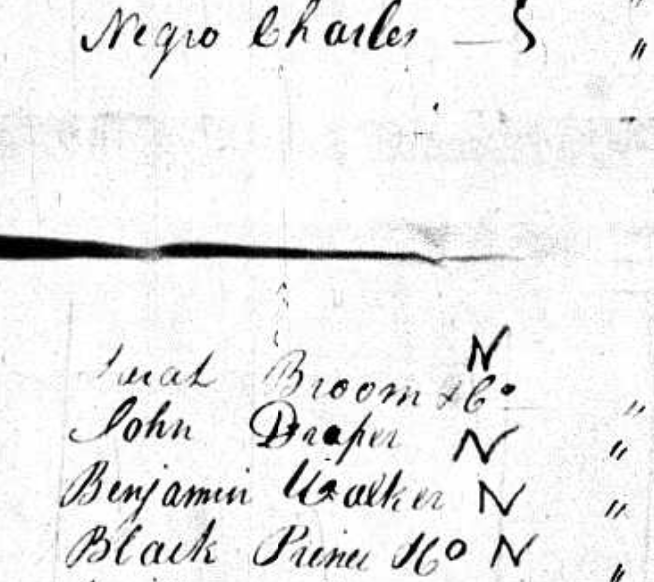
“Old Charles’ or perhaps the younger Charles, born about 1763, may correspond to the household head Negro Charles, in the US 1800 Census, in Christiana Hundred, New Castle, Delaware. Household total: 8 free persons of color.
The 1810 census for Christiana Hundred lists a Charles Hart, as head of a household of 7 persons of color.
Then, the 1820 census lists a Charles Hart and, eleven lines away, a Charles Hart, Jr, They are presumably father and son.
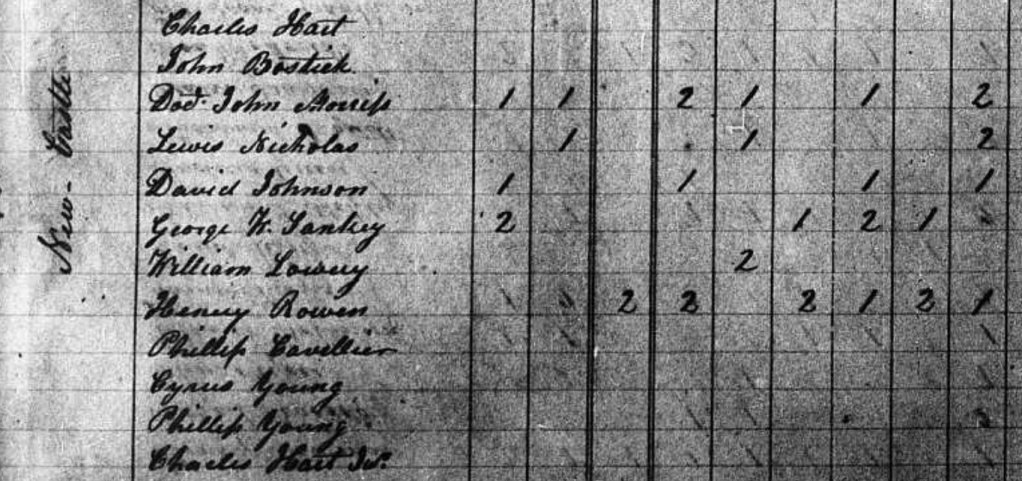
The 1830 census also list a Charles Hart, whom I presume is the younger man. Then, a Charles Hart, born about 1794, who is presumably Charles Hart, Jr., is listed in New Castle Delaware in the 1850 census as a laborer, living with his wife Julia, adjacent to the the Black family of William and Elizabeth Morris , who are perhaps kin.
JOHN
Perhaps relevant: a John Rodney is listed as head of a household of 7 free persons of color in the 1820 census for Little Creek Hundred, Kent County, Delaware, the same neighborhood in which Harry Rodney (discussed below) is listed. The same man is listed in the 1830, 1850. and 1850 censuses.
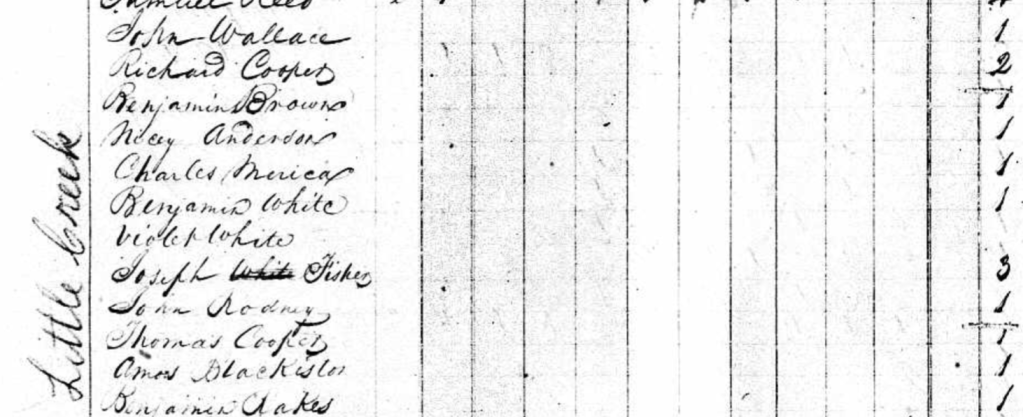
The 1850 census in the same Little Creek Hundred shows John Rodney married to Sarah (Furbee), age 64, with children Matilda, 17 years old, and John (Jr.), 10.
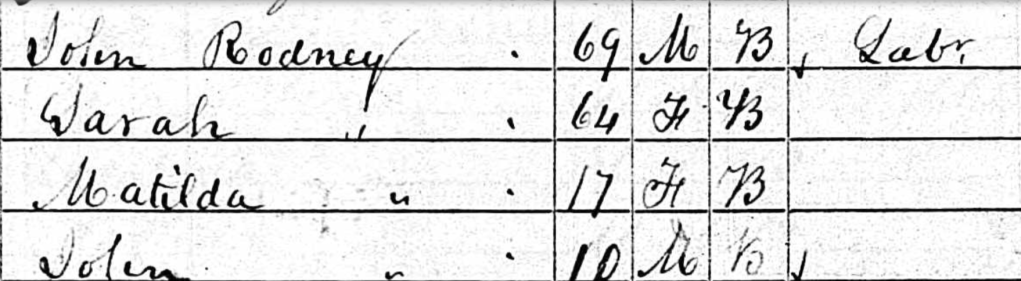
John Rodney Jr. married Matilda Parker or Pasker, and had three children, Matilda Rodney 2nd. b. 3 NOV 1876 • New Jersey; d. 14 OCT 1911 • Philadelphia, Philadelphia, Pennsylvania) Henry Rodney, Birth 1858 • Camden, NJ, Death 3 FEB 1923 • Philadelphia, Philadelphia, Pennsylvania; and Sarah Elizabeth Rodney Williams, born in Camden, NY, Death 24 MAR 1929 • Washington, D.C. (buried in Paynes Cemetery). I do not see descendants for these Henry and Sarah Elizabeth. However. Matilda Rodney, daughter of John Rodney Sr and Sarah Furbee Rodney, married it appears David Miller. Their children included Henrietta and Laura Miller, who seem to have had descendants.
A possible relative, a different John Rodney, born Pennsylvania, is referenced as Secretary of Masonic Lodge 16 of Hartford, CT in the The Weekly Anglo-African 1859 December.
HARRY (b 1769)
A Harry Rodney appears in the 1830 census in Little Creek, Kent County, Delaware , in a household of six free Black persons, as follows
Free colored persons – Males – Under 10 1
Free Colored Persons – Males – 24 thru 35 1
Free Colored Persons – Males – 55 thru 99 1
Free Colored Persons – Females – 10 thru 23 1
Free Colored Persons – Females – 24 thru 35 1
EZEKIEL (the younger)
A black man named Ezekiel Rodney, died 5 August, 1821 age 40, in Philadelphia, Pennsylvania, so seems likely to be the infant Ezekiel, born about March 1784, listed in Caesar Rodney’s probate inventory.
HANNAH, b. 1763
There is a negro Hannah, with no surname listed. in the 1800 census, in Duck Creek Hundred, Kent County, Delawar, heading a household of three free persons of color. Perhaps she is the same person as the Hannah manumitted by Caesar Rodney.
CHARLES, b. 1763
It is possible that the younger manumitted Charles (born around 1763) resurfaces in a fugitive slave advertisement in 1800 for a Charles Rodney, having escaped from a John Quimby residing in Newtown, Chester Ferry, Queen Annes County (later known as Chestertown, Kent County, Maryland), along with the pregnant enslaved woman Nanny and her daughter Ariana. The fugitive Charles Rodney is referred to as a “noted ferry man,” who had driven a wagon in the Revolutionary War, and is said by his enslaver to “read tolerably well.” This Charles is said to be about 40 years old, whereas the Charles owned by Caesar Rodney would have been born 1763, so about 37 years old.
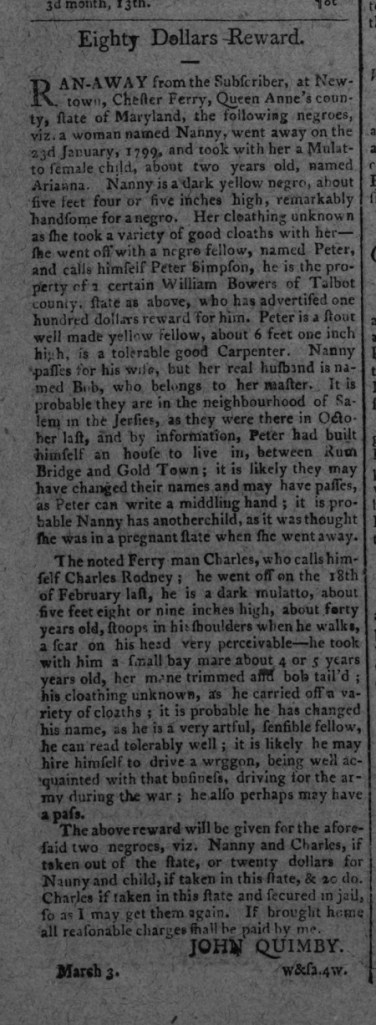
The relevant section of the advertisement reads: “The noted Ferry man Charles, who calls himself Charles Rodney; he went off on the 18th of February last, he is a dark mulatto, about five feet eight or nine inches high, about forty years old, stoops in his shoulders when he walks, a scar on his head very perceivable — he took with him a small bay mare about 4 or 5 years old, her mane trimmed and bob tail’d; his cloathing unknown, as he carried off a variety of cloaths; it is probable he has changed his name, as he is a very artful, sensible fellow, he can read tolerably well it is likely he may hire himself to drive a waggon, being well acquainted with that business, driving for the army during the war; he also perhaps may have a pass.”
If this is the same Charles, then it would follow that the manumission stipulation of Caesar Rodney’s will was not actually followed by his heirs, and that Charles was sold out of the state of Delaware and that his promised manumission was not in fact honored in 1788.
CHARLOTTE b. 1760
Speculatively, perhaps Charlotte became Charlotte Croker, who died 1 July 1850 in Philadelphia, PA (residing at Lombard Street below Eighth) at the age of 90, so born around 1760. There is a long line of African American Crokers, in Delaware, including Daniel Croker, in the 1840 census in Dover Hundred, Kent County, Maryland, as head of a household of five people of color. His apparent son, Daniel Croker, born 1841, lived in Camden, NJ during the Civil War. Perhaps these two Daniel Crokers are Charlotte’s descendants.
Caesar Rodney, Escaped and Free
Perhaps significantly, a black man named Caesar Rodney appears in an 1802 runaway slave ad. 22 years old Cesar Rodney has escaped from enslaver Frederick Stump, and is thought to be heading to Philadelphia, where he had been raised by a Mr Wirtz. He escaped 12 June 1802, at age 22, so was born around 1780. ( Frederick Stump is infamous in colonial Pennsylvania history for having murdered at least ten Native Americans in 1768)
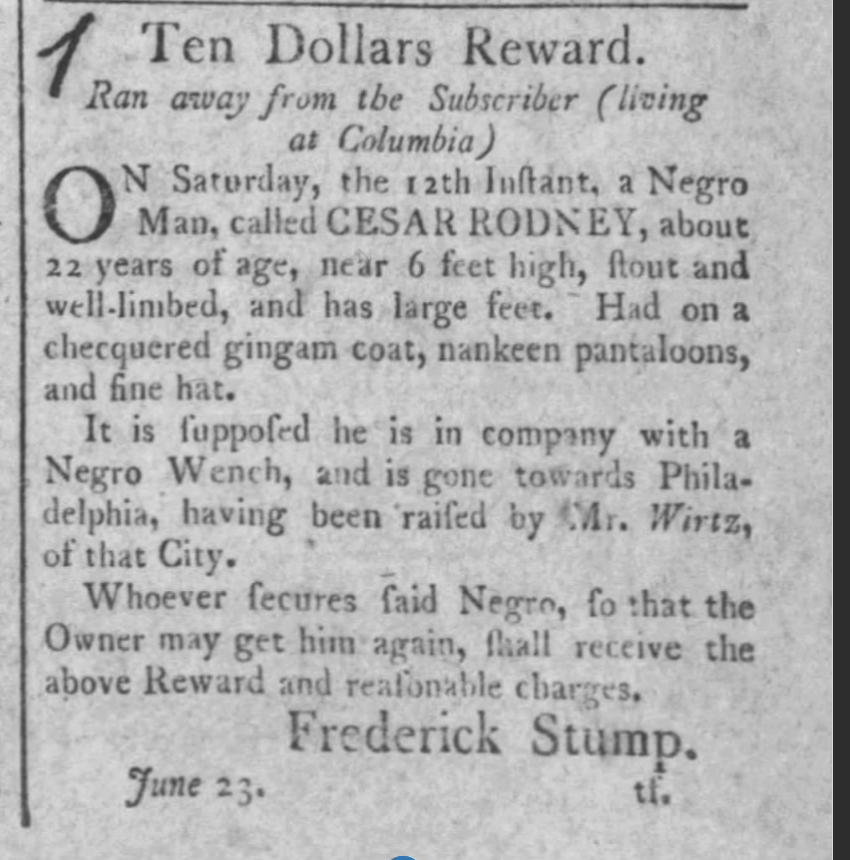
This Caesar clearly attained his freedom at a subsequent point. He is enumerated in the 1820 census (7 August 1820) residing in Salisbury, Lancaster County, Philadelphia, and in the 1830 census in Drumore, Lancaster County, Pennsylvania, in a household of two persons of color; an African American man named Caesar Rodney, perhaps he same person, is listed in the 1830, 1840, 1850 and 1860 censuses in Little Creek, Kent County, Delaware.
Perhaps this Caesar had been previously enslaved by Caesar Rodney the signer of Declaration and even fathered by him.We will continue to work on documenting the stories of these enslaved people and their descendants. Perhaps there will be a way to honor this community at Freedom Plaza in downtown Washington DC when the statue of Caesar Rodney is placed there.
References
Scott, Jane Harrington. 2000. A Gentleman as Well as a Whig: Caesar Rodney and the American Revolution. Newar: University of Delaware Press. (National Society of the Colonial Dames of America in the State of Delaware).
 Mark Auslander