My students and I in ANTH215 (Gender, Sexuality, Culture) at American University are developing close looking guides to works on display in the exhibition, “Here: Pride and Belonging in African Art.” at the Smithsonian National Museum of African Art.
Here is a draft giude to Va-Bene Elikem Fiatsi’s roZen (Rituals of Becoming)
Va-Bene Elikem Fiatsi
b. 1981, Ho, Volta Region, Ghana; works in Kumasi, Ashanti Region, Ghana
Polyptych from froZen (Rituals of Becoming) series 1–4
2016
Photographic print
Notes by Mark Auslander
Visual description: In four photographic prints, arranged in a row, the world famous performance artist Va-Bene Elikem Fiatsi (who goes by the name “crazinisT artisT”) sits naked, in profile facing toward our left, in a studio space preparing herself. She sits on a stool covered in black cloth, holding a compact mirror in her left hand and applying make up with her right hand. In front of her is a simple wooden dressing table (“vanity table” in American English) on which rests a small mirror and perhaps makeup . Some red substance, perhaps raw meat or fabric, can be seen on the table and on its base. The entire background is a set of red sheets, with a white vertical line rising from the mirror towards the ceiling.
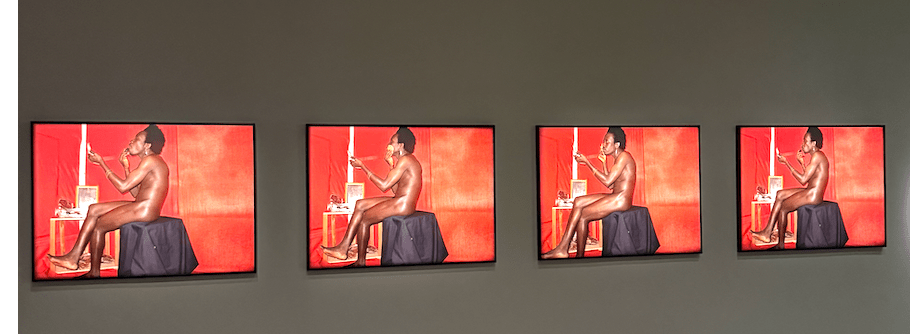
The artist’s body is photographed in such a way as to obscure the conventional biological indicators of sex; both the groin and chest areas are somewhat obscured, although the general sense conveyed (and made explicit in the video iteration) is that the performer lacks breasts in a biological sense.
Each image is slightly different. In the first, to the far left, the artist’s head is titled back in profile, as lipstick is applied to the lips. In the second, some of her face is obscured by foundation being applied. In the third, more of her face is visible, as foundation is applied on her right side, invisible to the camera. In the final image, she holds her head more upright, and is once again applying lipstick.
Background: The still photographs are drawn from the larger performance project froZen (Rituals of Becoming) , which has been captured on video, including on Vimeo: vimeo.com/250720337 In this 10 minute video, we see a crowded studio, filled with costumes and regalia. We see the artist successively from the front, side and behind, in a red bra, seated, preparing her hair. We then see her in close up, perhaps engaging in careful facial hair removal. We next see her washing her face from a smallmetal bowl, and then standing naked in a larger metal tub, covered with suds as she scrubs herself, then dries herself and dresses in feminine garments. The net effect is extraordinary intimacy and self-revelation, which complicates conventional readings of gender, as a seemingly “male” body is transformed into a “femme” presence.
The four photographic stills on display in HERE similarly take us into moments that would normally be considered supremely private, giving as access to “frozen” moments when gender is being actively made in front of of our eyes.
Interpretive Notes: The drag artist Ru Paul has famously observed, “We are all born naked. Everything else is drag.” This dictum is powerfully illustrated by the froZen project; which emphasizes how the gendered appearance of “the feminine” is carefully built up from a naked body that might be conventionally read as bio-physically male. The title “froZen” presumably alludes to the ways in which the observer’s attention is frozen, or stopped in its tracks, as we experience cognitive dissonance in facing up to gender itself being made right in front of our eyes.
As Arnold van Gennep long ago observed, rites of passage the world over are divided into three parts: (1) separation from everyday life; (2) radical transformation within a liminal period in which the subject is “betwixt and between” conventional coordinates of experience; and (3) re-entry and re-aggregation, in which the subject is returned to everyday life, in which everything is the same, yet everything is different. In the ritual space of the “froZen” series, we gain entry into the topsy-turvy world of the liminal period, in which the most important work of ritual is accomplished. Conventional rites of female initiation or male initiation seek to intensify dichotomous gender-based identities; but in “froZen”, the ambiguous mysteries of the liminal period, normally hidden away from the public, are brought into the light, so that we see gender-making in action
The series title ““froZen”,” might conjure up associations with the famous Disney 2013 animated film, “Frozen”, which itself challenges conventional gendered narratives about love, identity. and agency: the child viewer learns that the apparently heroic prince is in fact a villain, and that the most important form of love is sibling solidarity between the two sisters, Anna and Elsa, who ultimately must save themselves without depending on male figures.
The emphasis on the letter “Z”, capitalized in “froZen”, might evoke the ways in which “Z,” the final letter of the alphabet, comes directly after “X” and “Y”, the conventional genetic chromosomes governing femaleness and maleness. “Z” in this sense would seem to transcend the conventional male/female binary. In this sense, the series seems to proceed according to what James Fernandez, in reference to the initiation process in the central African religious movement Bwiti, terms “edification by puzzlement,” intensified experiences of cognitive dissonance and epistemic shock that catalyze deeper understanding and elevated forms of consciousness. Here, in “froZen”, we come to understand that gender, rather than being in a fixed state of being, confined to the static male/female dichotomy, is rather produced through a continuously unfolding state of becoming. The fully dressed trans or drag performer will eventually emerged gorgeously from chrysalis, but here we are taken into the site of mysterious transformation, within the normally hidden pupa of the studio.
In this photographic series of four stills (“frozen” in time). the time-based unfolding of a video or live performance is played with in interesting ways. Careful inspection indicates minor but significant differences between each still, paradoxically calling attention to the minute processes through gender is made (and “made up”).
Speculatively, might the prominence of red cloth and black cloth in the these four photographic stills be read through Asante (or more broadly Akan) ritual symbolism? The vertical white stripe above the minor, dividing the red field might suggest, in keeping with the imagery of Kente, a dynamic relationship between blood and sacrificial energies (redness) and the purity of ancestral light (whiteness). The black cloth-covered stool on which Va-Bene sits, undergoing extraordinary transformation, just might evoke the Asante practice of draping a chiefly stool in black cloth during the funeral period, indicative of a suspension of a normal state of being, while inviting ancestral energies to infuse continuity into the long term life of the community. Similarly, the red cloth hung in the background of the studio might parallel the use of red cloth by close relatives during the mortuary process, expressive of inconsolable grief and raw emotion. In the regular funeral process the death of a person is honored. In contrast, in froZen, a different kind of loss and regeneration is unfolding: an older gender identity is being eclipsed in favor of a new gendered-ness, a different cycle of death and the regeneration of life that transcends conventional dichtomies.
In that light cosnider the white-ish color on the red cloth, to the right side, behind the performer, which partially echoes the white stripe on the cloth, the whiteness glimpsed in the table mirror, and the the shiny illumination along the artist’s side. Might these instances of whiteness or birghtness be evocative of ancestral presence? The mysterious process of radical gender fluidity and transformation, it is perhaps being suggested, is being blessed by ancestral forces, which operate at levels beyond conventional mortal understanding.
Prompts for closer looking:
- How do you make sense of the symmetries within the sequence of four images. In the first, on the far left, the artist applies her lipstick, which is true as well, for the final image, on the far right. In the two middle images,
the artist applies foundation with a make-up sponge. In image 2, she applies the sponge to her left cheek, and then in image 3, she applies it to her right cheek, away from of our immediate view. What is the net effect of these balanced symmetrical contrasts through the four moments of the work? - Continuing with the theme of symmetry, what do you notice about use of mirrors in the four pictures? A framed mirror is placed on the simple dressing table, and a smaller hand mirror is held by the artist in her left hand as she applies make up. What might be suggested about mirror imagery and the mysteries of gender: how might we perhaps, be invited to move, through the looking glass, to a place in between the conventional contrast between maleness and femaleness? (You may wish to compare this mirror imagery with other works in Here, include the mirror in the bathroom in Tarek Lakhrissi’s Out of the Blue, in which the alien or angel appears to the protagonist, or the mirror at the beginning of Tobi Onabolu’s film, “Dear Black Child,” which the protagonist appears to travel as he journeys into the other world of the sacred forest?
- What do you think is the red and white substance glimpsed on the top of and the lower level of the dressing table? Might it be cloth, or meat? What might it be suggestive of?
- Why do think the exhibition designers have placed this sequence in this particular elongated alcove of the exhibition, leading from the main entrance, near Ṣọlá Olúlòde’s large Eternal Light, to the west gallery, devoted to themes of Spirit and Futurity? In this particular alcove, the Van-Bene “froZen” sequence is framed by a delicate small print by Zanele Muholi of Pam Dlungwana, and a enormous blown up image by Zanele, “Muholi, Muholi. The small image of Pam is female-presenting, and the large image of “Muholi, Muholi”, in which the black faced artist wears a hat, is male presenting. Is it perhaps significant that in between these female and male poles the designers have placed the Va-Bene sequence, which hovers somewhere between ‘female” and “male” poles of being? Might the four images by Va-Bene be escorting us into the final gallery of the show, to themes of spirituality and mysterious futures?
 Mark Auslander