I have been fascinated by the sculptural installation “Subject to the Tide” (After David Hamons) (2018-2025) by artist Oluseye Ogunlesi (sometimes known as Oluseye), now accessioned into the National Gallery of Canada’s permanent collection.
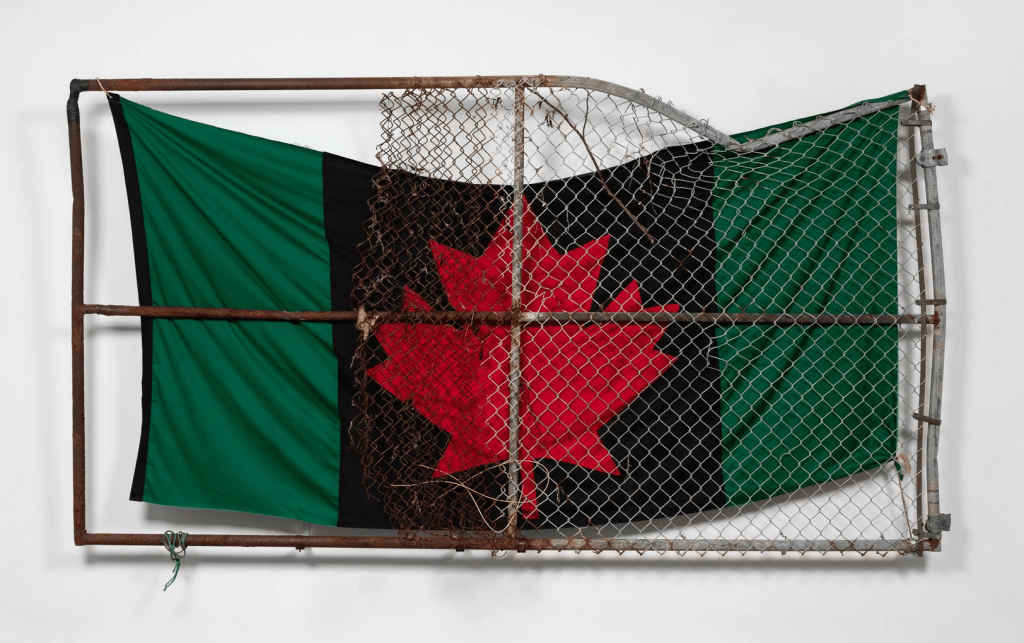
Subject to the tide (After David Hammons), 2018-2025 Twill flag, salvaged fence from Africville 11 x 6 x 1 ft
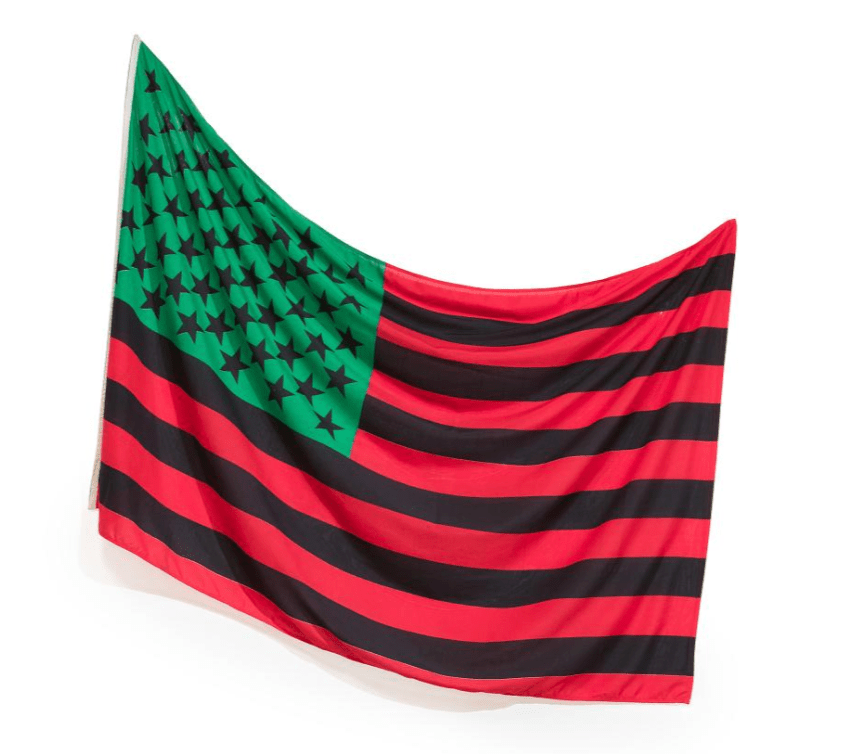
Artist’s Statement: “Inspired by Hammons’ famed transformation of the American flag, this installation reimagines the Canadian flag in the Black Nationalist tricolour created by Marcus Garvey’s Universal Negro Improvement Association in the 1920s — red for the blood of Black people, black for our skin and racial identity, and green for the verdant lands of Africa.
The flag is integrated with a fence salvaged from the shores of the Bedford Basin in Africville, Nova Scotia, becoming a powerful symbol of cultural reclamation, unity, and the resilience of Africville—a Black community forcibly displaced in the 1960s that remains a poignant marker of systemic erasure in Canada.”
Mark Auslander’s commentary: The work’s title, “Subject to the Tides, ” seems to have multiple associations. In a manifest sense, the metal gate washed up on the shore of the Bedford Basin where the artist recovered it, was subject to the local tides, taken away from the beach and finally flowing back in. More broadly, the phrase presumably evokes the complex, often tragic fate of the Afro-Canadian community of Africville, subjected to the tides of historical vicissitude, since the 1840s, culminating in the area’s ”urban renewal” clearance between 1964 and 1970. (See the Mapping Memories of Africville project ) The fisher folk of Africville were people of the tides in another sense, surviving through their deep knowledge of local currents and waterways. As descendants of captives in the Middle Passage, they and their ancestors were subject to the tides of an even longer historical trajectory, forcibly relocated, under horrific conditions, by maritime vessels from their African homelands to the Americas and the Caribbean. Many were “subject” to the British Crown in British Colonial North America of colonial Jamaica; then after the American Revolution, the Americans were subject for a time to United States rule under the slavery regime, and then once again were subjected to the Crown, either as former Loyalists in the Revolution as as Black Refugees during the War of 1812, transported to Nova Scotia, and then subject to often unequal conditions under Canadian sovereignty.
The recycled metal gate that frames the composition would seem to embody the condition of twoness or double consciousness long ago articulated by WEB DuBois. The tattered gate evokes both Nova Scotia’s early status as sanctuary or open door for Black freedom-seekers as well as Afro-Canadians’ repeated historical experience of being locked out, the gates slammed in their face by the nation’s enduring system of white domination. The metal grill, behind which the Afro-Canadian flag is positioned, may also signal the fraught position of Black Canadians in the nation’s mass incarceration system, within which Black inmates are disproportionately subjected to solitary confinement and harsher treatment than their white counterparts. Afro-Canada is simultaneously part of the proud Pan-African world and, in many cases, confined behind bars. (Echoing Oscar Mischeaux’s 1920 silent cinematic condemnation of US racism, the work may be taken as a visual denunciation of all that which transpires “Within Our Gates”)
Equally of interest is the locally-sourced twill fabric out of which this Garveyesque flag was produced in Côte d’Ivoire. The highly prized textiles of the Ivory Coast had a complex relationship to the slave trade. As a major source of ivory and fabric, the Ivory Coast was spared some of the worst depredations of slave trade, yet cloth was a significant medium of exchange in the slave trade throughout the African continent. (In the Ngoni communities of eastern Zambia in which I work, the most beloved song is a piercing lament that recalls “Long ago our Ancestors suffered terribly” because of the cloth for which their loved ones were sold away.) Twill, created out of diagonal weave, conveys particular strength to fabric such as denim. Hence the diagonal weave patterned twill, out of which the flag is composed. would, like the gate, seem to have multiple meanings, recalling long duree history of suffering grounded in the Europe-Africa colonial nexus, while also celebrating threads of African unity and resilience, epitomized by post-independence Côte d’Ivoire.
A possible reading is that the entire assemblage constitutes a map of the Black Atlantic, tracing the centuries-long history that led to Black settlement and residence on Nova Scotia. The horizontal and vertical wire cross hatching of the metal gate may echo lines of longitude and latitude, its quadrant borders recalling the equator and prime meridian. The black lines that radiate across the flanking green fields of the flag from the central black square may trace innumerable Middle Passage voyages from Africa to the New World, as well as marking the historical Black settlements throughout the Maritimes. We may also glimpse in the lines the numerous Loyalist, Refugee and Maroon voyages from the British colonies in North America and Jamaica, and from the United States during the War of 1812.
Speculatively, might the installation be conceived of as a kind of altar, into which far-flung worshipers through the Diaspora may lay down their fears, suffering, and deepest aspirations, as they seek blessings from the invisible world? Perhaps, those gazing into this multi-colored matrix honor Yemaya (Yemoja) orisha of the oceans and the tides, or perhaps the redness of the central maple leaf honors Shango, orisha of thunder, lightning, fire, justice, and virility, or Oya, divinity of wind and storms; perhaps the metal of the gate summons Ogun, orisha of iron; or the central cross signals Elegua , Lord of the Crossroads. Whatever the precise cosmological referents, the gate, cast up on the shore by the tides, which are themselves governed by the ancient lunar cycles of destruction and creation, may be much more than a closed barrier; it may equally be a dynamic portal, opening up those who stand before it to the transformative tidal forces of the hidden universe.
 Mark Auslander