My students and I in ANTH215 (Gender, Sexuality, Culture) at American University are developing close looking guides to works on display in the exhibition, “Here: Pride and Belonging in African Art.” at the Smithsonian National Museum of African Art.
Here is a guide to Rotimi Fani-Kayode. Nothing to Lose IX from the Bodies of Experience portfolio (1989). Large format C-print
Notes by Mark Auslander
Visual Description: In a large format, richly colored photograph, the artist is viewed in profile, unclothed except for a leather and metal harness that criss-crosses his neck, chest. and waist area. He is prostrate in front of a standing Yoruba-style sculptural figure with a red face, and a forehead marked with alternating vertical red, blue and white stripes. The sculpture, evidently created by Fani-Kayode’s collaborator Alex Hirst, does not directly resemble any known work of African art, but may evoke the iconography of the orisha Eshu, (or Èṣù, also known as Elegua), ambiguous Lord of the Crossroads.
The configuration may be read erotically as implying the sculpture is sexually offering itself to the crouching male figure. Alternately (or in a complementary fashion) it may be read as the male paying reverence to his spiritual precursors or to divinities on the threshold between this world and the next.
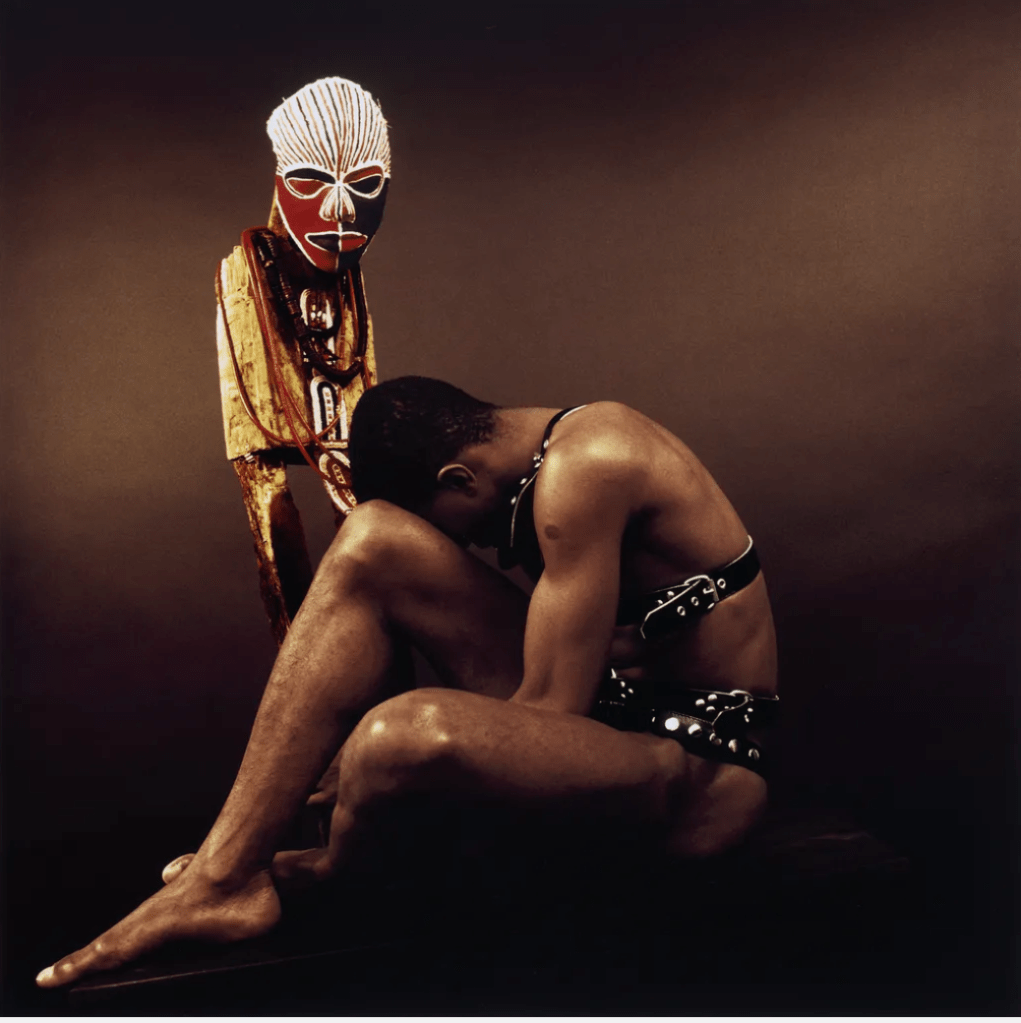
Background: The rather painterly photographic series Nothing to Lose, drawing on classical European and Yoruba artistic traditions, was created in the 1989, the year that the artist knew that he was infected with HIV-AIDS. Complications of the disease would take his life December 21 of that year.
Interpretive Notes: As the title suggests, the “Nothing to Lose series may be read as a letting go of conventional reservations and hesitations, fully embracing the terrors and possibilities of death and the ultimate journey into the unknown, shortly before the artist’s death.
The novel sculptural form standing above the kneeling artist, generally held to be evocative of the orisha Eshu, might be read as a kind of ritual portal between the world of the living and the world of the ancestors, into which the dying man is preparing to journey. Since Eshu at times transmits prayers from mortal worshippers to the orisha and conveys their blessings, it may be that the artist is expressing hope that his prayers and final aspirations may be answered, either in this world or the next.
The leather and metal chains that clothe the otherwise naked body of the artist may be read as evocative of sado-masochistic pursuits of pleasure, or as chains of desire (or of stigmatization) from which the artist will soon be released as he moves beyond this earthly coil.
An alternate, or complementary reading, is that the sculpture is an emanation of the artist’s own person, hopes, and dreams. The black pendant hanging around the sculpture’s neck may resemble the harness worn by the artist, and the red coloring of its surface is not unlike the redness of the artist’s skin.The sculptures right arm seems to be directed towards its groin area, which may be true for the right arm of the naked artist. These shared features may suggest a deep affinity between the two figures: perhaps in that sense the sculpture is an externalization or outwards projection of the artist’s inner state of being, especially as he explores his own Yoruba spiritual heritage. Eshu is classically conceived as a trickster and perhaps Fani-Kayode here acknowledges his own trickster and interstitial proclivities.
Speculatively it is possible that the sculpture may be an elaborate erect phallus, arising out of the artist’s middle section, evoking his power or agency in the world.
Prompts to closer looking:
Consider the relationship between frontality and profile perspectives in this image, as well as the question of what is visible and what is obscured. The standing sculpture is viewed front on, with a horizontal line bisecting its face. The artist’s kneeling body is viewed in profile. The pubic area of the sculpture partly obscured by the artist’s head and knee, and the artist’s own pubic area is obscured as well. What kind of doubleness and contrast between the two figures is evoked by this composition?
- Compare the positioning of the organs of perception in the two figures. The artist’s face is obscured here, nestled behind his bent knee. Only his left ear is visible. in contrast, the eyes of the sculpture are fully visible, staring directly out at us. (The artist’s ear is arrayed on a line parallel to the sculpture’s eyes_. What effect is caused by this contrast? Might this hint at complementary or interdependence between these two beings? Does the artist in a sense only “see” through the standing sculpture, and does the sculpture only “hear” us through the artist?
- How erotic or sensual is this image? Is the sculpture implicitly sexually or romantically offering itself to the artist? Or is the sense conveyed here beyond eroticism, evoking a joining that is spiritual but not necessarily grounded in the flesh or carnal desire?
- Contrast the two figures portrayed here with the double figures in the adjacent work by Fani-Kayode, “Every Moment Counts” (from the Ecstatic Antibodies) series. In each work, do you have sense of the lower figure being directed upwards, to a higher plane, perhaps being moved on to state beyond this mortal domain to a higher level of existence?
For more reading:
W. Ian Bourland, Bloodflowers; Rotimi Fani-Kayode, Photography and the 1980s. Duke University Press, 2019
 Mark Auslander