My students and I in ANTH215 (Gender, Sexuality, Culture) at American University are developing close looking guides to works on display in the exhibition, “Here: Pride and Belonging in African Art.” at the Smithsonian National Museum of African Art.
Here is a guide to Rotimi Fani-Kayode’s Every Moment Counts (Ecstatic Antibodies), 1989.
Chromogenic print
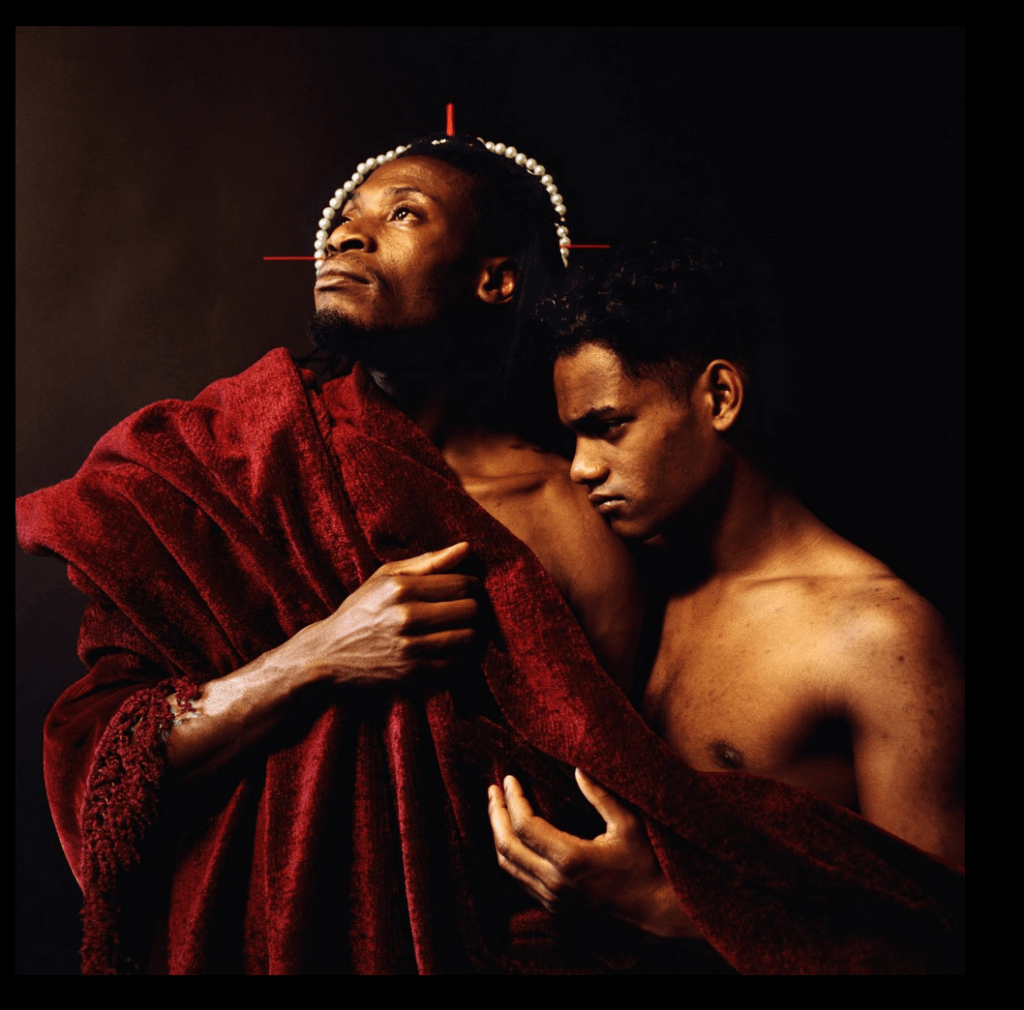
Description: The bearded artist, clothed as a priest or friar in a red cloak, gazes upwards reverentially, his head in a halo-like crown of white beads, perhaps in the mode of a Byzantine icon, with possible hints of a Yoruba white ritual crown. Small red lines protrude from the crown perhaps reminiscent of Dirk Bout’s Christ Crowned with Thorns, c. 1470.
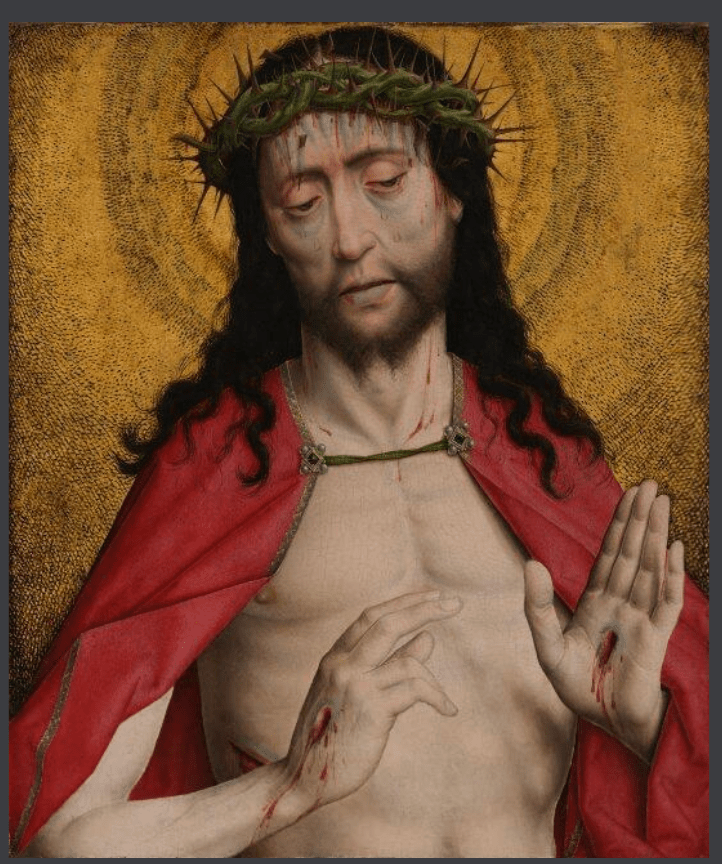
His right hand is crossed over his chest, his left hand cupped in a manner reminiscent of Christ in Bouts or other early Renaissance Christian works. Resting on his shoulder is a younger man, whose torso is unclothed, his eyes cast downwards.
Background: The rather painterly photographic series Ecstatic Antibodies, drawing on classical European and Yoruba artistic traditions, was created in the 1989, the year that the artist knew that he was infected with HIV-AIDS, Complications from this disease would take his life December 21 of that year.
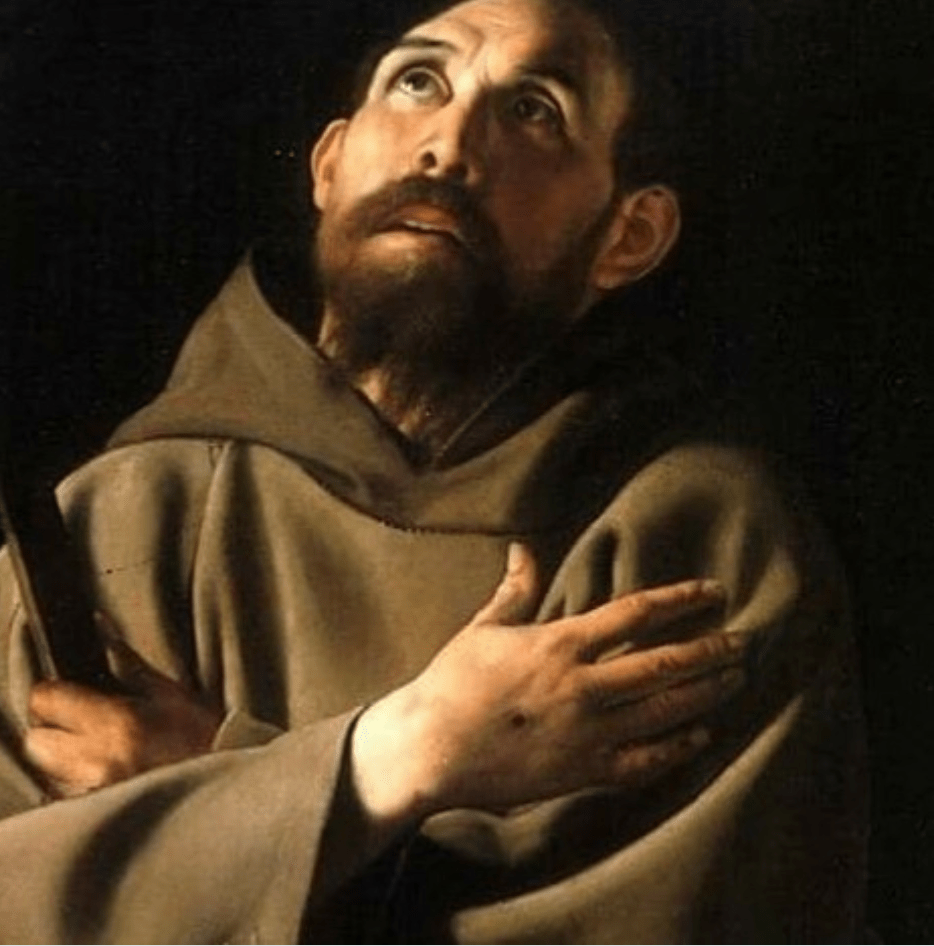
Interpretive Notes: The work would seem to to fuse Catholic and Yoruba iconography. The work may be a direct citation of Caravaggio’s St Francis of Assisi in Ecstasy, c 1598, in which the bearded robed friar gazes heavenwards, his right hand held faithfully over his heart.
As noted above the hagiography of Bouts and his contemporaries may also be at play. At the same time, white beads in Yoruba regalia and sculpture, particularly on beaded crowns (ade) tend to connote purity and spiritual connections to ancestors and the orisha. The friar figure may thus be cast as an intercultural sacral intermediary, leading the younger man towards a space of spiritual sanctuary, under the benevolent divinities
The term “ecstatic” in the series title “Ecstatic antibodies” may conflate the sexual meaning of ecstasy (evocative of the gay scene in 1980s New York and London) with the spiritual meaning of the term, implying a standing out of oneself in mystical union with the Godhead. Under conditions of intense immuno-suppression from the retrovirus, imperiled antibodies may have taken on the quality of saviors, rather like spiritual guardians. In this light, the reverent friar may himself be a kind of healing antibody, protecting the younger man from the scourge of disease. Or, as noted above, he may be a spiritual guardian, guiding the young man from this world to the next.
Prompts to closer looking
- Note how multiple lines converge to highlight the face of the younger man. These includes a line proceeding downwards from the upturned eyes of the friar and his right arm, and the implied line proceeding from the white beaded halo-crown’s right side. What is the effect of this compositional strategy?
- How do you understand the title “Every Moments Counts” (shared by other images in this series)? Is this an exhortation to seize the day, given the ephemeral nature of life amidst the pandemic? Are the two figures perhaps each representative of a temporal moment, a precious sequence of events at the close of life?
3 Contrast the two figures portrayed here with the double figures in the adjacent work by Fani-Kayode, Nothing to Lose IX in the Bodies of Experience series. In each work, do you have sense of the lower figure being directed upwards, to a higher plane, perhaps being moved on to state beyond this mortal domain to a higher level of existence?
For further reading:
W. Ian Bourland, Bloodflowers; Rotimi Fani-Kayode, Photography and the 1980s. Duke University Press, 2019
 Mark Auslander