Notes by Mark Auslander
My students and I in ANTH215 (Gender, Sexuality, Culture) at American University are developing close looking guides to works on display in the exhibition, “Here: Pride and Belonging in African Art.” at the Smithsonian National Museum of African Art. Here are my initial notes on Tarek Lakhrissi’s stunning and enigmatic video “Out of the Blue” (2019)
See stills from the video at: https://tareklakhrissi.com/Out-of-the-Blue
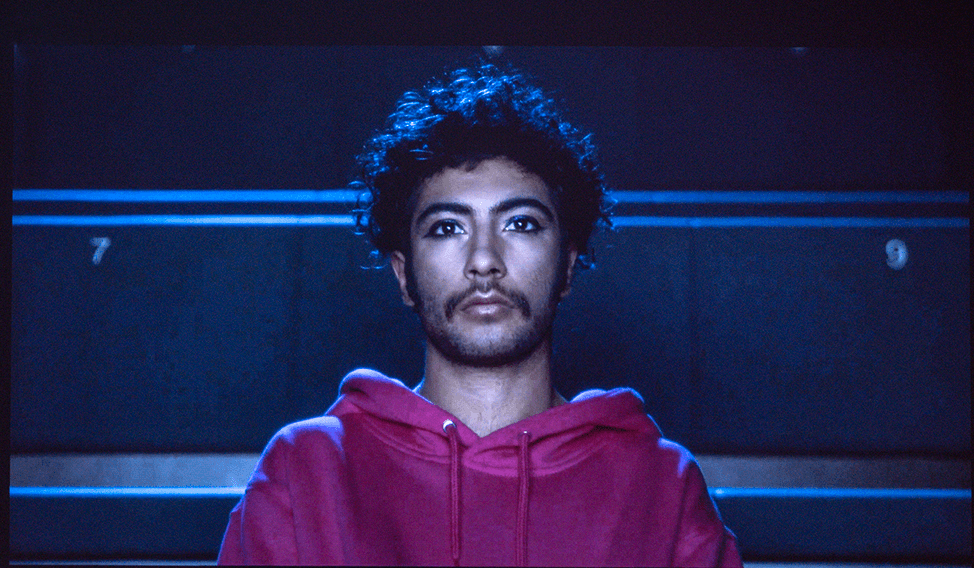
Description: This mesmerizing 13 minute French-language Afrofuturist video work stars Sorour Darabi, the Iranian-born, Paris-based choreographer, dancer, and artist. The film follows the character Mejda played by Darabi (identified halfway though as the “The Chosen One” (“L’élu” ) on a surreal journey of self-realization. In the opening scene the protagonist walks, perhaps a little swishingly or mincingly, through a banlieue, a lower income Parisian suburb, as night falls. They enter a green modernist building and attend screening of a film. Wearing a purple hoodie, they fall asleep in their seat as futuristic electronic music is heard in the background. (The ensuring scenes may comprise a dream sequence).
Awaking and walking out of the theater, the protagonist encounters a man and woman racing in from the outer door; the man warns him not to go outside, there may be aliens invading.
We then cut to a hilarious out of this world newscast, delivered by beautiful lighter skinned Black woman (played, I believe, by Anissa Kaki) sporting an Afro, in front of a montage of outer space scenes. She reports that the city (presumably Paris) is under attack by aliens, who have kidnapped corporate CEOs while leaving untouched the most vulnerable among us.
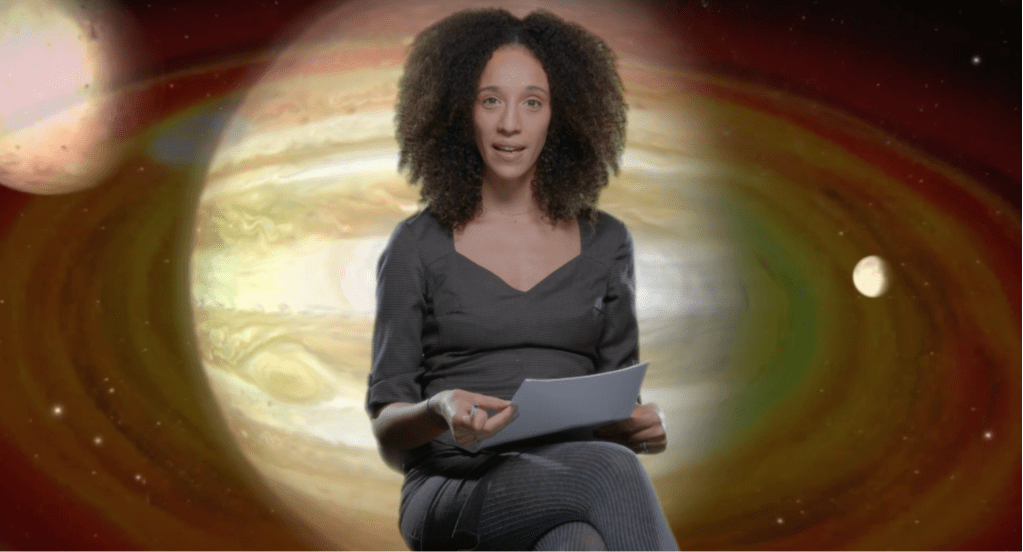
She runs through various conspiracy theories about why this is happening: perhaps an explosion of the capitalist system or a US scheme to revive the shows X-Files and Roswell, or an illustration of the “Grand Replacement Theory”, the far right paranoid claim in the US and Europe that shadowy forces are promoting a demographic take over by people of color from the global south (In France, there is a particularly Islamaphobic tilt to the theory.) She then emits a riotous laugh and notes that some speculate that these events are consonant with great feminist thinkers, from science fiction author Octavia Butler to cultural theorist Donna Haraway, to poet-philosopher Audre Lourde (who famously called for the dissolution of “all hierarchies of oppression.”)
We cut to the protagonist in a bathroom gazing into a long horizontal mirror. A beautiful Black woman (perhaps Cherry B. Diamond) with white straight hair appears beside Mejda, perhaps an angel or a space alien. She tells them they are the Chosen One (“L’élu”), that the pyramids are reversed. She repeats, “You are the chosen one, my sister, You know it.” She continues “I know you hang out in radical spaces, including ones in which people discuss the latest Audre Lourde book to be translated into French.” She laughs, telling Mejda not to look at her, but that they have a power to see, a gift to open the pyramids, as the apocalypse is reversed. They embraces her, then gazes into the mirror and declares, “I am the Chosen One.”
We cut to a blue lit hallway where the hero walks slowly, in full diva splendor, wearing a fur coat, seen from behind. They turn to the left. A young man tells them the aliens are looking for you, gesturing inwards, noting that the show will begin. Our hero advances dressed like an elegant lounge singer, towards a beautiful light skinned Black woman sporting an Afro (perhaps also Annisa Kaki?) seated at a piano. As Mejda advance sthey slowly take off their fur coat, allowing it to drop to the floor, revealing their long black cocktail dress and a black choker around the neck.
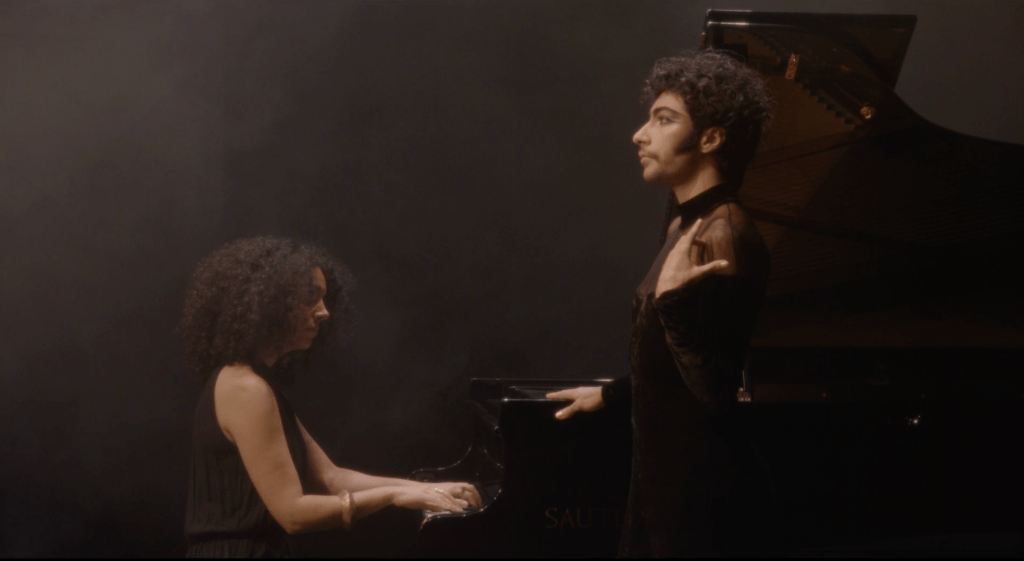
The Chose One takes a breath and places their right hand on the piano, hand on shoulder.
They recite a prose poem, as the pianist plays chords, a little reminiscent of Debussy.
The poem contains the repeated couplet, “Bitter is the Truth/You will have to get used to it”
Other lines include:
“Incomplete as much as the Absolute can be””
“Freedom is scary”
“What the shadow reflects”
There are cuts to the audience members, perhaps the Space Alien guests. These are phenotypically of varied complexions, which might primarily be read as “Black,” at least in the US. At one point the young man who invited the Chosen One into the hall, looks admiringly at them through the curtain.
Another line references “My hand on my stomach and the other on my thorax.” (Perhaps an allusion to the upper part of the torso, where breathing takes places)
The poem concludes:
“We are constantly waiting, for the alignment of the stars, while acting in the moment. I know that nobody will improve themselves in my place. Bitter is the truth.”
The screen fades to black.
Interpretive Notes: The whole work is perhaps an enormous joke on The Matrix (1999), with touches of Lewis Carroll’s “Alice in Wonderland” mediated through Black Queer and Black Feminist critical stances. The protagonist is called “ L’élu” (The Chosen One), the same phrase used in French translations of The Matrix for Neo, the hero played by the white actor Keanu Reeves, who learns to see beyond surface illusions and achieves supernatural powers in his struggles against the villainous machines of the matrix universe. In Out of the Blue, the hero undergoes a radical transformation, across lines of gender, to see themself anew, embracing radical self love in a metropolis that normally expresses little love for persons of color or the non-binary.
There may also be allusions to Stanley Kubrick’s film 2001, in which mysterious advanced extraterrestrials guide human cognitive evolution through transformations administered through a humming monolith.
Some viewers may be puzzled as why by Lakhrissi has given this French language video the English language title, “Out of the Blue,” as opposed to a French equivalent phrase, such as “Comme une coup de tonnere” (Like a thunderbolt). Perhaps the implicit reference to the sky in the phrase “Out of the Blue” works with the concept of space aliens descending from the sky. The phrase may resonate with penultimate scene in which the Chosen One walks slowly down a blue hallway, then stands in a cocktail dress by the piano and recites a beautiful poem, a evocative declaration of radical self love, evincing a consciousness that seems to have descended like a bolt from above.
It may be significant that the first known published use of the term “Out of the Blue” was in Thomas Carlyle’s 1837 book The French Revolution: A History. In Book 3, Carlyle writes about the epochal date, the 15th day of March, 1794, when the Revolution began to turn on its former partisans: “Arrestment, sudden really as a bolt out of the Blue, has hit strange victims.” (see: https://www.gutenberg.org/files/1301/1301-h/1301-h.htm_ ) Perhaps the dream vision of the film envisions a sequel to the Revolution, the new battle waged not on the streets but in the “radical spaces” of art and performance sites.
Prompts to closer looking:
- Consider carefully the uses of glass windows, screens, mirrors and reflective surfaces in the film. What might be suggested or implied about the fluidity and transformations experienced the protagonist?
- Look carefully at the transitional passage scenes through the video: the first walk through the neighborhood, the exiting from the theater, the long slow walk down the blue lit hallway, the slow entrance towards the piano. How do these scenes of movement operate and what do they seem to suggest about journeys of self discovery?
- In what ways does the video reference or explore the power of film itself, or highlight the complex relationship between dreams and cinema? The Chosen One falls asleep during a film screening, and perhaps crosses over to the other side of the screen, into a space of fantasy and utopian dreaming.
- It would be fun to research the feminist visionaries referenced in the newscast, including Octavia Butler, Donna Haraway, and Audre Lourde. What aspects of their thinking and imagery are reflected are played with in the film?
5 . You may also wish to contrast the bathroom scene with other scenes in the history of art or the history of film in which a chosen one is visited by a guide and informed of their destiny: such as the Annunciation in which the angel Gabriel informs Mary she will conceive Jesus, or the scene in The Matrix in which Morpheus tells Neo he is the Chosen One. How has Lakhrissi played with and transformed this mythic scenario?
6. You may also wish to trace other visual citations in the video, referencing other works in the history of cinema.
7. How do you understand the repeated line in the concluding poem, “Bitter is the truth/You will have to get used to it”? What is bitter and yet necessary about the truths that are revealed in the poem and the film as a whole?
8. It would be interesting to compare Out of the Blue with other works installed in HERE, including Paul Emmanuel’s “Untethered/Retethered”: https://markauslander.com/2026/02/05/close-looking-guide-to-paul-emmanuels-untethered-retethered-multimedia-video-installation-2025/ In the Emmanuel installation a screen takes us in another kind of dreamtime, in which protagonists explore rather edgily the outer boundaries of gender in a landscape on the threshold between joy and despair. What is different and perhaps parallel in the ways that the two works navigative utopian and dystopian possibilities in our world?
For Further Reading
See interview with Tarek Lakhrissi: https://bombmagazine.org/articles/2020/05/19/bitter-is-the-truth-tarek-lakhrissi-interviewed/
 Mark Auslander