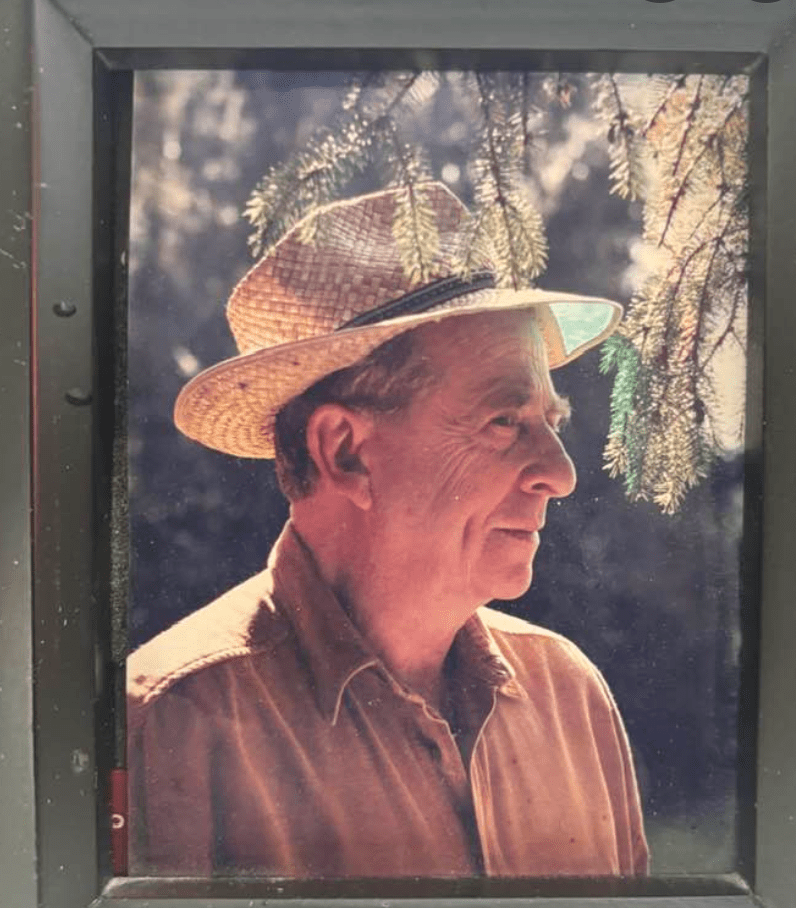
Gathering to Remember Alan Saks
February 9, 2026 at 11:00 am
Riverside Memorial Chapel, W 76th and Amsterdam, New York, NY.
Eulogy for my Uncle Alan Saks
Mark Auslander
February 9, 2026
Good morning. Welcome to our Remembrance of Alan Joseph Saks. Thank you for all for coming through the cold and ice this morning to honor Alan’s life and legacies, and for joining together as we express our love and sympathy for Judy and for Eva.
I’m Mark Auslander, Alan and Judy’s nephew, and first cousin of their daughter Eva. Judy and Eva have asked me to officiate here this morning.
Alan was born January 9, 1933 in Manhattan to Arthur Saks and Helen (Herman) Saks. He attended Queens College and received his JD from Cornell University Law School in 1956. After entering the bar in New York State in 1957, he practiced law with the New York State Division of Human Rights. Beginning in 1981 he served as a judge for the Civil Court of the City of New York. In 1988, he joined the Bronx County Supreme Court in the 12th Judicial District of New York.
He was known during his judicial tenure for his commitment to conflict resolution and arbitration, and for witty and compassionate turns of phrase. After retiring from the bench in 2009, he continued to to serve the people of the Bronx by working as a mediator. A member of the Reform Democratic Club of the Bronx, he worked closely with Oliver Koppell, whom we will hear from in a moment.
Alan married Irene Judith “Judy” (Auslander) in 1956. The couple bought into the Amalgamated Housing Cooperative in 1957, and were among the Amalgamated’s longest-running residents or “cooperators”. There they raised their two daughters Eva and Nina, worked together on the campaigns of many progressive political candidates in the Bronx, and had a great circle of friends. They were summer residents of Stephentown, NY, where Alan famously raised generations of home-grown tomatoes, which each spring he would start from seedlings from their terrace in the Bronx.
My sister Bonnie and I have wonderful, vivid memories of Alan, which date to early childhood. We remember, at times of difficulty and crisis, Uncle Alan’s profound decency, compassion, and integrity. My late father Joe, an early political comrade of Alan’s, greatly admired his deep knowledge of American history and his incisive political and legal analyses across their seven decades of friendship. My late mother Ruth absolutely adored Alan, whom she referred to as a ‘true blue” and the epitome of a Mensch. (They also loved eating seafood together.) She often remarked that the arc of American history would have been immeasurably better if only Alan, the most judicious person she knew, were on the US Supreme Court! (Truer words…)
As we mourn Alan, we remember other dear ones who are no longer with us, among them: his father Arthur Saks (1961), his mother Helen (Herman) Saks (1990), brother Eugene David Saks (2001) and Eugene’s wife Pearl, who spent much of their adult lives in France.
Most poignantly, we miss their daughter Nina Saks, who died too young while she was a student at Columbia. Her death was the great sorrow of Alan’s life. A vibrant and insightful young person, she brought enormous joy into our extended family from the moment she was adopted and became Eva’s beloved younger sister and our dear cousin.
It seemed to us that from the unimaginable pain of Nina’s death, Alan drew even deeper resolution to serve others. He finally decided to put himself forward for higher judicial office in the Bronx County Supreme Court. We remember visiting him in his chambers and being struck how committed he and his fellow judges were to the cause of social betterment in the Bronx, especially safeguarding affordable housing stock, consistent with his deep belief that good housing was a fundamental human right.
As a deep believer in the value of mercy in the courtroom and beyond, Alan, more than anyone I have ever known, exemplified Shakespeare’s admonition, voiced by Tamora, in Titus Andronicus (Act 1, Scene 1), which you will find printed on the program:
Wilt thou draw near the nature of the gods?
Draw near them then in being merciful:
Sweet mercy is nobility’s true badge.
Throughout his life of service, Alan did indeed wear nobility’s true badge
Yet what so many of us will remember about Alan was his passion for baseball and the great joy he and Judy took across the decades in watching the game together. Allow me, as we fondly think on Alan, to quote the opening and closing of Bart Giametti’s baseball essay “The Green Fields of the Mind.”
“It breaks your heart. It is designed to break your heart. The game begins in the spring, when everything else begins again, and it blossoms in the summer, filling the afternoons and evenings, and then as soon as the chill rains come, it stops and leaves you to face the fall alone. You count on it, rely on it to buffer the passage of time, to keep the memory of sunshine and high skies alive, and then just when the days are all twilight, when you need it most, it stops. Today,,, a Sunday of rain and broken branches and leaf-clogged drains and slick streets, it stopped, and summer was gone…Of course, there are those who learn after the first few times. They grow out of sports. And there are others who were born with the wisdom to know that nothing lasts. These are the truly tough among us, the ones who can live without illusion, or without even the hope of illusion. I am not that grown-up or up-to-date. I am a simpler creature, tied to more primitive patterns and cycles. I need to think something lasts forever, and it might as well be that state of being that is a game; it might as well be that, in a green field, in the sun.”
Thank you
A Tribute to My Father
by Eva Saks (read aloud by Eva’s cousin, Bonnie Auslander)
My father, Alan Saks, was better-looking than Paul Newman and a better singer than Bing Crosby. He loved Chinese food, baseball, his family, and justice.
Of course, justice had its own demands. On one memorable road trip, when I was about eight, I finally talked my parents OUT of staying in some “charming one-of-a-kind country inn,” and INTO staying in my idea of heaven: Howard Johnson’s. A chain where they’re all the same! The real America! Going into the dining room there for breakfast, I will never forget my delight at the plastic menu with photos of food, the uniformity, the conformity….I was blissfully eating mass-produced blueberry pancakes when suddenly my dad noticed something on the menu and got very quiet. He called the waitress over, and very politely asked her, “Do you know that Howard Johnson’s has locations in South Africa? Where they have apartheid?” I realized instantly that I better eat my pancakes fast, as we would be leaving Howard Johnson’s VERY soon. And so we did. Bravo, Dad.
Dad was a proud public servant. Before becoming a judge, he worked as a Civil Rights lawyer at the New York State Division on Human Rights. (As a matter of fact, he hired the first woman law clerk there. He also won the anti-discrimination case for the first female umpire in the Major League.) He believed in the power of the law to do good. He also enjoyed that his office was right near Chinatown, and tried just about every restaurant there.
Dad was never naive, but nonetheless he remained an idealist. Again, I confess, it took me a while to appreciate his idealism: Throughout my childhood, I begged him to stop being a Civil Rights lawyer and go into private practice, so I could get a pony. Fortunately, he ignored these entreaties.
I finally realized how lucky I was when I went to visit him at work at the New York State Division on Human Rights, when I was in high school. I was sitting reading at a long table covered with law books and person after person kept coming up to take me aside and tell me how my dad had saved them when they were in need: “Your father was there for me when I lost my mother” “Your father helped me when I went bankrupt” “Your father helped me get a student loan.” Honestly, it was like something out of IT’S A WONDERFUL LIFE. Dad made the world better.
Dad was a hero to me in other ways, too. I will always treasure the memory of Father’s Day at the middle school I went to, Fieldston, because on that day, fathers came to gym class and participated in an outdoor game of kickball. (Kickball is basically the same as baseball, except instead of batting a baseball, you kick a watermelon-sized rubber ball.) I remember my anxiety as dad waited his turn. Some fathers missed the ball altogether. “You’re OUT!” Some fathers kicked it so high it was easily caught. “You’re OUT!” Another father kicked a triple and got to third base. Oy – who could compete with that? Then it was dad’s turn. Would he lose the game for our team? Dad was cool as a cucumber. He concentrated and he kicked…I waited…and the ball went over the field…over the wall of the school grounds… and across the street into a distant park. “HOME RUN!” Not only did this end the tension, it ended the game altogether, as no one could even FIND the ball. Dad was the hero of the day, actually a superhero.
Did you know my father loved birds? And botany? He even took a night course in botany when I was very little. Perhaps this botany course contributed to his later evolution into Farmer Saks: It turned out this New York City kid had a Green Thumb, especially with tomatoes. He grew copious tomatoes, both at our country house in Stephentown and on the balcony of our Bronx apartment.
Again, initially I was slow to appreciate this gift. In fact, when my parents showed up to visit me when I was a student in law school, they arrived bearing a HUGE basket of home-grown tomatoes. In the main hallway of Yale Law School. I was honestly a little embarrassed. But then a CROWD of my hungry classmates gathered round clamoring to get some. Another life lesson from dad: Home-grown tomatoes were cool! Dad made me the most popular girl at law school that day. Thank you, dad!
Dad loved to sing and we all loved singing together around the kitchen table. And Dad knew just about every song ever written (up to 1960). Like his mom Helen, he was an expert in Vaudeville and Tin Pan Alley tunes. My dear friend Sam Austin, a professional piano bar player, said my dad was the only person who ever stumped him with a song request. For the record, Dad’s favorite songs included “Pennies from Heaven,” Paul Robeson singing “Ballad for Americans,” and “Pale Hands I Loved, Beside the Shalimar.” That last one might be the song that stumped my friend Sam.
Dad was also a great connoisseur of old movies. He enjoyed a wide variety of them, but he never lost his RIGOR. Two months ago, we were on the phone and we were both watching Turner Classic Movies. He was watching DOUBLE INDEMNITY and I mentioned I was watching MR. BLANDINGS BUILDS HIS DREAM HOUSE. He considered this — really, took it under advisement — and replied, “That’s a fun movie, but DOUBLE INDEMNITY is better.” Quite right. My dad was dedicated to judicious precision – to what Wallace Stevens called “the romance of the precise.”
Of course the movie that we all associated with my dad the most was TO KILL A MOCKINGBIRD. After my college friend Jeff Nunokawa met my father, Jeff told me that my dad reminded him of Atticus Finch. Thereafter whenever my dad’s name came up, Jeff would always murmur a line from the film “Stand up, Scout. Your father’s passing.” This is what the townspeople said to Atticus’s seated daughter, as Atticus was leaving the courtroom after a day of defending the unjustly accused Tom Robinson. It was the ultimate act of respect from people watching a lawyer fight for justice: “Stand up, Scout. Your father’s passing.”
It is hard not to reflect that we are losing my father at a time when we can ill afford to lose someone who so loved justice.
The great loss of my father’s life – as for my mother and me – was the death of my sister Nina at 19. Dad once told mom and me, “I wouldn’t mind dying if I could see her again.” Here’s hoping.
The great joy of his life was my mother. They shared a passion for baseball, but it must be disclosed that mom supports the Mets while dad favored the Yankees. Mom would laugh at this conflict and point out that “A house divided against itself cannot stand.” But stand they did. A vivid memory of their bond: When I was in junior high school, I remember asking my parents at the dinner table, what was MADAME BOVARY about? Little did I realize what I had started. They both began telling me the story, taking turns with plot turns, and the next thing I knew, they were both crying over Emma Bovary’s fate. Their emotional relationship to literature, not to mention each other, was poignant and indelible.
When I last saw dad, he looked less like Paul Newman but still sang better than Bing Crosby. We all spent a lot of time singing around the kitchen table! Dad and mom showed off a recently unearthed duet from vaudevillians Gallagher and Sheen, as well as the 1919 classic “Snoops the Lawyer,” by Bert Kalmar & Harry Ruby.
Dad turned 93 a week before he died. He and mom had Chinese food. Mom tells me he loved the blue pajamas I sent him for his birthday. I also sent him a plaque that said NUMBER ONE DAD. He died holding my mom’s hand.
And there you have it.
Please eat a tomato in his memory. And go to a protest.
“Stand up, Scout. Your father’s passing.”
A Memory of Alan Saks by Ellen Schattschneider (niece)
One of my favorite passages about gardens is the poem by E.B White, “To My American Gardener, With Love” (1930):
Before the seed there comes the thought of bloom,
The seedbed is the restless mind itself.
Not sun, not soil alone can bring to border
This rush of beauty and this sense of order.
Flowers respond to something in the gardener’s face —
Some secret in the heart, some special grace.
Remembering Alan contentedly working in his Stephentown garden with supreme concentration, calls to mind that remarkable poem. Alan’s face radiated pleasure, as he pulled weeds and tied up tomato plants. lost in his garden world. The warmth of his bright red tomatoes, carefully transported as seedlings from the Bronx to the rear plot on Goodrich Hollow Road, were testament, I always felt, to some secret in Alan’s generous, bountiful heart. Gathered around Judy’s table, feasting on those tomatoes, we were indeed nourished by his “special grace.”
I am also reminded of the heroine Mary’s discovery of the mysterious garden in Frances Hodgson Burnett’s novel, The Secret Garden: “She was inside the wonderful garden and she could come through the door under the ivy any time, and she felt as if she found a world all her own.”
Walking out the back door of the house on Goodrich Hollow, which led to vegetable garden, I always felt that I was entering into Alan’s dappled summertime world, from which tiny miracles sprang forth all season long.
So, thank you Alan for our memories of that abundant sanctuary and those luscious tomatoes– from your very own “secret garden”.
_____
A Poem of Remembrance (read by Judy Saks)
A Meaning
Because there is a meaning
in the lily, let there be worship;
and in the poplar, let there be height;
and in the arborescent heather,
let there be growth;
and in the copper, first treatment
I give to the vine, let there be harvest.
And another meaning, I predict,
there is in memory,
so let there be outburst.
And another, immeasurable,
in love, so let there be surrender.
And another, definitive,
in death, let there be release.
—António Osório (1933-2021) (Translated, from the Portuguese, by Patricio Ferrari and Susan M. Brown.)
—Note: also at the Remembrance ceremony, the poem “One Art” by Elizabeth Bishop was read aloud by Nancy Gair: https://www.poetryfoundation.org/poems/47536/one-art
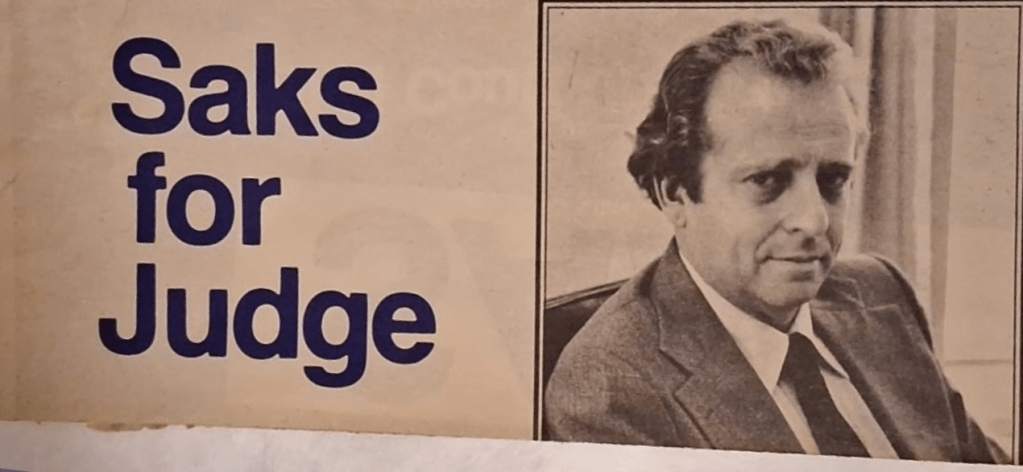
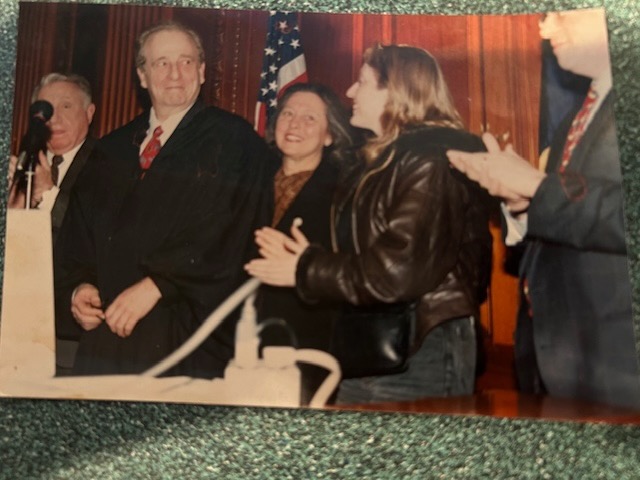
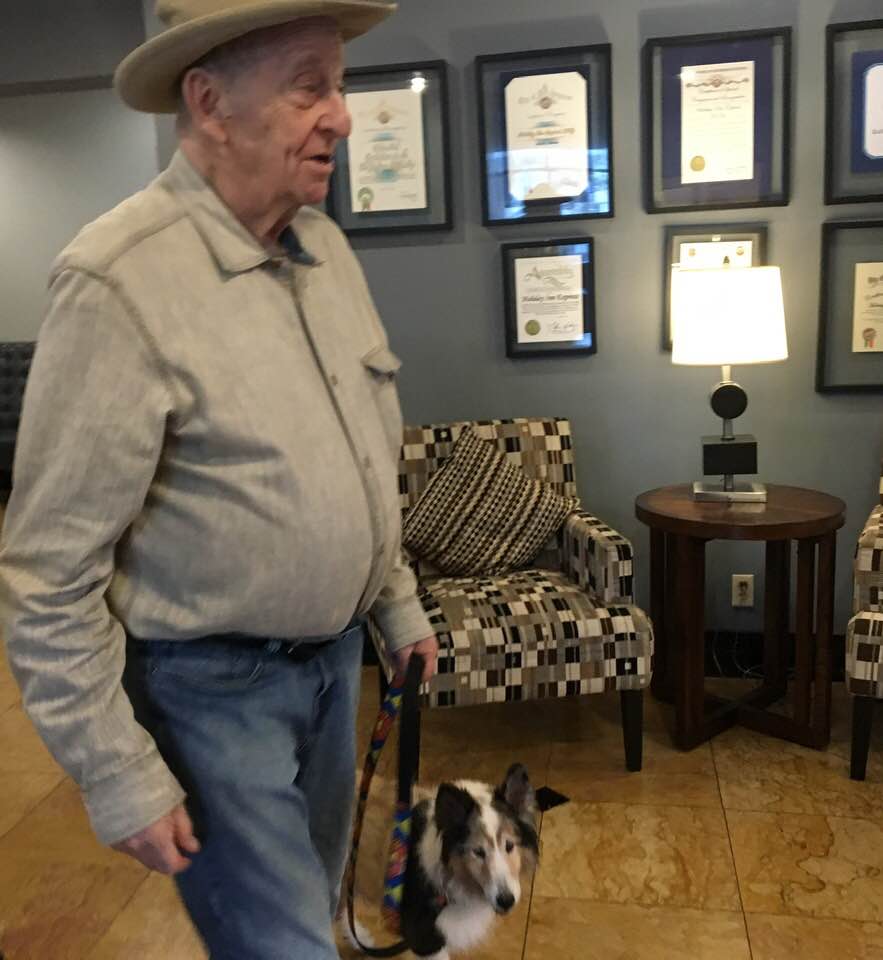
Overview Remembrance: Hon. Alan J Saks (retired) died peacefully in Bronx, NY on January 16, 2026 at age 93, following a brief illness. Born January 9, 1933 in Queens NY to Arthur (Sklarsky) Saks (a surplus goods merchant) and Helen D (Herman) Saks, he attended Queens College and received his JD from Cornell University Law School. He entered the bar in New York State in 1957 and the same year moved to Bronx, NY, where he resided with his wife Irene (“Judy”) for the rest of his life. He practiced law with the New York State Division on Human Rights, and beginning in 1981 served as a judge for the Civil Court of the City of New York. In 1988, he joined the Bronx County Supreme Court in the 12th Judicial District of New York. He was known during his judicial tenure for his deep commitment to mediation and arbitration, and for witty and compassionate turns of phrase. He retired from the bench in 2009. After retirement he continued to serve the Bronx community as a mediator for several years. He also served on Community Board 8 and was a Democratic district leader. He was a lifelong progressive and member of the Reform Democratic Club of the Bronx.
Alan married his wife of seven decades, Irene Judith “Judy” (Auslander) Saks in 1956, after they met at the Tanglewood Festival House, where he was working during the summer as a waiter while a law student. (He had previously worked with Judy’s brother Joe in the anti-fascist organization American Youth for Democracy at Queens College.) The couple bought into the Amalgamated Housing Cooperative, adjacent to Bronx’s Van Cortlandt Park in 1957, and were ranked among the Amalgamated’s longest-running cooperators. There they raised their two daughters Eva and Nina, worked together on the campaigns of many progressive political candidates in the Bronx, and had a great circle of friends. They were summer residents of Stephentown, NY, a community the family dearly loved, living close by Judy’s beloved cousin Alice (Shapiro) Swersey and her husband Burt.
Alan was a prodigious consumer of political news and, with Judy, an avid baseball fan. He and Judy adored old movies, including The Great McGinty (1940), Casablanca (1942), Watch on the Rhine (1943) and The Apartment (1960), the latter about the struggle to resist the corporate ladder and become a “Mensch” on the eve of the 1960s.
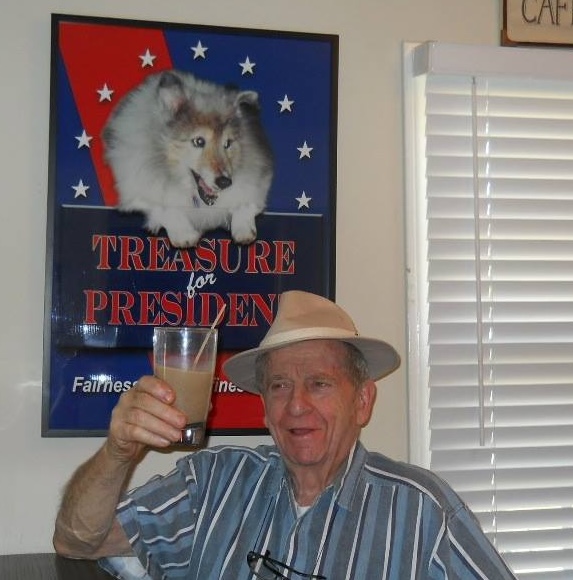
Alan, along with Judy, took great pride in the varied accomplishments of their daughter Eva Saks, as a theater director, film director, casting director, entertainment attorney, and most recently, as an animal advocate and director of Sheltie Rescue Alternative, Inc, a 501(c)3 charity (dog rescue) for seniors/special needs dogs, mostly Shelties. Alan deeply loved and mourned his gifted daughter Nina, who passed much too soon when she was a student at Columbia University.
Alan was preceded in death by his father Arthur Saks (1961), his mother Helen (Herman) Saks (1990), brother Eugene David Saks (2001), and daughter Nina Saks (1989). He is survived by his wife Judy of the Bronx, daughter Eva of Los Angeles, California, niece Bonnie Auslander of Lyons, Colorado, nephew Mark Auslander of Washington DC, great-niece Nina Auslander-Padgham, great-nephew Milo Glover, and many cousins.
Friends and family are invited to give donations in Alan’s memory to Amnesty International USA; the United Farm Workers Foundation (which currently works to prevent family separations); or, for animal lovers,Sheltie Rescue Alternative of Los Angeles (Van Nuys), California.
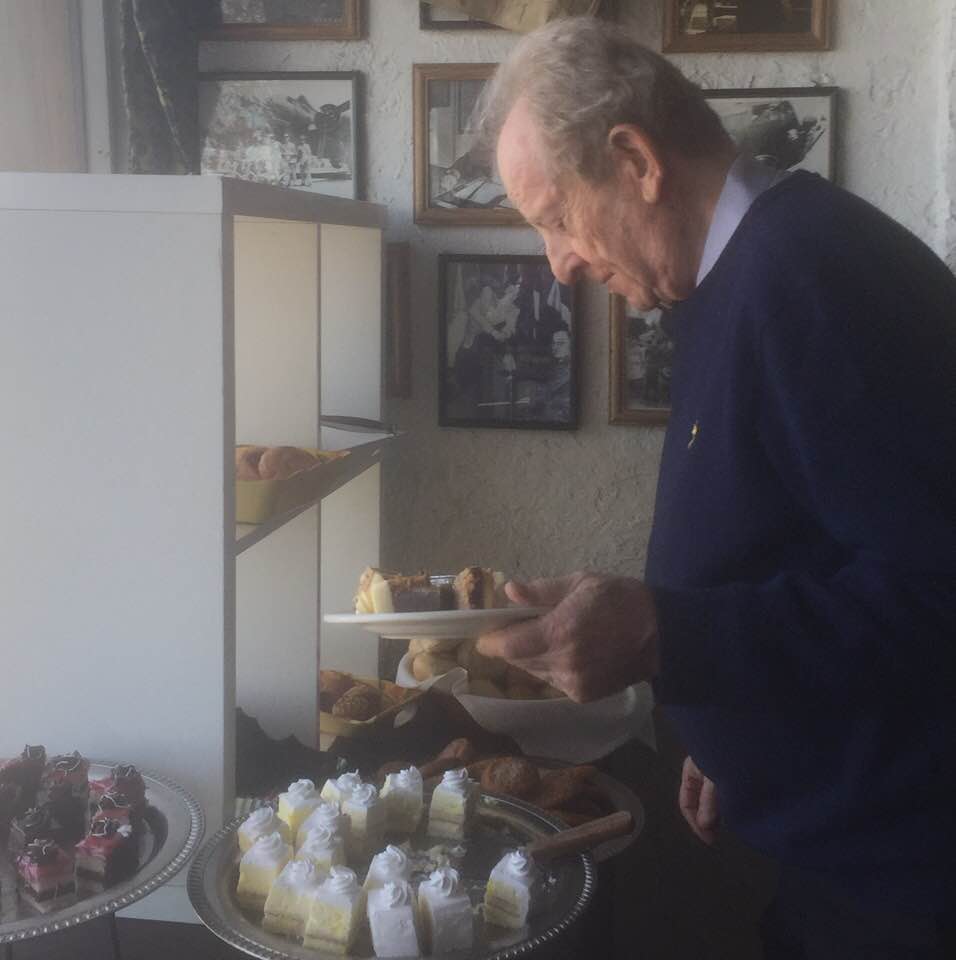
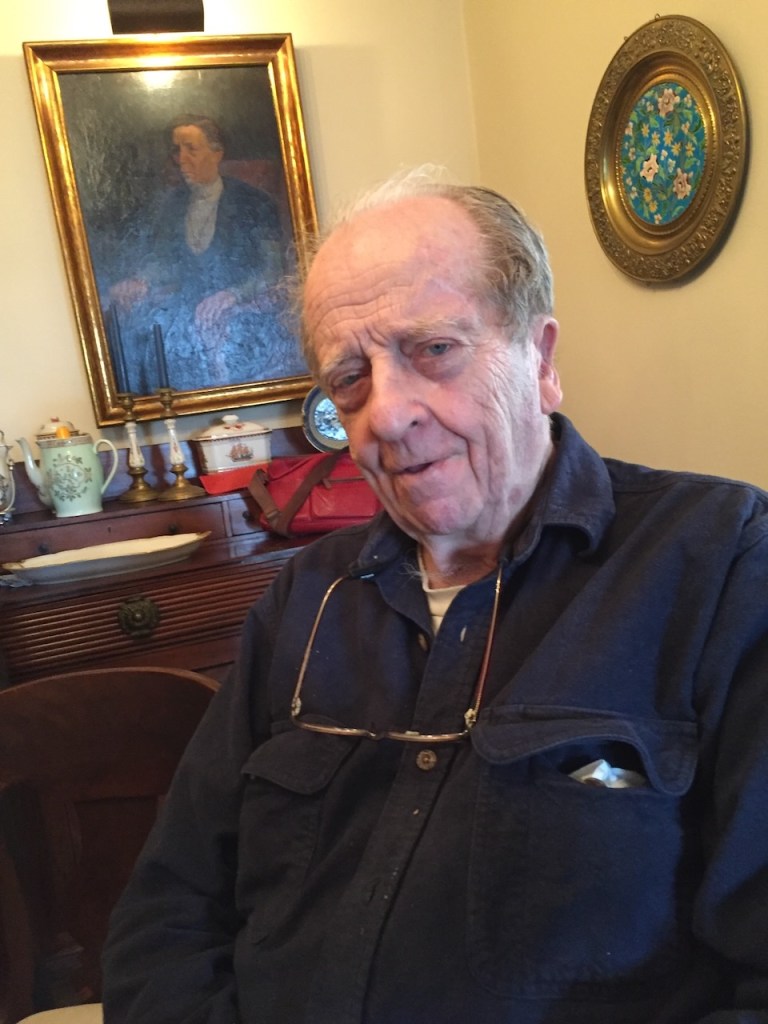
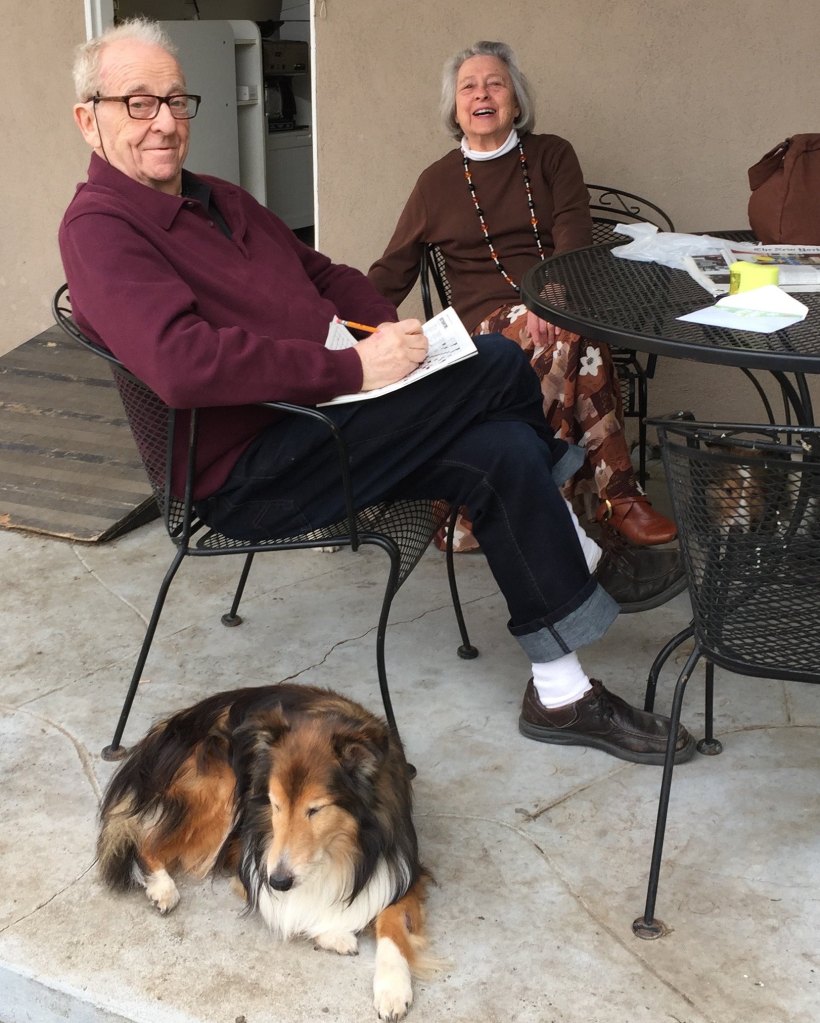
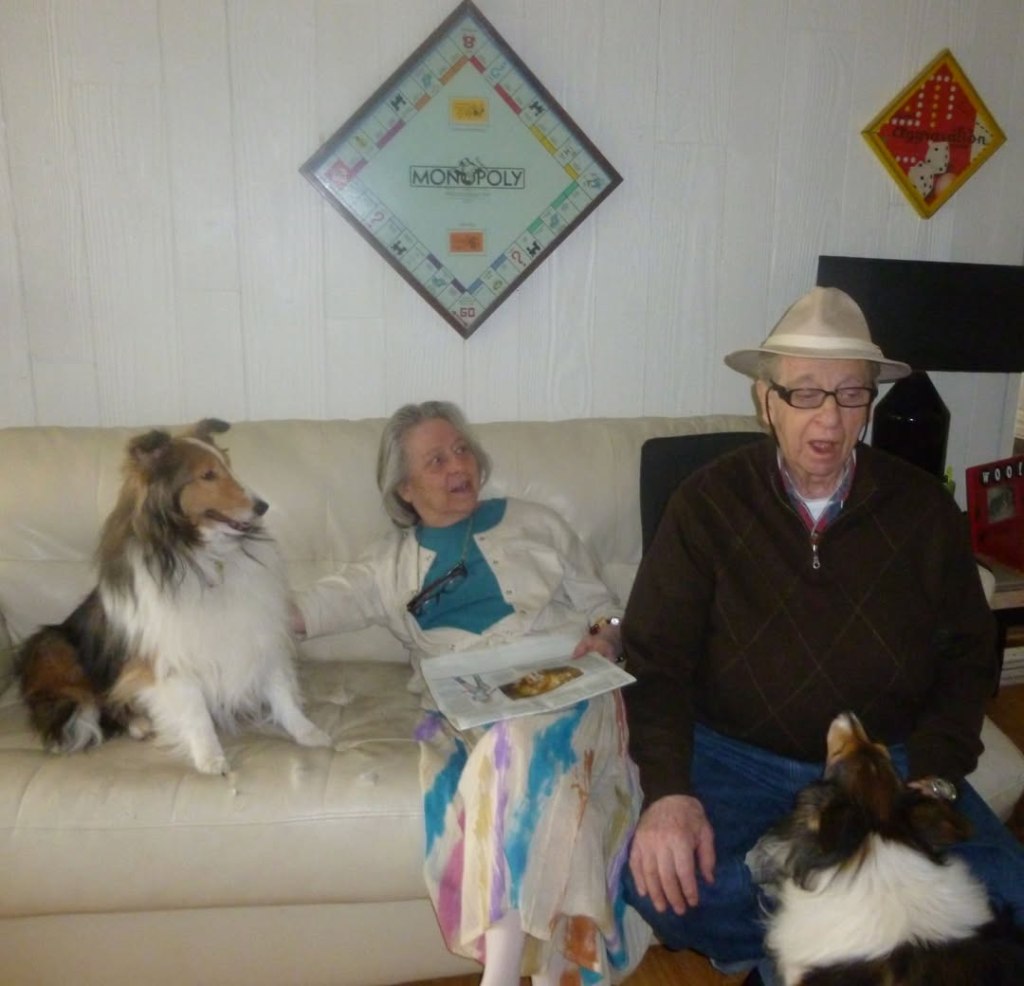
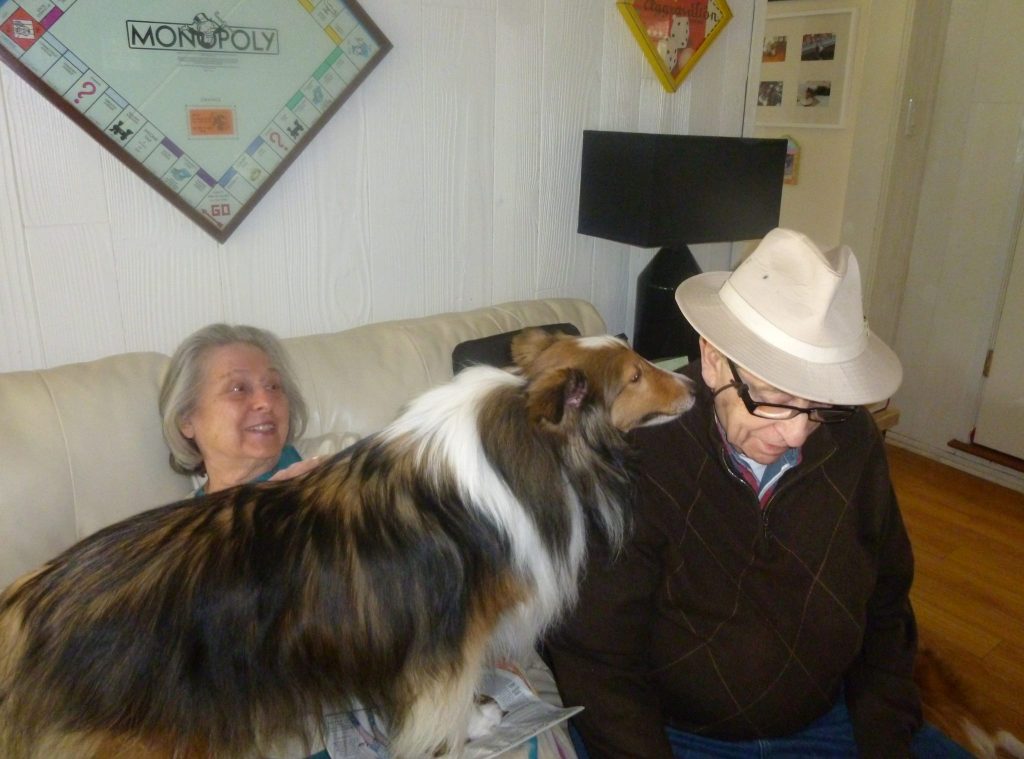
Alan converses from the Bench with canine Counselor for the Defense, as the jury looks on.
”
Memories of Alan by Family and Friends
Ellen Schattschneider (niece through marriage; married to Mark Auslander, Alan and Judy’s nephew ): From the time I came into the family, I was dazzled by Alan’s astonishing command of history, world affairs, and innumerable other domains of inquiry. Alan had the remarkable gift of sharing his encyclopedic command of human knowledge without ever making the other person feel in the least diminished; he always managed to make conversations on politics, film, sports, or music feel like shared explorations and never like didactic lectures, always suffused with playfulness and curiosity.
As a fellow gardener, I particularly loved watching him nurture his tomatoes from seedlings on the Amalagamated terrace to robust maturity in Stephentown, a significant accomplishment given the fickleness of these varietals! And what joy conversing to him about baseball, especially the complicated history of the New York teams: Alan was a Yankees fan, Judy a Met’s fan, and my Dad a Giants fan, so we had all possible Subway Series pretty well covered (and after the Giants’ moved to San Francisco, we had cross-continental travel covered too!)
Finally, I was always honored when he told me I resembled his beautiful mother Helen, a kind and generous compliment that made me feel welcome into the family from the very first day!
Barbara Meeker (Sister in law): My late husband Joe Auslander (Judy’s sister and Alan’s brother-in-law) was very proud of having known Alan before Judy met him; Joe always thought it was one of his own life accomplishments to have introduced Alan to the family.
Second, I want to acknowledge Alan’s loving and steady care for his mother Helen over many years.
Daniel Shaviro (cousin): Because Alan was a judge, he performed Pat’s and my wedding ceremony on September 11, 1988. He wanted to get to know Pat before performing the ceremony, and was lovely and kind throughout. We were very glad to be able to do this in the family, and with someone I knew and liked, especially given that we did not want a religious ceremony of any kind. (And we didn’t know any other judges, not to mention ship captains.)
My mom (Frieda Shaviro) would always tell me that we “owed” him for doing this, which I thought a bit over-scrupulous as he seemed to take genuine pleasure in it.
I always enjoyed meeting him at family functions thereafter (as well as before), as he was always good-humored and fun to talk with.
Lucy Kerman (cousin): I have lovely memories of Alan, especially from my college years, when I would visit my Uncle Sol and Aunt Frieda in the Amalgamated. He was such a warm, funny, welcoming man!
 Mark Auslander