I have been trying to trace enslaved people held at Bennett’s Point on Morgan’s Neck in Queen Anne’s County, Maryland, referenced in the 1749 will of Richard Bennett III. (Our information on these enslaved people is limited because it appears that no probate inventory of Bennett’s estate was taken, perhaps because neither he nor his principle heir and executor, Col. Edward Lloyd III (1711-1770), has substantial debts to settle.
One of those named in the will is the enslaved house servant Jack Gooby. In his original will Richard Bennett III bequeaths “Jack Gooby that attends the house” to his cousin John Rousby (who inherited the property on Morgan’s Neck where Bennett had resided). However, in the third codicil to his will Bennett makes an alteration: “My negro Jack Gooby that attends in the house, given by my will to cousin Mr. John Rousby, I now give to cousin Edwd. Tilghman.” (Bennett also bequeaths, “To Mr. Edward Tilghman, for his trouble in writing this will & other services, 100 pounds”)
This was Edward Tilghman, Sr, “Of Wye,” 1713-1785, a prominent planter and politician who served as High Sheriff and Justice of Queen Anne’s County, Colonel in the Maryland militia, member and speaker in the Maryland Assembly, and representative of the colony to the “Stamp Act Congress’ of 1765. He owned Whitehall Plantation, which he passed on to his son Edward Tilghman, Jr in 1772; around 1774 he also seem to have transferred 24 slaves to his children.
Jack Gooby then appears over three decades later in the will of this same Edward Tilghman (of Wye), Sr, testated in 1785. Tilghman asserts that Gooby had, back in 1749, requested that he be willed to Tilghman, and asks that Gooby be treated with special consideration by his future owners:
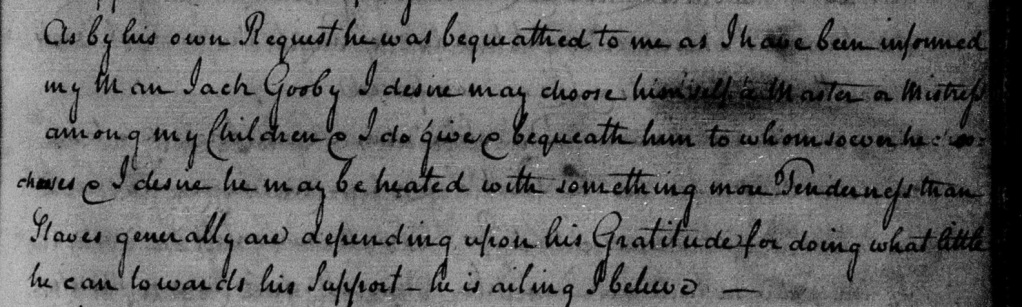
“As by his own request he was bequeathed to me as I have been informed my man Jack Gooby I desire may choose his own master or mistress among my Children. I do give bequeath him to whomever he desires. I desire he may be treated with something (sic.) more Tenderness than slaves generally are depending upon his Gratitude for doing whatever he can towards his suppo
rt. He is ailing I believe.” (Queen Anne’s Wills 1777-1785 vol 1, p. 281.)
Tilghman also notes in the will, “I give and bequeath unto my Daughter Susannah five hundred pounds lawful money and the mulatto girl Polly who waits in the House daughter of Jack Gooby over and above the share of my personal estate as atd (attested?)” I have not seen a reference yet to who Jack chose as master or mistress, although it may be that he chose to be transferred to Susanna Tilghman (later Susanna Jones) in order to remain close to his daughter Polly.
Thomas Goody: Possible Kin of Jack Gooby?
Beatriz Hardy (Goucher College) notes that the Black man Thomas Gooby is repeatedly referenced in the 1769 and 1770 diary of Jesuit Father Joseph Mosley, as serving as godfather to fthe baptisms of five Black children. Fr. Mosley, SJ, was during this period assigned to St. Joseph’s Tuckahoe and St. Peter’s Queenstown on the Eastern Shore, which included many Black enslaved and free communicants (Source; Archives of the Maryland Province of the Society of Jesus at Georgetown University’s Special Collections)
25 July 1769: Mary ngo (negro), godfather Thos. Gooby ngo and godmother Sue
25 July 1769 Isbabell Ngo, godfather Thos. Gooby ngo and godmother Betty ngo
25 July 1769 Frances ngo, godfather Thos. Gooby ngo and godmother Marina
4/15/1770 Isabella N., godfather Thos. Gauby and godmother Elizabeth
5/6/1770 Richard N., godfather Thom Gouby N. and godmother Judith N.
Thomas Gooby at the time of the baptisms in 1769-70 was age 72, the oldest enslaved person on a Blake family plantation on the Wye River in Queen Anne’s County. I believe this was the former plantation of Charles Henry Blake, who was married to Henrietta Lloyd II, half sister of Richard Bennett III, who served as a testator to Charles Blake’s will in 1732. (Source: Beatriz Betancourt Hardy, “The Papists..have shewn a laudable Care and Concern: Catholicism, Anglicanism and Slave Religion in Colonial Maryland, ” MARYLAND HISTORICAL MAGAZINE, VOL. 98, NO. I (SPRING 2003).
Perhaps Thomas Goodby was the father, uncle, or cousin of Jack Gooby.
Kennersley and Swan Point Connections?
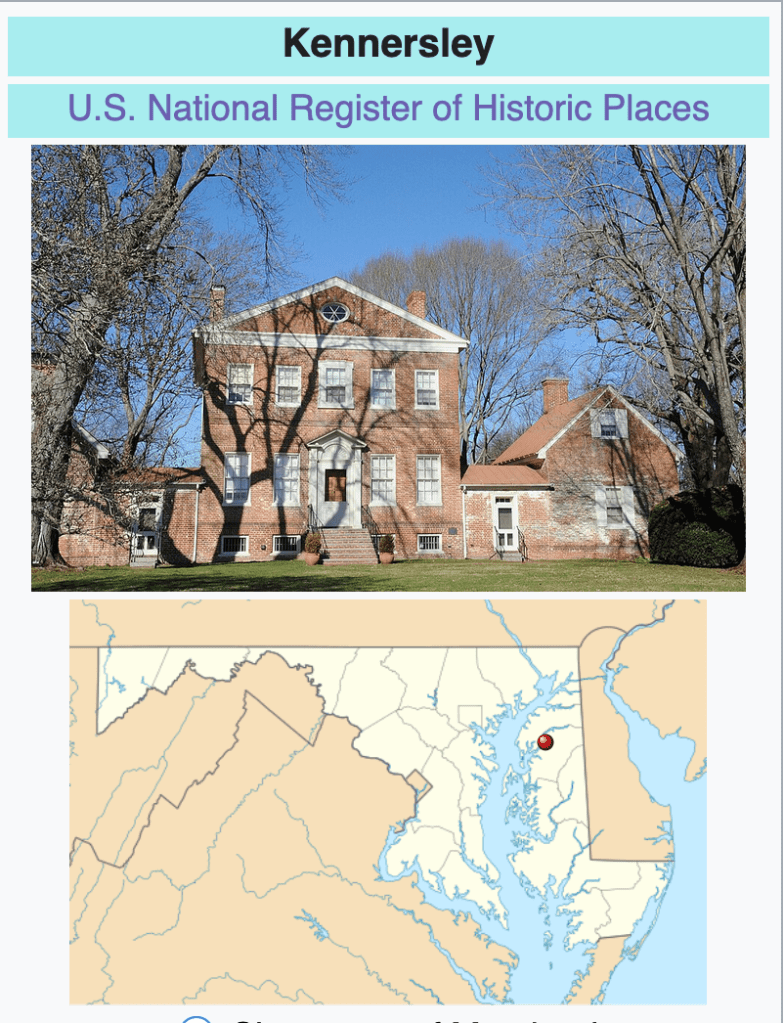
I am not sure what became of Jack Gooby or his daughter Polly (Gooby?) after 1785. Shortly after her father’s death, Susanna Carroll Tilghman married Richard Ireland Jones, who legally acquired her property. On her land on Southeast Creek he began to build in the late 1780s the plantation house known as Kennersley or Kinnersley, which still stands on Southeast Creek Road, Church Hill in northern Queen Anne’s County.
Susanna appears to have died around 1800 (I have not found clear information on her death). She and Richard Ireland Jones had only one child, Arthur Tilghman Jones Sr, 1787-1849,who, according to secondary sources, inherited both land and slaves from his mother. (I have not located Susanna’s will or other probate records in Queen Anne’s or Kent County records).
After the War of 1812, Arthur Tilghman Jones Sr ,filed for compensation for the escape on a British naval vessel from his Swan Point ( Kent County MD) farm, on September 16, 1814 of the following freedom seekers; Jacob Murray, Delilah Murray, George Horner, Abraham Lyles, John Chambers, Hannah Lyles, Elijah Lyles, and Polly Chambers. The British ship had traveled along the Patapsco River after the attack on Baltimore and anchored at Swan Point, where it boarded these self-liberated people.
The freedom-seeker Polly Chambers was 17 years old at the time of her escape, so born around 1797. One wonders if she might be the daughter of, or otherwise related to, the mulatto “girl” Polly Gooby, who, as noted, had been inherited by Susanna Tilghman (Jones) in 1785. If Polly Gooby was, for instance, 15 at the time of Edward Tilghman’s death, she would have been born around 1770.
Also escaping in the same event was 18 year old John Chambers, perhaps the husband or brother of Polly Chambers. John served in the Second Company of the (British) Colonial Corps of Marines. “In December 1814, he participated in the British invasion of Cumberland Island in Georgia, which liberated many enslaved people. I believe the Corps was then stationed in Bermuda, until they were disbanded. During 1815-16, John Chambers was one of about 800 former Black troops settled by the British on designated land in southern Trinidad, establishing the so-called “Merikin” community. “By 1823, however, Chambers had moved to the Fourth Company’s hospital for “mal d’estomac,” now understood as hookworm.” (Source:https://msa.maryland.gov/megafile/msa/speccol/sc5400/sc5496/001600/001610/html/001610bio.html) Weiss, John McNish, The Merikens: Free Black American Settlers in Trinidad 1815-1816. London: McNish & Weiss, 2002). I do not known if he was an ancestor of the prominent politician George Michael Chambers, 1928-1997, who served as Trinidad and Tobago’s Second Prime Minister,and who was the son, I believe, of George Basil Chambers.) I am not sure if Polly also settled in Trinidad.
In 1822, Susanna’s son Arthur Tilghman Jones, suffering extensive debt, sold 19 enslaved people, some or all of whom had been inherited from his mother Susanna: Solomon, William, Charles, Metus, Frank, Dick, William, Mitty, Kitty, Emory, Anna, Sally, Bill, Edward, Betsey, George, Charles, Metus, Bill. I am not sure if any of these individuals were kin to Jack or Polly Gooby.
Other Possible Jack Gooby Descendants
Various enslaved and free persons of color with the surname Gooby on the Eastern Shore may be direct or collateral descendants of Jack Gooby and his daughter Polly.
- The will of Arthur Emory in Queen Anne’s County, 8 March 1807, proved 7 April 1807, manumits a Lucy Gooby, with her freedom to commence 8 March 1824.
- The 1850 census in Queen Anne’s County, District 3, records a free man of color, Charles Gooby, born around 1810, residing in the household of the white farmer James Burris.
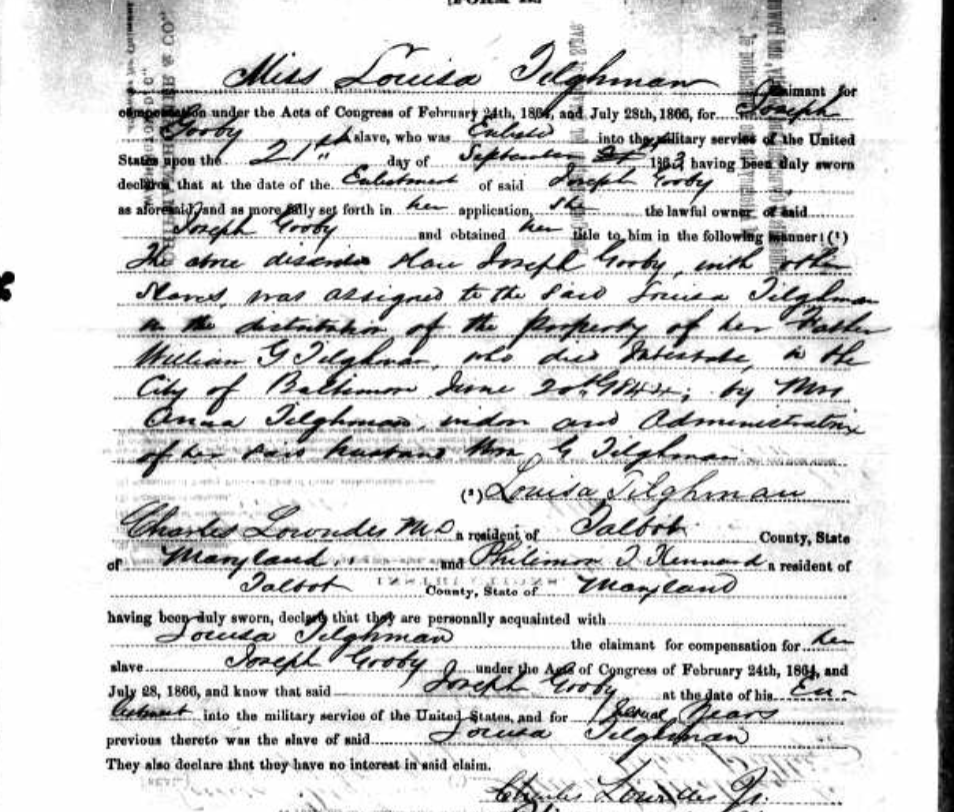
- Robert Gooby, born around 1832, enlisted in Baltimore on 21 September, 1863 in United States Colored Infantry Regiment 7, Company G, He mustered out in Indianola Texas on 13 October 1866. On 5 December 1866, his former owner Miss Louisa Tilghman claimed compensation for his enlistment during the Civil War. Louisa writes she had inherited Joseph from the estate of her father, William Gibson Tilghman, 1785-1844, of Baltimore, who was the son of Richard William Tilghman, 1739-1809, son of William Tilghman, 1711-1782, brother of Edward Tilghman, who had inherited Jack Gooby from Richard Bennett in 1749 and who passed Jack Gooby on to one of his children in 1785.
Robert appears in the 1870 census in Talbot County living with Annie Gooby, age 50 (born about 1820), his likely mother. He is married to Betsy Gooby, with children Alice and William.
- In the same USCT regiment is Private Joseph Gooby, perhaps Robert’s brother, born around 1830 in Talbot County. Joseph Gooby also enlisted on 21 September 1863, and served in the United States Colored Infantry Regiment 7, Company C (unlike Robert who served in Company G). He was mustered out of the Army on May 3, 1865, from the US General Hospital in Norfolk, VA, on account of disability: he had sustained a wound to his hip, evidently in the Battle of Chaffin’s Farm and New Market Heights, September 1864, in the Siege of Petersburg. leaving him paralyzed in one leg.
As she did with Robert, his former owner Louisa Tilghman also claimed compensation for Joseph, noting that she had acquired him in 1844 though the division of the estate of her father William Gibson Tilghman in Baltimore.
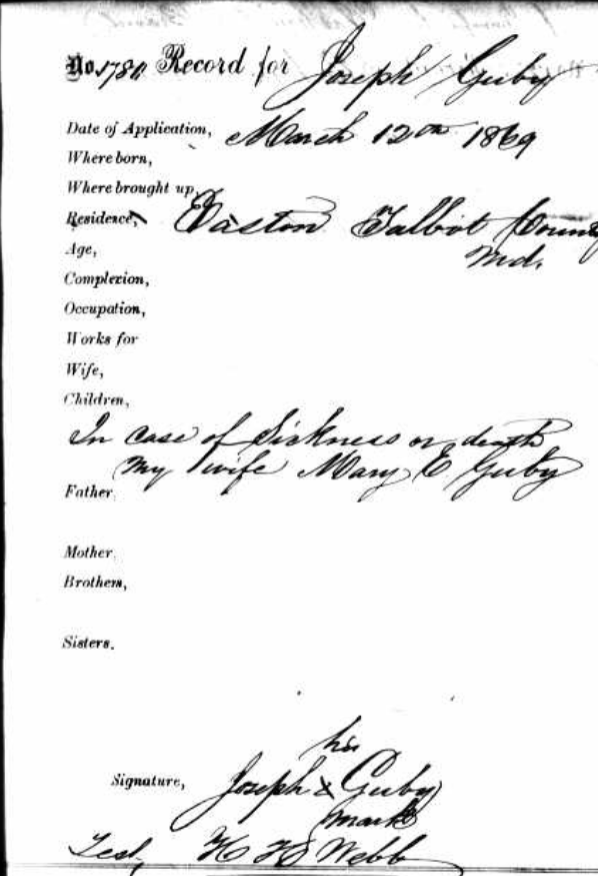
After the war, Joseph was one of the founders, with other USCT veterans, of Unionville, Maryland. On 12 March 1869, Joseph opened a Freedman’s Bank account in Baltimore, giving as his residence Easton in Talbot County and noting that in case of illness or death, his wife Mary was to have access to the deposited funds.
In 1875 (or earlier) Joseph married Mary E Roberts; their children included born 1876, Kate Goodby, b 1877, Emma Gooby, b 1879, Henriette Gooby, b 1879, Tilghman Owens Gooby, b 1880, Mary E Gooby, 1885, Anna Gooby, 1889, Laura Gooby, 1893, and Lillie Gooby, 1895.
Joseph Gooby died in 1901, and was buried in Saint Stephens Church Cemetery in Easton, Talbot County
The first name of his Joseph Gooby’s son, Tilghman Owens Gooby, emphasizes a connection to the Tilghman family. Tilghman Gooby appears in 1910 in the Baltimore City Directory as a porter. He later appears in the 1940 census, married to Rachel Ennels. Their children included Joseph Gooby, 1926-1995; Robert Owen Gooby, 1937-2012, Samuel Gooby, and Emma Gooby.
It is hoped that future research will cast more light on the descendants of Jack and Polly Gooby and others formerly enslaved by Richard Bennett III of Bennett’s Point.
Acknowledgements: Many thanks to William Kelly and Chris Haley, Legacy of Slavery in Maryland Project, Maryland State Archives, for research guidance. Dean Bea Hardy (Goucher) is an invaluable source of insight into Richard Bennett III and his Eastern Shore Catholic contemporaries.
Sources.
Kelly, William. Black Freedom Seeking During the War of 1812: From the Chesapeake, Cumberland Island, and Beyond Part 2, National Park Service.
Weiss, John McNish, The Merikens: Free Black American Settlers in Trinidad 1815-1816. (London: McNish & Weiss, 2002).
 Mark Auslander