by Ellen Schattschneider and Mark Auslander
We just read Christie Thompson’s delightful interview with L.M. Bogad (author of “Tactical Performance: The Theory and Practice of Serious Play”) on the long political tradition of absurdist protest and “tactical frivolity” that is exemplified by the Portland Frog Brigade, Operation Inflation, and the other dancing costumed frogs and fanciful critters that have been taunting agents of the Trump regime in recent weeks. As anthropologists deeply interested in animal-human transformations, we have been wondering why frogs in particular have proved so particularly beloved by those protesting ICE and other Federalized law enforcement in our current moment of crisis? As many commentators have noted, the hilarious inflatable costumes highlight the absurdity of the regime’s claim that Portland and other progressive urban areas are “war-ravaged” and worthy of invoking the Insurrection Act. Yet, why are animals, and why frogs, of all taxonomic genera, so well “suited” (pun intended) to Trump 2.0 protests?
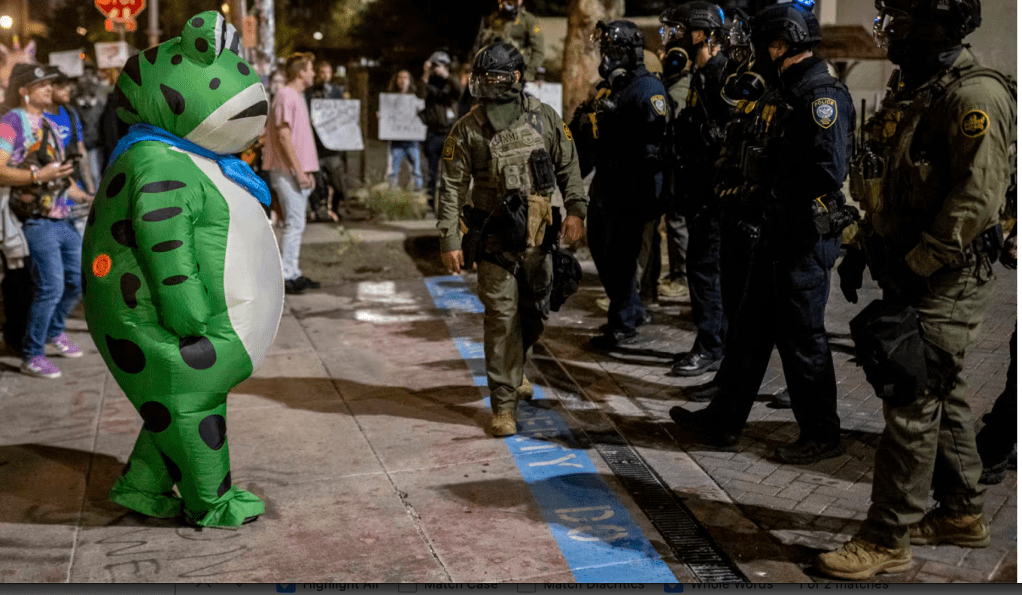
https://www.nbcnews.com/news/us-news/dancing-frogs-unicorns-protest-portland-war-zone-rcna236887
Our point of departure is Claude Levi-Strauss’ classic observation that animals and plants are not just good to eat but “good to think.” Animal symbolism, from a structuralist perspective, offers particularly rich affordances for characterizing human social dynamics. This is not so much because of the intrinsic qualities in individual species, but because, frequently, differentiation between species highlights structural contrasts between different human social groups. Levi-Strauss urges that in unpacking the logic of totemism, we should pay attention not simply to surface “relations” between elements, but rather to ”relations between the relations.” For instance in some Pacific Northwest Coast societies, it is not so much that human members of the Eagle or Turtle clans directly resemble eagles or turtles, but that the underlying relationship between predating raptors and vulnerable reptiles is structurally comparable to the contrast between (higher ranked) wife-takers and (lower ranked) wife-givers in the human realm. For the Nuer, a Nilotic people of South Sudan, “twins are birds,” not because human twins can literally fly, but because the contrast between the great majority of fauna, which are terrestrial, and birds that fly above in the sky, is analogous to the contrast between ordinary people, who enter the world through single birth, and twins, who through the miracle of excessive “kwoth” or spirit, enter the mortal domain through multiple birth. Human twins are like birds in that birds defy the usually classificatory scheme that animals creep upon the ground, just as twins defy the usual tendency of humans (unlike most mammals) to be born one at a time.
Might this basic structuralist insight help illuminate the current choice of the frog in facing off against incipient fascism? In the most immediate sense, frogs are generally prey for predatory species including herons, snakes, raccoons, and of course people. So for protesters who wish to highlight the fact that they are not in fact a threat to their would-be oppressors, a preyed-upon species is entirely appropriate. Prey is to Predator as playful protesters are to armed uniformed jackbooted squads. Hence, it would be less effective for the protesters to be costumed as a snarling wolf or a venomous snake. How interesting in this light, that the Revolutionary War flag of the coiled rattlesnake, “Don’t Tread on Me,” has been adopted by far-right extremists and guns rights advocates. The frog, in contrast, is at the opposite end of the predator/prey spectrum. Hence, the particular horror ignited across the country when an ICE officer inserted a chemical irritant into the air vent of frog protester’s inflated costume, practically guaranteeing that the frog motif would be taken up totemically by dissidents nationwide.
In general, contrastive symbolism works best when there is an underlying resemblance between the opposed pairs. As it happens, frogs bear some physical similarities to humans, especially when they are leaping and look momentarily bipedal, even though they are usually thought be uglier than people: hence, the classic folkloric motif of the princess kissing the frog who turns into a prince (a protean mytheme which probably plays upon the near miraculous transformation of tadpoles into frogs). Green inflated frogs with large rounded heads bear an exaggerated visual resemblance, as well, to paramilitary officers clad in camouflage green tactical outfits and visored helmets, a point highlighted in many of the viral photographs and videos of stand-offs between the prancing frog brigade and the grimacing line of armed ICE agents.
Endlessly protean, moving improbably from egg to tadpole to frog, hopping from water to land and back again, puffing up their throats to utter the loudest of collective calls, frogs have long served as natural channels of chaotic magicality. Heinrich Cornelius Agrippa, in his 1533 edition of De occulta philosophia libri tres (Three books of occult philosophy) recalls the ancient wisdom of Pliny:
“Pliny reports that there are red toads that make their home in briars, and are full of sorcery and do wonderful things. For the small bone that is in its left side, when cast into cold water, makes it immediately become hot. It restrains the attacks of dogs. Added to a drink, it arouses love and quarrels. When tied to someone, it arouses lust. On the other hand, the little bone that is in the right side cools hot water, and it will not become hot again unless the bone is taken out. It cures quartan fevers, when tied in a fresh lamb’s skin, and prevents other fevers and love and lust. And the spleen and heart of these toads make an effective remedy against the poisons that are drawn from those animals” (Quoted in Anthony Grafton, Marked by Stars Agrippa’s Occult Philosophy)
Summoning up reservoirs of magical metamorphosis and healing energy, the frog at the front of the protesting crowd is the cure to all that ails us: as mere individuals at the present moment each one of us is a quivering mess of anxious fear, but through the frogs at our vanguard, we are transformed (poof!) into the brave Prince staring down the Dragon.
Indeed, the raucous inflatables resonate with the magicality of premodern masquerades, which for millennia have channeled the cosmological energies of animals and supernatural beings. In ritual masking traditions the world over, performers lend their physical bodies to the intangible spirits of the mask. In the modern protests, the masked critters —plump frogs, cute bunnies, dancing unicorns— evoke the frisson of childhood animated cartoons. It is as if the entrancing energy of Saturday morning TV shows, a treasured dreamtime of childish safety and delight, is being summoned up to defuse the brutal nightmare of looming totalitarianism. The intrepid wise-cracking spirit of Kermit, everyone’s favorite alter ego, manifests himself as a fearless guardian in the face of every schoolyard bully we’ve ever known. As Kermit bursts through the TV screen of Sesame Street and the Muppet Show, we behold a particularly potent effort to undo a populist figure who has shown an uncanny genius in commanding global airwaves and social media feeds.
At the heart of the current struggle, as Henri Lefebvre and David Harvey would remind us, is the question of rights to the city. Are the urban areas of tomorrow to be ruthlessly homogeneous, subject to panoptic state surveillance and the capricious rule of an all- powerful sovereign, who delights in tormenting all adversaries high and low, serving the interests of an impossibly privileged oligarchy? Or is the city to be the site of irreducible heterogeneous difference, in which power flows not from a unitary center but from innumerable sites of creative practice anchored in the practical lived experience of the masses?
Hence, perhaps, the deep visceral appeal of children’s most beloved ritual of reversal, Halloween itself. As the dark shadows of winter loom, children, subordinate to the whims and dictates of their elders for the rest of the year, have one magical night in which their wishes are paramount. On Halloween, children take over the streets of their environs, empowered by their costumes and their chorused playful cries of “trick or treat.” Some of that magic seems summoned up in the costumed front line of protesters, in Portland and across the nation, joyously and absurdly speaking truth to power.
In so doing, they reenact one of the oldest narratives of liberation from bondage. When all hope seemed lost way down in Egypt’s land, when his people were oppressed so hard they could not stand, the Lord commanded his servants to “Stretch out your hand with your rod over the streams, over the rivers, and over the ponds, and cause frogs to come up on the land of Egypt.’ (Exodus 8: 6) Amphibians, unique in their ability to traverse underwater and terrestrial domains, move instantly from the invisible to the visible. Now, facing down the new agents of Empire, a new irrepressible flock of frogs comes up over the land. They are hilarious, absurd, unarmed, unarmored, portly, inflated. True weapons of the weak. Yet they carry with them the oldest of dreams, that the Last shall be First, and those who had been bowed down with fear shall spring up with the joy of a million frogs, and propel themselves, irrepressibly, back into the light.
 Mark Auslander