Like millions around the world, I have been transfixed by the journey of “The Herds”, often termed the largest public art project ever attempted, during the spring and summer of 2025. Hundreds of life-size wild animal puppets or mobile animal sculptures, guided or animated by their human puppeteers, have undertaken a dramatic migration from the Congo Basin northwards though Africa and Europe, culminating this month in the Arctic Circle and the northernmost points in Europe. (See the project video gallery at: https://www.theherds.org/video-gallery _
The plot line is both simple and profound: escaping from the destruction wrought by climate change and habitat destruction in the center of Africa, these avatars of wild nature—giraffe, elephants, kudu, gazelle, lions, chimpanzees, gorillas and other African fauna—have “invaded” a succession of cities, seeking refuge from advancing global catastrophe. As the project travels, it grows and transmogrifies: in each city in Africa and Europe, local puppeteers are trained to create and bring life to more animals, their hosts welcoming the expanding Herds with a range of artistic performances that are grounded in local traditions and experience, while connected to growing networks of shared global awareness of climate and human-nature interdependence.

The Herds project is both a continuation and transformation of the earlier transnational project, “Little Amal,” in which a single 12 foot girl puppet, representing a Syrian refugee child, travelled westward across Europe seeking her mother. Both projects, guided by artistic director Amir Nizar Zuabi, were organized by the production company The Walks, under producers David Lan and Tracey Seward. The theme of refugee movement infuses both projects: the migrating wild animals of the Herds are in some respects avatars of untold masses of displaced human climate refugees from Africa and elsewhere who have hazarded perilous crossing of the Mediterranean, often at the cost of their lives, in search of survival and a better life for themselves and loved ones they have left behind. Both projects emerged out the brilliance and ingenuity of Ukwanda Puppetry and Design Art Collective, based at the Centre for Humanities Research in South Africa’s University of the Western Cape, where the Ukwanda team are resident artists. (See an exemplary history of the collective, associated with a recent exhibition curated by art historian Rory Bestar.) Ukwanda, founded by Luyanda Nogodlwana and the late Ncedile Daki in 2010, was mentored by Adrian Kohler and Basil Jones of Handspring Puppet Company (famed for Ubu and the Truth Commission and War Horse among many other projects).
The work of Handspring and Ukwanda has depended upon the miracle of what the late puppetry scholar Jane Taylor termed “as if” configurations, in which willing human suspension of disbelief gives birth to the deeply sensed animacy of human-created objects. In so doing as-if-ness energizes or reanimates bonds of shared intersubjective exchange between observers and performers. Mimesis, initially fictional representations which become deeply true through performance, in that sense is a vital wellspring of human culture in all its infinite variety.
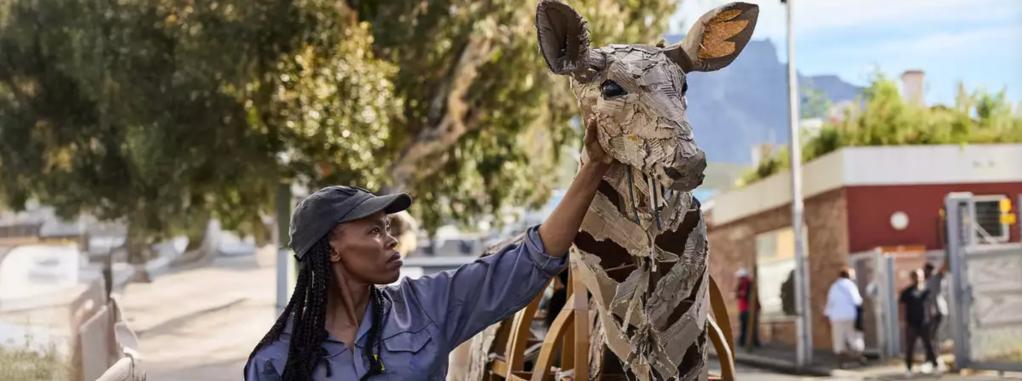
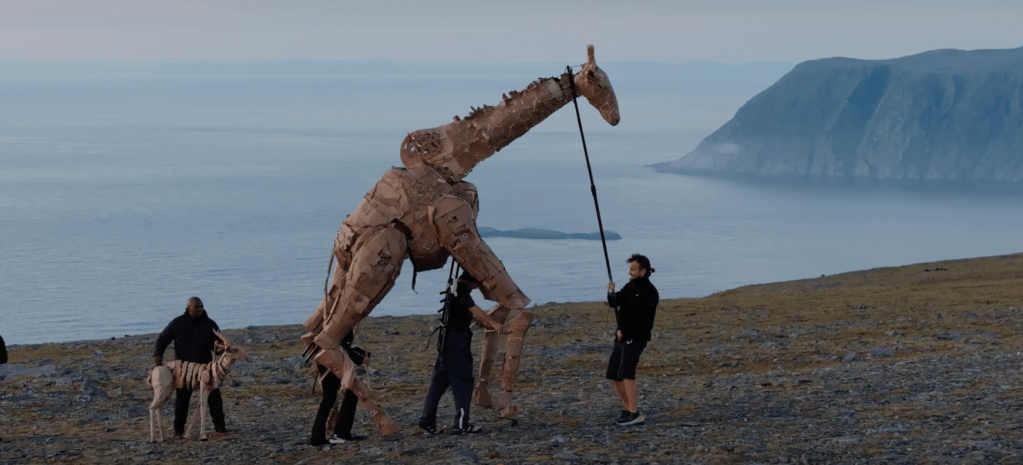
In some ways, The Herds inverts the logic of Little Amal. The Syrian child was seeking her mother; here, the hundreds of animal refugees are escaping the violence done to our shared Mother, the Earth itself. Little Amal was a supplicant, her much discussed distress and tween ungainliness evoking sympathy and compassion (along with episodes of xenophobic denunciation in some quarters during her trek). The Herds’ animals, in contrast, are hardly pleading; they are fierce and majestic, roaring and springing forward through the air, or in the case of the giraffe, nobly towering above us all as it canters through city centers and up a vast, imperiled glacier. The Herds are in danger, but the emotions they engender are, generally speaking, not so much pity or compassion as much as awe, tinged at time with a frisson of fear.

The mythic power of the Herds pilgrimage partly lies, I suggest, in the ways in which it evokes the deepest histories of our species and even our genus, Homo. Hominins evolved out of the fragmentation of dense African forests and the emergence of Savanah biomes, which opened up new opportunities and dangers for our primate ancestors. On the open savannah, australopithecine and their descendant species were uniquely vulnerable to predation of big cats, which drove over time the evolutionary imperative towards intelligence, technological innovation (from fire onwards), language, and complex sociality, our only defenses as we traversed early landscapes of fear. Across prehistory, human survival and expansion depended on understanding and tracking animal migration patterns, and increasingly learning from and competing with non-human carnivores. The expansion of earlier hominen species, about one million years ago, and later homo sapiens out of Africa, around 100,000 years ago, colonizing the planet in successive waves, depended in part on our capacity to follow migrating herds, of wildebeest and zebra, and later caribou and mammoth to the far reaches of Eurasia and eventually into Australia and the Americas.Thus the Herds in a sense recapitulates our collective prehistory, in which human and animal migrations were inextricably intertwined.
The Herds also surely evokes the impossibly ancient origins of art, performance, and mimesis. Acts of hunting and gathering, on which our species depended on prior to the invention of agriculture around 13,000 years ago, seem to be bound up in complex processes of interpolation between the consciousness of humans, animals, and plants. Through mimesis, representational acts that turn image into reality, our ancestors in effect became the natural animals and plants that variously threatened us and sustained us. Through ritual and art making, from the swirling masquerades of animal-like beings to the cave paintings of southern Europe, our ancestors gave birth to dynamic visions of wild animal herds, and used those vast channeled energies to engage in the most important collective work of humanity, the shaping of social persons into responsible members of a collectivity.
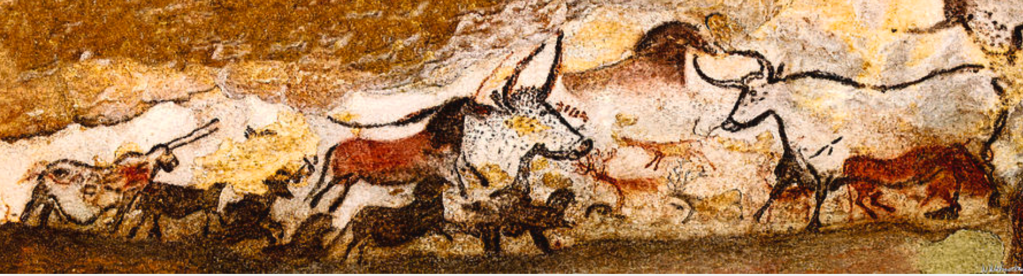
Rites of passage, which move human beings through successive stages of maturation, very often draw on the performed symbolism of wild animals, who in effect kill off earlier stages of one’s life to give birth to higher degrees of consciousness and advancement There is strong reason to think that the subterranean chambers of Chauvet and Lascaux, adorned with vibrant charging herds of wild beasts, were used as collective symbolic wombs to birth new generations of human adults, who in turn would capture and channel the energy of wild nature through painting (probably combined with musical and dance performances) in turn to collectively rebirth future generations of their posterity. Now, in 2025, tens of thousands of years later, something of that earlier impulse is rekindled: the power of the animal herd, it is hoped, will re-inspire a new stage in human development, moving our species beyond obsessive resource extraction towards a shared mutual care for our biosphere and all who make up the intricate global web of life.
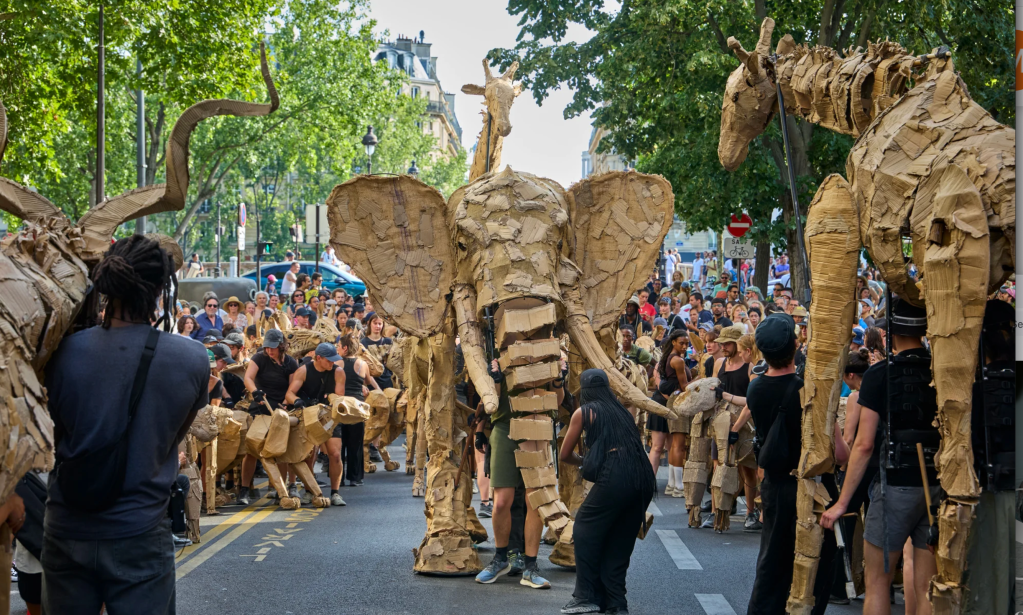
In the connection, I am especially fascinated by the complex metaphor of breath in the artistic practice of Handspring and the Ukwanda collective. The puppeteers explain that if the articulated puppet is seen to breathe, a “true illusion” that depends on the controlled breath of the puppeteer, then the puppet becomes alive in a deep sense. The rhythm of shared breath, which is commonly experienced between observer, performer, and the animal subject, thus sustains life not only for our respective physical organisms but sustains the extension of interpolated subjectivity across the domains of the human and the natural, and across divide between the organic end the inorganic. We all, under the discipline of controlled respiration, learn in effect to breathe together and thus to experience a sense of oneness that cuts across the artificial divisions of us and them. We all breathe in, breathe out, breathe in again.
The isiXhosa and isiZulu term “ukwanda” evokes growth, multiplication, and expansion, which can reference the expansion and development of the bonds of community and of shared learning, principles to which the Ukwanda collective, like Handspring before it, has long been dedicated. The process of Ukwanda is, I presume, most fundamentally incarnate in the act of breathing itself, which when practiced with care and discipline, leads to the expansion of consciousness and intersubjective awareness.

In many cultural worlds in Southern Africa and beyond, breath is understood as a gift of the ancestors, at times incarnate in wind or other atmospheric movement. Acts of breathing together by the living can thus bind people together not only to those who are currently alive but to the honored Dead, who may manifest their energies in natural phenomena, including the springing leaps of a gazelle across the savannah, a crocodile swimming through a deep pool, an eagle traversing the boundless sky. The Herds depends on hundreds of puppeteers, across cities in Africa and Europe, synchronizing their breath and their bodily movements to emulate the breath and movement of wild animals, and to make them collectively into living animals and a living Herd.

In this sense, the grand spectacle of migration north from the threatened rain forests of the Congo Basin, one of the vital “lungs of planet Earth,” can be understood as a collective act of respiration. The ancient carbon cycle, as we all know, is profoundly endangered through wanton acts of destruction, ranging from the uncontrolled logging of old growth forests to the acidification of the world’s oceans. Carbon repositories, which help absorb carbon dioxide, a primary greenhouse gas, are diminished with each episode of wild habitat destruction, which catalyze global warming and all its attendant miseries. Facing the awe-inspiring sight of the leaping, galloping puppets of the Herds, crossing London’s Tower Bridge or a Venetian piazza, or climbing an escarpment at the northern top of the world, we all catch our breath, our heart in our throats, and then start to breathe once again. That shared act of exhalation, followed by breathing in and breathing out, just might help to reset our collective clock, and guide us towards common awareness of the most important respiration cycle of all, the shared breath of our fragile planet, and towards a deeper commitment to honoring the biosphere, our ancestral legacy on behalf of all, human and non human, who might someday migrate across it, as an interdependent, ever-expanding Herd.
 Mark Auslander