On October 18, 1759, two “new negroes” (recently arrived from Africa), named Isaac and Sarah, escaped from Robert Peter (July 22, 1726 – November 15, 1806), a prominent Scottish-born merchant then living in Georgetown. On December 6, 1759, Peter placed the following advertisement in the Maryland Gazette:
“Ran away from the Subscriber, on Thursday, the 18th of October last [1759], Two New Negroes, the one a Man, about 5 feet 8 inches high, supposed to be about 25 years of age, Had on when he went away of Crocus Shirt and Trowsers, and a white Plading Jacket. He will answer to the name of Issac. The other a woman is very small, talks in her own language very fast, and appears to be older than the Man. Had on when she went away, a Crocas Shift, and a white plading Petticoat; she also carried with her a piece of greenith colour’d Cloth, which I suppose may supply the want of a Jacket. She will answer to the name of Sarah.
Whoever takes up the said Negroes, and brings them to me at George-town on Potowmack River, or secures them so that I can have them again, shall have a reward of Twenty-give shillings for such, besides reasonable Charges paid, if taken up 20 Miles from home, and delivered to me,
Robert Peter”
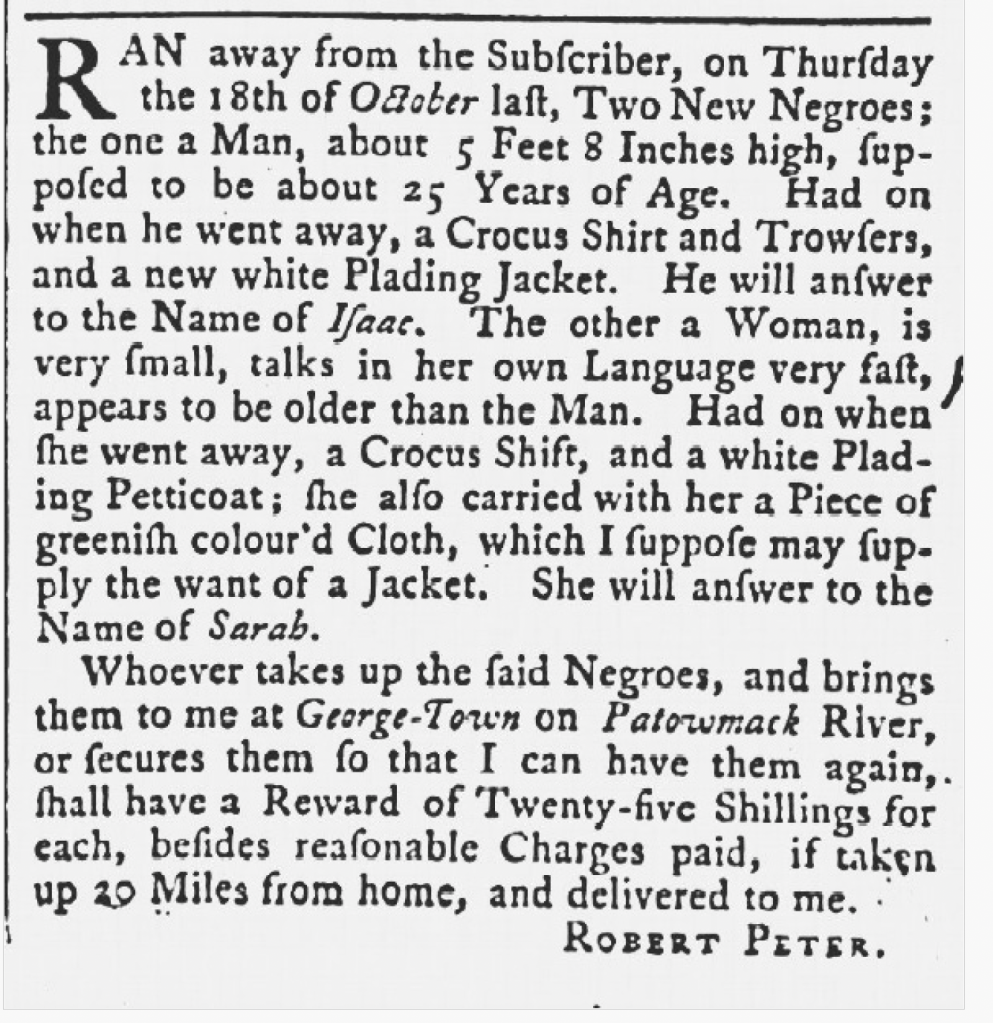
The advertisement was republished several months later, starting in April 1760, with the addendum: “Since first publishing the above advertisement, some circumstances have been discovered by which it is conjectured the above Slaves were stolen. ( Maryland Gazette, Thursday, April 3, 1760)
I am fascinated by the description that Sarah: “..talks in her own language very fast.”Is there any way of determining what language Sarah spoke, what ship brought her and Isaac to Maryland, and what subsequently became of these two escaped individuals?
Several slave ships might be candidates, having landed enslaved people in the area during previous 12 months prior to October 1759:
- The True Blue, which had purchased slaves from Anomabu on the Gold Coast (present day coastal Ghana), a major hub of the transatlantic slave trade. (Transatlantic slave trade database voyage #90763) The True Blue, captained by William Rice, disembarked 350 slaves on “North Potomac” on August 16, 1759. “North Potomac” is a somewhat ambiguous designation, which appears to reference the north bank of the Potomac river, stretching about 100 miles from the Chesapeake Bay to the Fall line, the furthest point navigable by ocean going vessels. In 1751, the port of George, later George-town, where Robert Peter lived, was laid out just below the Fall line. On August 20, 1759, the firm John Champe and Company held a major sale at Nanejmoy, in Charles County, Maryland, about fifty miles downriver from Georgetown, where Robert Peter resided.
- The Venus, bearing slaves from Gambia, held a major sale at the Naval Office, near Cedar Point, “opposite Hoe’s Ferry,” in the neighborhood of Nanjemoy, on August 20, 1759 in a sale organized by the firm Tayloe and Ritchie. The Venus is recorded as landing at Cedar Point on August 16, 1759. [Hoe’s or Hooe’s ferry operated across the Potomac River between Mathias Point in Virginia and Lower Cedar Point in Maryland.] Curiously, this voyage is not listed in slavevoyages.org
- The Upton, captained by Thomas Birch, bearing 205 enslaved people from Gambia, landed in Annapolis on August 28 1759. (Transatlantic slave trade database voyage #90772)
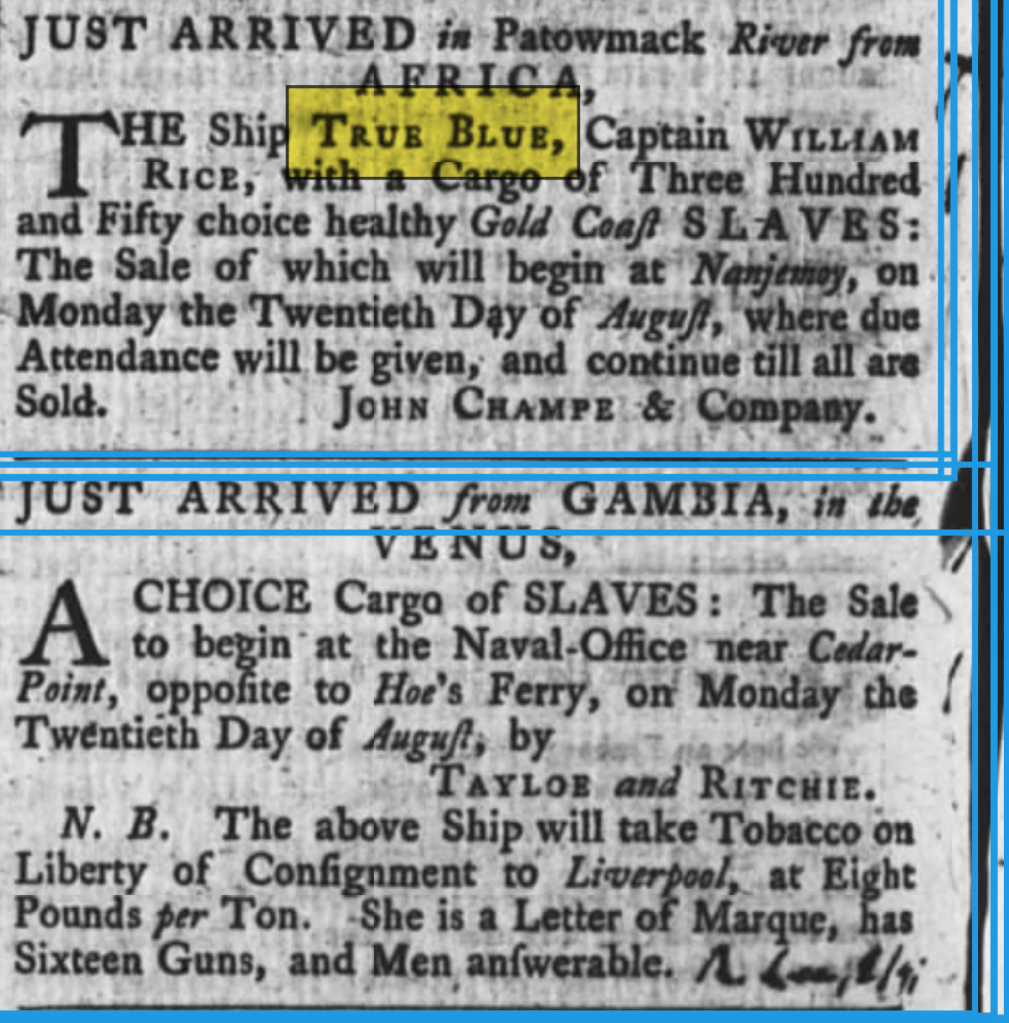
Thu, Aug 16, 1759 ·Page 2

Thu, Aug 30, 1759 ·Page 3
It is perhaps relevant that on October 9, 1761, Robert Peter placed an advertisement for an escaped man named Tom, about 25 years old, “imported from Africa about two and half years ago”, which would be same time frame as the arrivals of the True Blue, the Venus, and the Upton in August 1759. So it is possible that Sarah, Isaac and Tom were all purchased from the same cargo in August 1759.

It is possible that Sarah and Isaac, who escaped together, were married or romantically involved. Did the two of them know one another prior to the horrors of the Middle Passage? Were they from the same ethno-linguistic community in West Africa? Was Sarah speaking “very fast” to Isaac or was she in effect speaking aloud to herself? Perhaps she was repeatedly uttering a prayer?
What might have been the language that Sarah spoke so rapidly? The principal language spoken in Anambo is Fante, an Akan language, but captives sold by Fante-speaking merchants in Anambo primarily came from elsewhere, including present-day central and northern Ghana. So Sarah might have spoken another Akan language, such as Ashani Twi, or Dagbani, a Gur language that is the predominant language of the north.
If Sarah came from the Gambia region, she might have spoken Mandinka, Pulaar (Fula), Wolof, and Jola, or other languages of the area.
An alternate possibility is that she was speaking a kind of ritual phrase or incantation, that functioned for protection or guidance. Muslims facing challenges or a task at times may repeatedly utter the phrase in Arabic, “Tawakltu ‘ala Allah” (I have placed my trust in God); might Sarah have been uttering such a phrase? There certainly were significant Muslim populations in the Gold Coast and Gambia. I did consult with my former colleague Fallou Ngom (Boston University), a leading specialist in African languages. He thinks it unlikely that Sarah would have used the Arabic phrase, more likely to have been by men in the period. He notes, however, “incantations that serve as prayers for protection are common and used by both men and women in Senegambia and beyond. The language of the incantations is typically esoteric drawing from the lexicon of local languages but with a grammar that is unique, and they are meant to be recited quickly, sometimes a specific number of times, to unleash their supernatural potency.”
It is hard to know what precisely Robert Peter meant by his addendum, speculating that Sarah and Isaac had been “stolen,’ In later usage, “stealing slaves” referenced efforts by abolitionists, including members of the Underground Railroad, to aid in the liberation of ensalved people. So perhaps Peter meant that Isaac and Sarah were assisted in their efforts by a sympathetic white allies.
I am not sure what became of Sarah and Isaac. Were they recaptured? The names are common and if they did attain freedom, they may have chosen to use different names. The records of Robert Peter with which I am familiar at Tudor Place and Mount Vernon primarily cover later time periods than 1759-1760., although there may be some documentation of Sarah and Isaac embedded within them. Thirty seven years years later, on April 20, 1797 Holy Trinity Church records in Georgetown do list a Sarah, a slave of Robert Peter, presenting her son Richard for baptism However, it seems unlikely that this could be the same Sarah (Archives of Holy Trinity Church Marriages and Baptisms)
Perhaps future research will cast light on Sarah’s fascinating story and clarify the language she spoke so rapidly during her initial months of enslavement in a strange land.
Addendum: Robert Peter’s 1795 ledger, Tudor Place Archives, does reference enslaved men named Tom and Isaac, who might possibly be the same men, referenced above, who escaped from Robert Peter, respectively in 1761 and 1759.
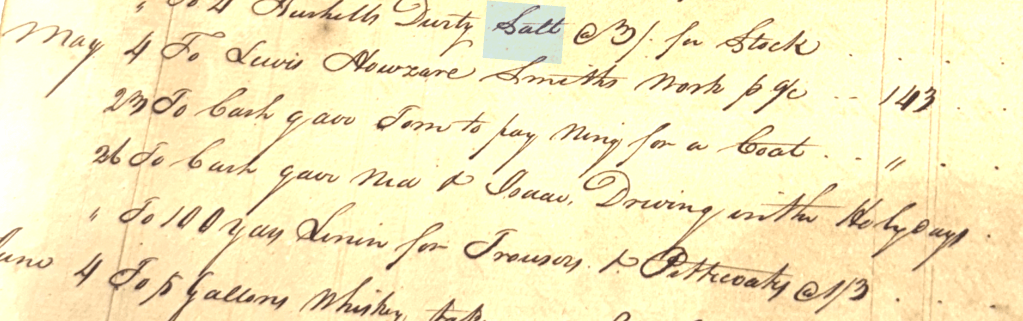
May 23, 1795 references “Cash gave Tom to Ning (?) for a coat, 15 cents. May 26 references “Case gave Ned & Isaac. Driving into the Holy.. (??), 15 cents. If this are the same men, then they were evidently recaptured, and were still owned by Robert Peter more than three decades later; or they could have been other people.
 Mark Auslander