Yesterday, at the joint celebration of the sculptor Allen Uzikee Nelson and Paul Robeson, in front of the “Here I Stand (in the Spirit of Paul Robeson)” sculpture in Paul Robeson Triangle Park in Petworth DC, we had the great pleasure of hearing local poet CeLilliane Green recite her poem, “I am Perfectly Black”, inspired by a runaway slave broadside advertisement she had encountered in the Smithsonian National Museum of African American History and Culture. Ms. Green has performed this work at several of the Uzikee-Robeson gatherings; it brilliantly plays on the phrase “perfectly black,” in the broadside; a term used by the enslaver to indicate the color of deep blackness. The poet recasts the phrase in homage to the perfection of Blackness. (Her June 2023 performance of the poem, documented by American University’s Humanities Truck, is visible at: https://www.youtube.com/watch?v=txWMLljlkv4)
I see that the July 19, 1853 broadside advertisement reads in its entirety:
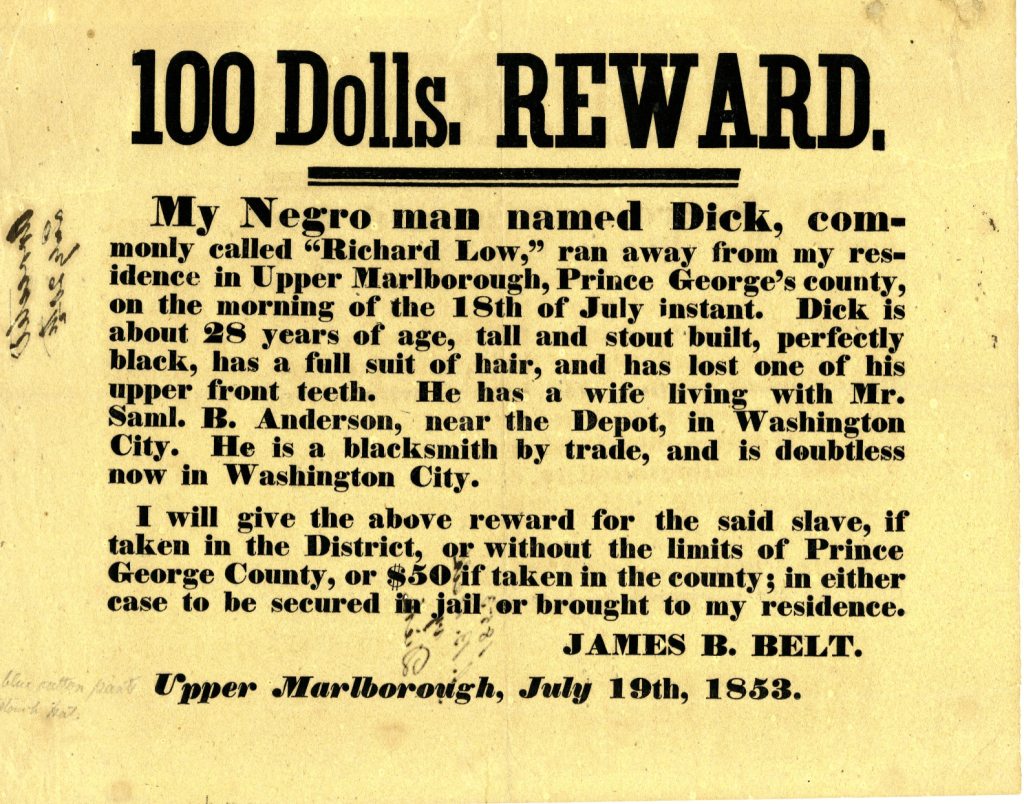
[100 Dolls. REWARD.] My Negro man named Dick, commonly called “Richard Low,” ran away from my residence in Upper Marlborough, Prince George’s county, on the morning of the 18th of July instant. Dick is about 28 years of age, tall and stout built, perfectly black, has a full suit of hair, and has lost one of his upper front teeth. He has a wife living with Mr. Saml. B. Anderson, near the Depot, in Washington City. He is a blacksmith by trade, and is doubtless now in Washington City.]. JAMES B. BELT.], Upper Marlborough, July 19th 1853.].
The enslaver posting the advertisement must be James Beall Belt, 1809-1883, a merchant and planter in Upper Marlborough, Prince George’s County, Maryland, married to Rebecca Lane Belt. James was the son of Tobias Belt and Rebecca Beall Belt. They were part of the extensive Belt family of enslavers, who resided in the District of Columbia, Montgomery County, Prince George’s County, Anne Arundel County, and Calvert County; I have written a good deal about members of the Belt family and their enslaved people.
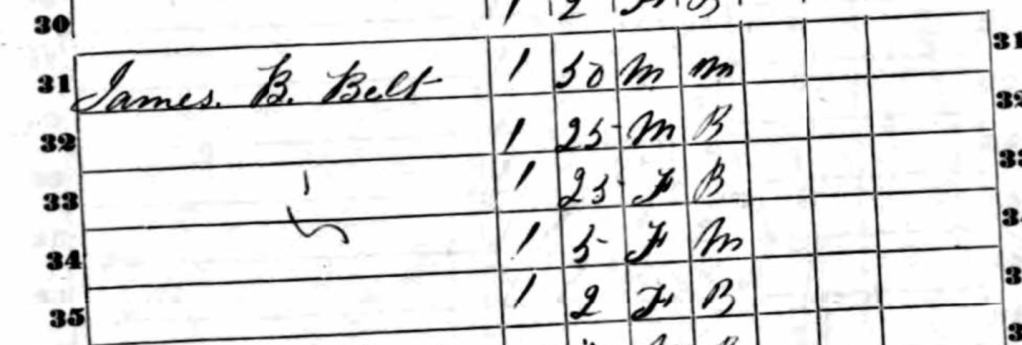
Who was “Dick” or Richard Low? If he was 28 years old in 1852, he must have been born around 1825. The 1850 slave schedule for James B Belt in Upper Marlborough, Prince George’s County, Maryland lists five (unnamed) enslaved people: a male, 50 years old, male, 25; Female 52, female 4, female 3. Presumably, the 25 year old was Richard Low, who would have been 28 in 1853, consistent with the age listed in the broadside. The 1840 census for James B Belt also lists five slaves, given in the following age ranges: two males, ages 10-23; two males, 36 to 54, and one female, age 24 to 35. Perhaps Richard Low, born about 1825, was one of the two younger males.
Was Richard Low recaptured?
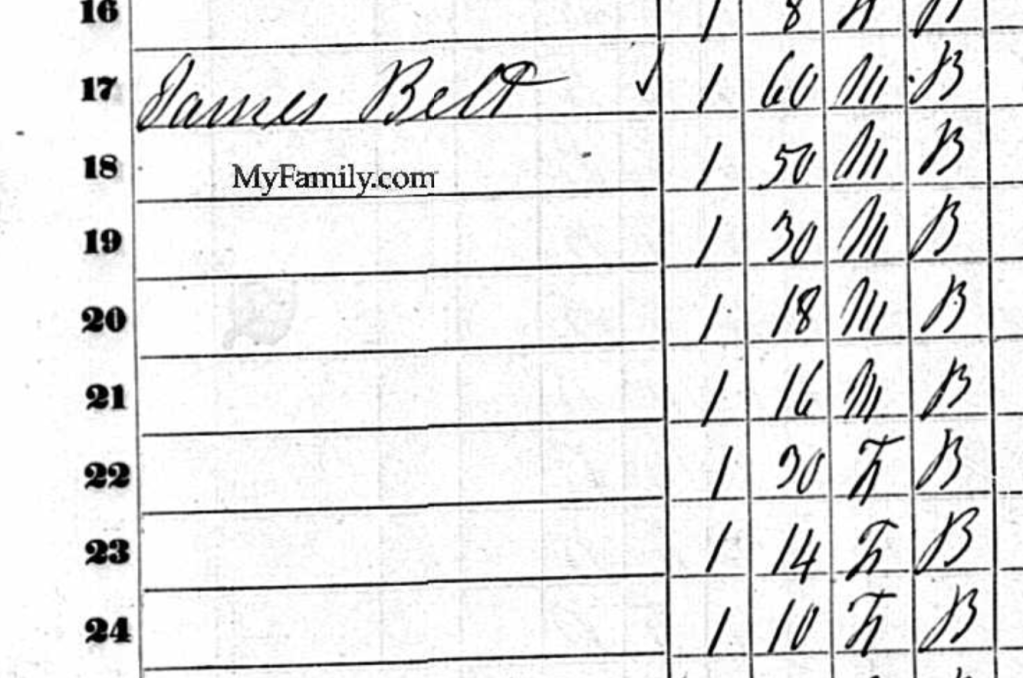
In 1860, James Beall Belt owned eight slaves: a male, 60 years old, a male, 50, a male 30, a male 18, a male 16, a female 20, a female 14 and a female 10. In 1860, Richard Low, seven years after the escape, would have been about 35 years old, and do not appear to correspond with any of the men listed in the 1860 schedule.
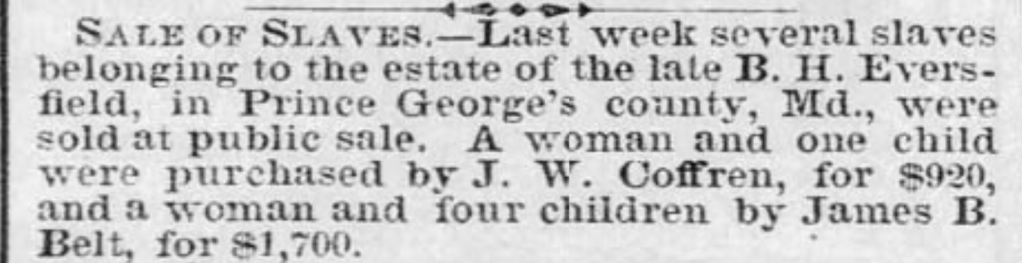
About one year later, in April 1861, the Baltimore Sun records that James B Belt purchased an enslaved woman and four children from the estate of B.H. Eversfield in Prince George’s County.
In 1867, former Maryland slaveowners had the opportunity to file for compensation for the slaves emancipated by the Maryland Constitution of November 1864. Several members of the Belt family in Prince George’s County did so, but not James Beall Belt (perhaps because he did not own slaves in 1864, or was not at the time loyal to the Union cause, a requirement for filing comensation). We thus do not currently have a list of the names of the enslaved people he owned. Nor does the Prince George’s County 1867 slave statistics census list a Richard Low. (It is possible that Richard was recaptured and sold into a different jurisdiction.)
I do not immediately see any reference to Richard Low following his 1853 escape. He may have changed his name after his 1853 escape, if it was successful.
Who was “Ellen Lowe?“
Richard was not the first person with the surname Low or Lowe to escape from James Beall Belt. Eleven years earlier, on October 23, 1842, Belt placed the following advertisement in the National Intelligencer (p 3)
One Hundred Dollars Reward. Ran away from the subscriber, living in Upper Marlborough, Prince Georges County, on Sunday night, the 16th instant, negro womann Ellen, who calls herself Ellen Lowe, about 25 years old, and about five feet three or four inches high, quite spare; her color is between copper and negro; has a full suit of hair, which she generally wears combed at length, fine teeth, with an open, pleasant countenance. She carried away a variety of clothing, such as calico plaid, cotton and muslin dresses &c. Ellen has acquainsances living in Washington City, on the Capitol Hill, at the late Rev McCormick’s and a mother living at Roseburg, in this county. I think it is probable she may try to hire herself in the District, as she is a good washer and waiter. I will give $25 if caught in this county, $50 if caught in the district of Columbia , $30 if taken in ofe the adjoiing counties, or the above reward if taken out of state, in either case she must be secured in jail,
James B Belt
Upper Marlborough, Prince George’s County
PS Ellen was at Mrs McCormick’s as above, on Monday, the 17th instant.
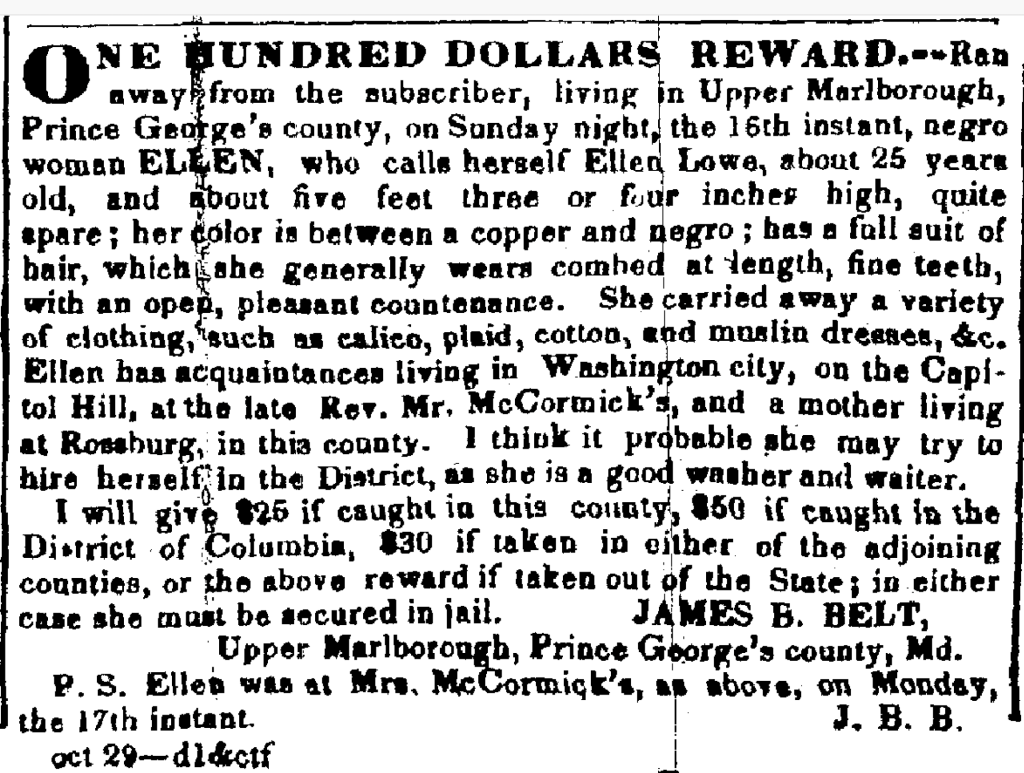
Ellen Low, born 1817, was about eight years older than Richard Low. She was perhaps an older sister or spouse of Richard Low.
The “Rev. Mr McCormick” referenced in ad was most likely Rev. Andrew T. McCormick, who had been a trustee of the Capitol Hill Ladies Seminary. He had died the year before Ellen escaped, in April 1841, in Alexandria. In 1840, he owned three slaves, and perhaps these were the “acquaintances” of Ellen referenced by James Belt.
Rev McCormick’s widow, mentioned in the ad, was Hannah Pleasonton McCormick. In May 1862, she filed for compensation for four slaves, all inherited from her late husband. These were: Rachel Contee age of Thirty Seven Years or thereabouts, about Feet 4. Inches 1. in height—In color a Mulatto— Harriet Cox was of the age of Fifty-Eight Years about Feet 5 in height. [Black?] Abraham Cox was of the age of Seventeen Years or thereabouts—Color Black—& about Feet 5 I 4 in height—& Susan Contee light mulatto was of the age of Thirty one or thereabouts, & Feet 5— I 6, in height. Perhaps Rachel Contee, Susan Contee or Harriet Cox had been kin to Ellen Low.
Other Family of Richard Low?
Some hints as to Richard Low’s background are suggested by the probate files of Tobias Belt, d, 1813 the father James Beall Belt, from whom “perfectly black” Richard Low escaped.. The 1813 probate inventory in Prince George’s County (Vol TT, 1) of the estate of Tobias Belt, taken about 12 years before Richard Low’s birth, records the names and ages of 12 enslaved people
Levy, age 36
James, age 26
David, age 24
Richard, age 22
Sarah 60
Rachel 45
Driden 18
Henny 16
Ary 12
Harriet 10
Lucy 8
Jenny, 5
Although we do not which of these enslaved people were distributed to James Beall Belt, some of these are likely to have been kin of Richard Low. Perhaps his mother was Henny, Ary, Harriet, or Lucy.
Other hints about Richard’s family are suggested by the broadside’s reference to Richard having a wife living with Samuel B Anderson, living near the “Depot” (the New Jersey Avenue train station) in Washington DC.
Samuel Belmear Anderson, 1802-1870, was an enslaver primarily located in Upper Marlborough, Prince George’s County and Brighton, Montgomery County, who seems to have had a residence in D.C. near the B & O New Jersey Avenue Train Station or “Depot”, the principal train station in DC prior to the construction of Union Station. In 1860 Anderson owned eleven enslaved people in the Brighton township District 4 of Montgomery County, Maryland, close to the border with Prince George’s County. In 1867, Anderson applied for compensated compensation (without success) for twelve people who had been emancipated on November 1, 1864 by the new Maryland state constitution. These included: James Lowe, age 17, listed as “moderately healthy.” and Laura Lowe, age 16. James Lowe, born around 1847, and Laura Lowe, born around 1848, seem likely to have been the children of the escaped Richard Lowe, conceived before Richard escaped, and mothered by a woman owned by Samuel Belmear Anderson.
Who was the wife of Richard Low, and mother of James and Laura? Two possible candidates are listed in the 1867 slave census of Samuel B Anderson, in Montgomery County: Fanny Williams, age 38 in 1864. Maria Lee, age 36. Maria is presumably the mother of Annie Lee, 19, and Henry Lee, 18. Fanny presumably is the mother of Isaac Williams, 7, and Robert Williams 4.
We may safely rule out as wife of Richard Low another slave of Samuel B Anderson, Chloe Marshall, born around 1812, and emancipated on April 16, 1862 in the District of Columbia (Enslaved persons in DC were emancipated, by act of Congress, about 20 months earlier than those in Maryland). Samuel B Anderson had purchased, he notes, Chloe from Thomas Clagget of Prince George’s County in 1850: she “hires herself”, he records, as a house servant for $100 per month, which suggests she was working her way towards purchasing her freedom. The Freedman’s Bureau marriage records indicate that Chloe, maiden name “Scott”, had been for decades married to Isaac Marshall. Issac is listed in September 1840 as having escaped from Thomas Clagget near Upper Marlborough, the same enslaver from whom his wife Chloe was purchased by Samuel B Anderson. (In 1860, Thomas Clagget owned 91 slaves.)
Isaac was emancipated in April 1862 from H (?) Magruder in the District of Columbia, along with an Emily Marshall, perhaps his daughter. The 1870 census records Isaac (a “wood sawyer”) and Chloe residing together, with a nine year old girl, also named Chloe Marshall, perhaps a granddaughter. From at least 1866-1870 Isaac Marshall resided in Georgetown, at 33 4th street (now Volta Place), a few doors from Isaac Williams, who as we have seen was also a former slave of Samuel B Anderson. We may infer that close relations continued between former enslaved persons owned by Samuel B Anderson, even if we have not reconstructed the precise kinship relations between them,
To summarize, in July 1853 the wife of Richard Low was being held in slavery near the Depot train station on New Jersey Avenue by Samuel B Anderson. She was probably later rotated out back to one of the Samuel B Anderson farms in Brighton, Montgomery County or Upper Marlborough, Prince George’s County. She may have been Fanny Williams or Maria Lee, or another woman, who might have died, been sold, or escaped in the years since 1853.
The Children of Richard Lowe
What became of James and Laura, the likely offspring of Richard Lowe and the unknown woman?
The 1880 census lists a James W Lowe on Howell street in Philadelphia, born 1842 in Maryland, married to Henrietta. The 1900 census lists a James W Lowe, laborer, residing at 1316 Addison Street in Philadelphia, born Jane 1846 in Maryland, married to Elizabeth Lowe. He may well be the same person as the James Lowe emancipated by Samuel B Anderson in 1864, and likely fathered by Richard Lowe.
I do not yet see a clear reference to Laura Lowe in the records.
Tracing Isaac Williams
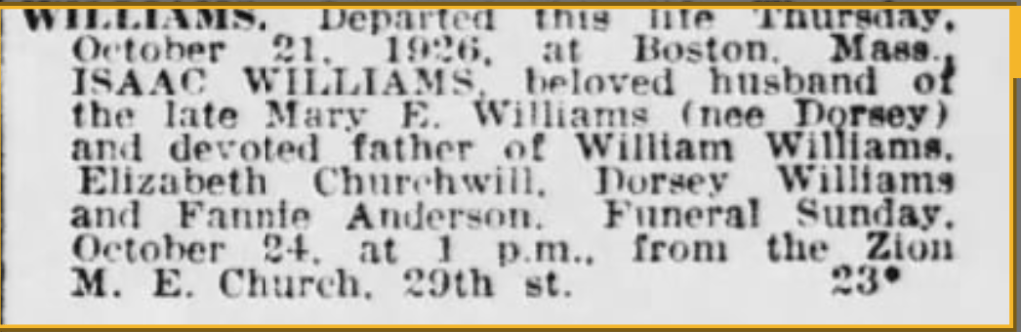
I am unsure of what became of Fanny Williams, who may have been the wife of Richard Low, but her son Isaac Williams, later married Mary E Dorsey in Washington DC, on 15 August 1875; in 1880, the couple lived in Georgetown at 24 Fourth Street, (now Volta Place) with Mary’s father Levi Dorsey. Isaac Williams died in Boston, Massachusetts, October 21, 1926, and was funeralized in Georgetown’s Mount Zion Methodist Episcopal Church.
His obituary in the Evening Star lists their children as: William Williams, Elizabeth (Williams) Churchill, Dorsey Williams, and Fannie (Williams) Anderson, which suggests that Fannie may have been named for her grandmother Fannie Williams, Isaac’s mother. Isaac and his wife Mary Dorsey Williams are buried in Georgetown’s Mount Zion Cemetery ( section, E7 grave 172).
Their shared headstone reads:
IN MEMORY OF
ISAAC WILLIAMS
BORN IN WEST WASHINGTON, D.C.
DIED IN BOSTON, MASS.
OCTOBER 21, 1926
HIS WIFE
MARY E. DORSEY
DIED DECEMBER 7, 1903
AGED 44 YEARS
The headstone seems to have been part of the gated Williams family plot in Mount Zion, before many headstones were relocated after 1976. This large headstone, evidently near its original location, remains intact.
Other Possible Kin?
There were several other free and enslaved people with the surname Lowe in the District of Columbia area, who may be related to Richard. These include the free man Jeremiah Lowe, born about 1805, married to Elizabeth. Their children include Charity, Phoebe, Michael. The 1850 and 1860 census records Jeremiah and Elizabeth as freepeople in Washington Ward 2, and also in the 1870 census, with Jeremiah listed as a “hod carrier.”
Also, the compensated emancipation petition of Selby Scaggs in DC in 1862 records the emancipation of a “Dennis Lowe, color Black, age 35 years (b 1829), both leggs (sic) off just below the knee very healthy, good ox cart driver and garden hand,: Dennis had been acquired by “purchase about five years ago [c. 1857] of Henry Hillary of Prince Georges County Maryland.
In addition, a Catherine Lowe, residing at H St between 24th & 25th Streets, worshiped in Georgetown at Mt Zion Methodist Church and was buried in Mt Zion Cemetery, after her death on June 27, 1876.
I am not sure if any of these individuals were kin to Richard Low.
In any event we will continue to work on tracing the stories of “Perfectly Black,” Richard Low, so vividly brought to life through the poetry of CeLilliane Green.
 Mark Auslander