Artist Lynn Marshall-Linnemeier routinely “mines” the visual history of race in America, combing through iconography found in old stereoscopic images, postcards, photographic albums. She repositions figures from the era of enslavement and Jim Crow, who were initially framed in keeping with prevailing white nationalist racial conceptions. Her multimedia composites give in effect, new life to these re-excavated predecessors, emphasizing their dignity and resilience, often relocating them within mythological terrains of restoration, tranquility, and healing.
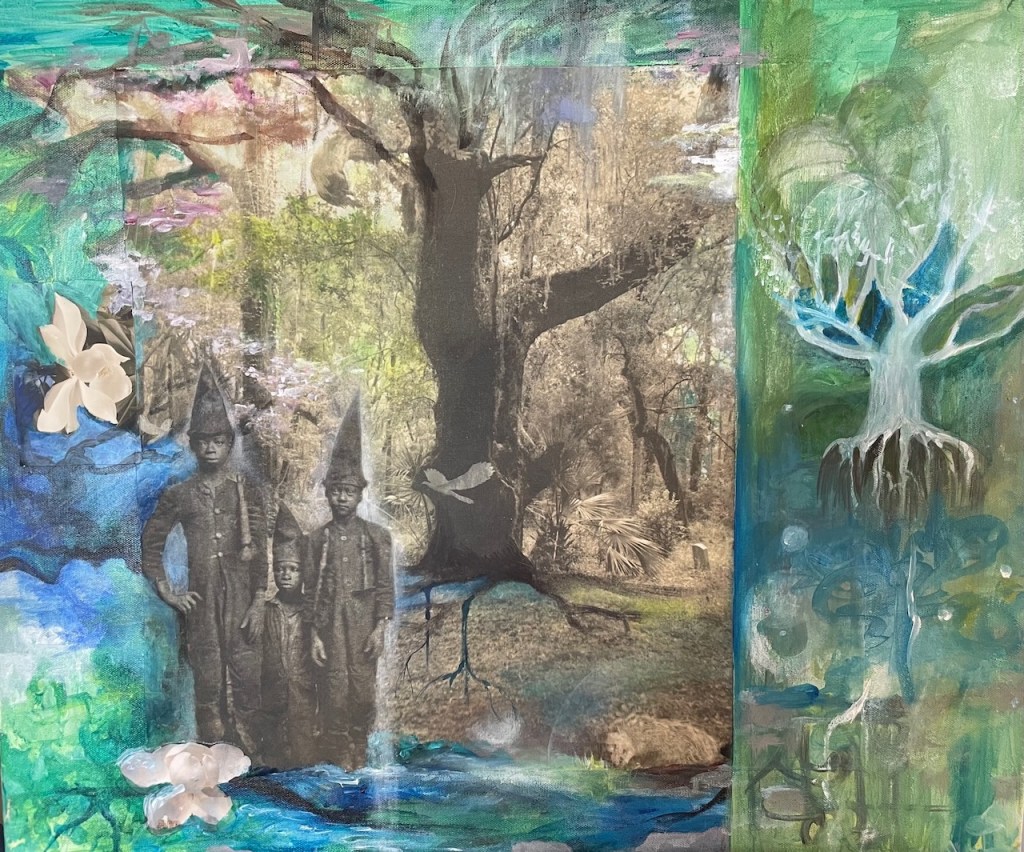
In her recently restored collage, “Sweeps” (2017-2024) Marshall-Linnemeier present three African American child chimney sweeps, perhaps taken from a stereoscopic card. African American boy chimney sweeps (“sweeps”) were used extensively in the US South into the early 20th century. As in Europe, apprentice boys were coerced into this extremely onerous and dangerous work, climbing through narrow, twisting flues (designed to increase the upward draft of fireplaces fires), scraping away creosote and accumulated soot with hand tools and with their special narrow caps. They risked asphyxiation, pulmonary disorders, burns, and soot-induced carcinomas. As apprentices they had no legal recourse if abused, ad if employed, they were often paid a pittance.
Curiously, in Europe, chimney sweeps, though subjected to great abuse and injustice, were often conceived to be agents of good fortune. It was considered good luck to touch their soot- covered sleeves or, when glimpsing them from afar, to touch one’s own button and make a wish.The superstition may have been rooted in the scenario of the sweep disappearing into the dangerous, invisible space of the flue and then reappearing, as if reborn from the land of the Dead. (An echo of that old folk belief appears Bert the Chimney Sweeps’s song in Mary Poppins: “Chim chim cher-oo!/Good luck will rub off when/I shakes ‘ands with you/Or blow me a kiss/And that’s lucky too.” (Songwriters: Richard M. Sherman/ Robert B. Sherman, Mary Poppins).
Perhaps a trace of that magicality informs Marshall-Linnemeier’s entrancing piece, Sweeps. In the original images, three boys of differing heights are posed facing the viewer, in dark uniforms, with their tools and pointed caps. I am not sure if the pointed caps, different from the usual stovepipe hats worn by sweeps, were meant as an allusion to dunce caps or Klan hoods, or were in fact practical tools designed to scrape away soot as the child worker ascended.
In any event, one senses that these children now rise up not into suffocating narrow chimneys, but rise with the majesty of trees in the wilderness of St. Helena, South Carolina, one of the Sea Island of the (Gullah-Gechee) Low Country. The youths remain in black and white, but stand beside a color-filled stream, with cool blues and turquoise promising to quench their parched lips and throats, in distinct contrast to the rising fire and smoke that once tormented them. Their erect postures are echoed in a great tree that towers above them, as floral petals and birds flit around them. The trees roots are visible through earth, reaching down towards the cooling spring.
In a second panel to the right, the same configuration is evoked, but now missing identifiable human figures, although there seem to be evocations of ancestral figurines in classical West and Central African sculptural traditions. A variation of the central tree is now rising in the air, its roots much more pronounced. To my eye, this floating tree’s branches are now raised like arms, and there may be three ancestral like large faces hinted at in the tree’s upper foliage. One has the sense that the three chimney sweeps, who suffered so much earthly toil, have now been translated or sublimated to a higher plane of existence, as they become integrated with the ancestral realm that blesses all who remain below. In this light, it is worth recalling that for the BaKongo peoples of central Africa, trees are honored as the dwelling places of the ancestors, serving as living portals between the visible world of mortals and in the invisible lands of the eternal powers.
In that sense, the work’s title seems to have multiple meanings. “Sweeps” were consigned in life to sweep away the detritus left behind by untold thousands of chimneys. The full value of their labor and lives was all to often ignored or swept away by the dominant order of things. Yet now, through the artist’s aesthetic and spiritual process, the young workers, like all who behold them, are swept upwards, rising with the trees with a water-world of life-sustaining spirit.
 Mark Auslander