The current traveling exhibition, African Modernism in America, 1947-67, now at the Philips Collection, Washington DC, features a first rate painting by the Ugandan artist Manyolo Betty Estelle (1938-1999) titled “Cattle People” (1961) on loan from the Fisk University Galleries. The scene is of a young couple, either courting or newly married, of the Bahima, an Ankole people of Uganda. A young woman, perhaps pregnant, stands to the left of a resting herd of Ankole cattle, with magnificent curving horns; to the herd’s right stands a young man, with a long staff of the sort that would be used in herding. The man is in profile, and the woman is seen frontally, her head turned towards the man; the couple gaze at one another, and the cattle’s eyes are, like the woman’s turned, towards the man.
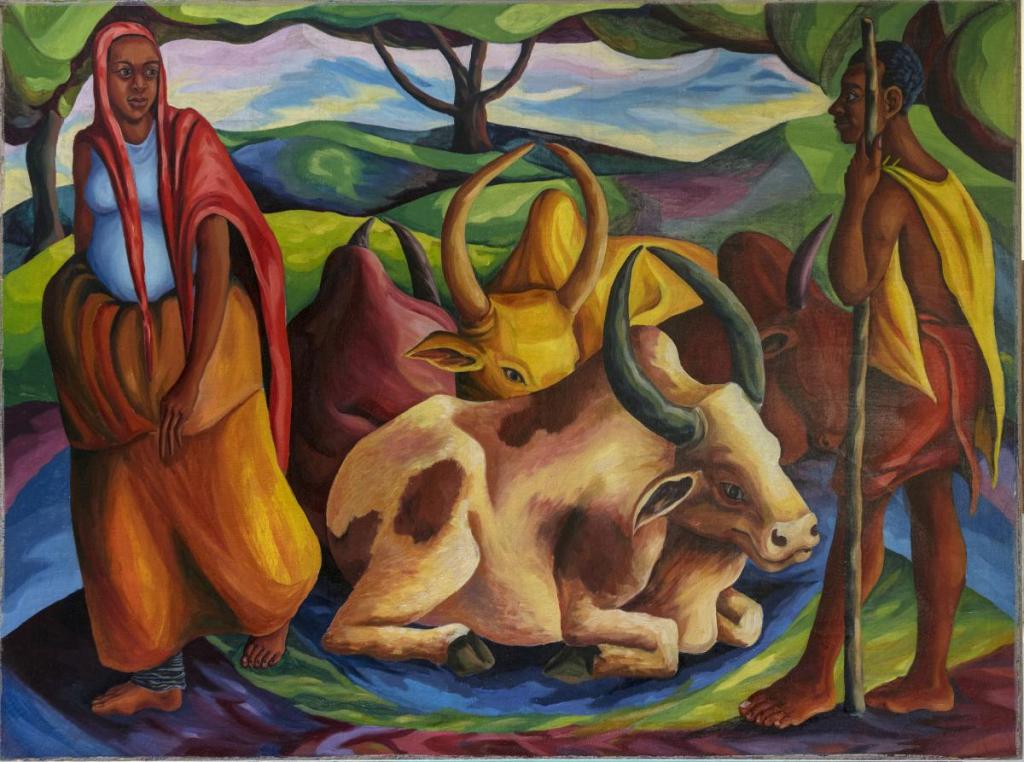
The figures are set in a verdant Ugandan landscape, framed below a green canopy of tree foliage. The composition is divided into a kind of triptych. A tree trunk rises from the left of the woman, and another tree in the center of the canvas is just above the cattle, its curving branches echoing the curving shape of the central bovine’s horns. Another branch is glimpsed to the right of the young man. His herding pole, taller than he is, functions as a kind of trunk itself. linking the ground and the canopy. A green pathway is visible below the herd, linking the man and woman. And just above the herd, green hills are visible in the background. The net effect is evidently to emphasize the intimate integration of cattle, persons, trees, and landscape in the Bahima cosmos/
Two head of cattle are in particular prominence: this configuration may be consistent with the opening Bridewealth prestation among the BaHima people. as described in Roscoe (1907), an early ethological account of the Bahima: “ When betrothed couples are old enough to marry, the youth takes a milch cow [a cow giving milk] and a heifer [a female cow that has not bore a calf yet] to the girl’s parents; this gift ratifies the engagement, though he is not allowed to see his future bride.” Alternately, the group of cattle may evoke the traditional ten cows, according to Roscoe and Eilham 1973 that were given as bridewealth, legitimating the marriage. If the woman is in fact pregnant, the implication may be that the coming child will be properly, by virtue of the bridewealth transaction, integrated into the lineage of the groom’s people.
The green pathway connecting the female and male figures, underneath the resting herd, seems likely to emphasize that the cattle bridewealth herd has help create an enduring path or bond of vitality and life-giving potential, binding the couple and their respective lineages.
Among the diverse cattle-keeping people of eastern and southern Africa, cattle are a repository of life-giving sacrality, imbued with ancestral energies and considered essential for the reproduction of Life in its deepest sense (see especially Evans-Pritchard 1940; Lienhardt 1961, Comaroff and Comaroff 1990). Both female cows and human females experience nine months of gestation, and for this and many other reasons, bridewealth cattle are deemed the most appropriate replacement for the loss by the bride’s people of the future fruits of her womb. Through cattle, the inevitable tensions between affines are modulated and recalibrated; multiple kin on the groom’s side often contribute to the bridewealth herd and the received cattle, in turn, are distributed through the bride’s people’s larger kinship network In this way, the two extended families’ shared investment in the future of the marriage is made visible to all, as a kind of tangible promissory note for the eventual future children of the union, who will continue to bind together their disparate in-laws into an intimately integrated social field. The possible pregnancy of the female figure may hint at this theme of future blessings, enabled through the life-giving potentialities of cattle.
It is intriguing that Manyolo has chosen to show the woman’s gaze and that of the resting cattle all facing to the right of the image, towards the standing young man. This might at first seem puzzling, since bridewealth cattle will leave the groom and his father’s people, and head towards the bride’s father and his people. Yet perhaps the evocation here is on a certain exchange of energy flows and the overall gendered framing of Hima society . The in-marrying bride will, as in so many patrilineal, patrilocal societies, leave her father’s household and move to the groom’s household; the groom and his lineage are the center of social action in the marriage process, and this centrality is made visible in the painting, arguably, through the upright herding pole. The young woman on the left (the ‘distaff’ side) and the cattle herd in this sense are all ultimately oriented towards the male figure, the Axis Mundi of this social drama, and thus they all turn their gaze towards him. There is, to be sure, a touching romantic poignancy to this exploration of courtship, but at the end of the day, one might surmise, the weight of patriarchy still organizes the composition of the painting, as it does the structures of Bahima social life.
Addendum: I’ve just read a brilliant essay by anthropologist Anselm Kizza-Besigye (2019). who is of Bahima background. He notes that his Muhima grandmother’s mother Zelda, in defiance of colonial and postcolonial state regulation, continued to graze her own cattle herd independently and nomadically into the 1990s, residing beside them . So perhaps I have misread the painting and Manyolo is depicting not bridewealth cattle as such, but rather the standing woman’s own herd, which is not in fact fully encompassed within male sovereignty.
References
Anselm Kizza-Besigye, The Bahima. June 13, 2019, posted on DocDroid
John and Jean Comaroff. Goodly Beasts and Beastly Goods. Cattle and Commodities in a South African Context. American Ethnologist, May 1990. pp 195-216
E.E. Evans-Pritchard, The Nuer. 1940
Itzhak Eilam. The Social and Sexual Roles of Hima Women: A Study of Nomadic Cattle Breeders in Nyabushozi County, Ankole, Uganda. Manchester University Press, 1973.
Godfrey Lienhardt Divinity and Experience : The Religion of the Dinka: Oxford University Press,1961.
REV. J. Rosco. The Bahima: a Cow Tribe of Entkole. Journal of the Royal Anthropological Institute. Vol. 37 (Jan. – Jun., 1907), pp. 93-11
 Mark Auslander